
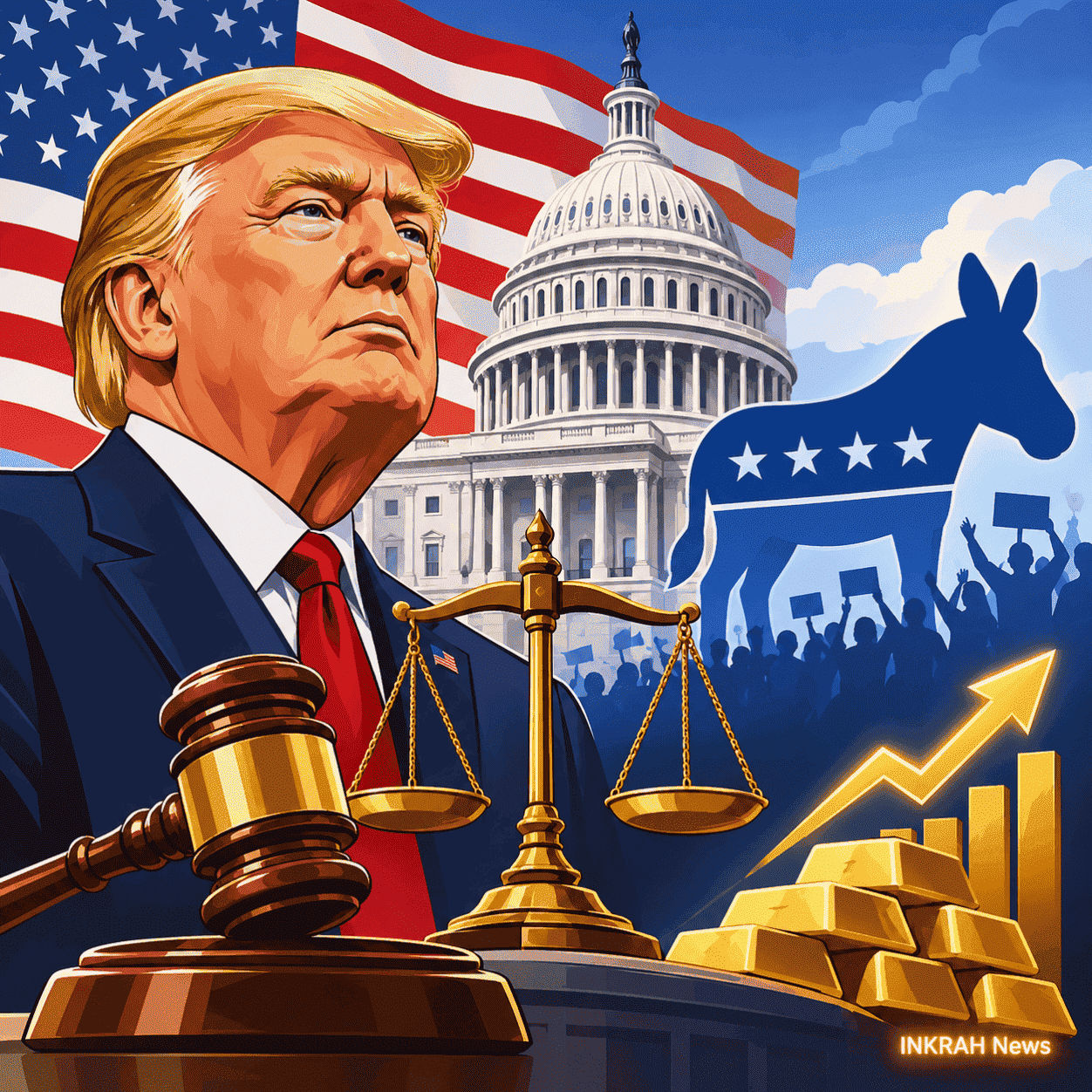
The United States midterm elections, held on Tuesday, 3 November 2026, became a major political test for President Donald Trump and the Republican Party. The voting results, announced progressively until Wednesday, 4 November 2026, revealed a significant victory for the Democratic Party in the contest for seats in the federal legislature. The opposition party reportedly succeeded in taking control of both the House of Representatives and the United States Senate. This achievement represented a serious setback for the Trump administration, which had previously enjoyed Republican support in Congress. The Democratic victory also demonstrated a shift in voters’ preferences regarding the direction of national government, particularly concerning foreign policy, public expenditure and domestic economic conditions. Several victories even occurred in states traditionally regarded as Republican strongholds. These developments conveyed a message that electoral loyalty towards a particular party can change when government policies are perceived as being inconsistent with the interests of society. Trump himself acknowledged that his administration’s decision to engage the United States in a war against Iran was one of the factors contributing to the Republican Party’s defeat. This admission attracted considerable attention because it demonstrated the direct relationship between a president’s strategic decisions and the political consequences borne by his party. The event also reaffirmed that midterm elections serve as a constitutional instrument through which the public can assess the performance of an incumbent administration.
The significance of the Democratic victory must be understood through the constitutional structure of the United States, which adopts a presidential system based on the separation of powers. The United States Congress consists of two chambers, namely the House of Representatives and the Senate, which exercise legislative and oversight functions over the executive branch. The House of Representatives represents the public according to the population of each state, whilst the Senate provides equal representation to every state. Each state is entitled to two senators, regardless of its geographical size or population. Every senator serves a six-year term, with one-third of the Senate’s membership replaced every two years to maintain institutional continuity. Before the Seventeenth Amendment to the United States Constitution in 1913, senators were elected by state legislatures, whereas the current system grants citizens the authority to elect them directly. The Senate possesses important powers to approve several senior officials nominated by the president, including executive and judicial appointments. This institution also has the authority to approve international treaties and conduct impeachment trials involving federal officials. The extent of these powers makes control of the Senate a strategic factor in determining a president’s ability to implement the administration’s agenda. The principle of checks and balances operates through this distribution of authority to prevent the concentration of state power within a single branch of government.
The Republican Party’s defeat acquired a broader dimension when several Democratic victories emerged in states that had remained conservative political strongholds for decades. Texas became one of the most compelling battlegrounds after Democratic candidate James Talarico defeated Republican candidate Ken Paxton in the Senate race. North Carolina also delivered a victory to former governor Roy Cooper, who secured a Senate seat previously held by the Republican Party. In South Carolina, paediatrician Annie Andrews recorded a historic victory as the first Democratic candidate in more than two decades to secure a Senate seat in the state. Kansas also witnessed a political shift after Adam Hamilton won a contest that had previously been dominated by Republicans for decades. In Michigan, Democratic politician Abdul El Sayed also attracted international attention following a victory that made him the first Muslim senator in American history, according to CNN Indonesia’s reporting. These victories demonstrated that the political identity of a particular region can change when economic concerns and national policies become primary considerations for voters. This phenomenon can be understood through the theory of political accountability, which refers to the obligation of those in power to account for their policies and governmental performance before society. The doctrine vox populi, vox Dei, literally meaning the voice of the people is the voice of God, carries symbolic relevance in illustrating the political legitimacy derived from general elections. Sociologically, this shift in support reflects public dissatisfaction with national policies perceived as placing burdens upon everyday life. Elections become a constitutional corrective mechanism through which society can alter the composition of political power without having to wait for the president’s term to expire.
The issue of the United States’ war against Iran became one of the principal factors highlighted following the Democratic victory. During an interview with Fox News on Tuesday, 3 November 2026, Trump acknowledged that the conflict with Iran had contributed to the Republican Party’s defeat. He even extended his congratulations to the Democrats for securing a political victory that had long been anticipated. This admission attracted attention because Trump had previously been the principal figure driving Republican campaigns across various states. Opposition to the war against Iran had developed amongst Democratic politicians and the wider public because of its economic consequences. Military expenditure was viewed as funding that could instead be allocated to public needs such as education, healthcare and welfare programmes. Rising global oil prices also placed direct pressure on transport costs, goods distribution, industrial production and household expenditure. Trump acknowledged that the conflict had influenced public perceptions and become one of the reasons behind his party’s defeat. This issue demonstrated that national security policies are closely connected to the economic welfare of citizens. The president’s authority as Commander-in-Chief of the armed forces remains subject to constitutional limitations and congressional oversight of government funding and national policy. The principle salus populi suprema lex esto, meaning the safety and welfare of the people shall be the supreme law, provides a philosophical foundation for the proposition that public interests should remain the principal objective of every governmental action. When military policies impose widespread economic burdens, the political legitimacy of a government may come under serious pressure from the very people who bear their consequences.
The impact of war on the lives of American citizens can be traced through rising energy prices and pressure on the cost of living. The military conflict involving the United States and Israel against Iran has intensified geopolitical tensions in the Middle East. Iran reportedly retaliated against American and Israeli air strikes beginning in late February 2026. Tehran’s closure of the Strait of Hormuz became one of the most concerning developments for international energy markets, as the route represents a crucial corridor for global oil distribution. Disruptions to energy traffic through the region created pressure on supplies and increased geopolitical risk premiums in oil price formation. Rising fuel prices had become an issue experienced by American society, including farmers facing higher diesel costs. Farmers, industrial operators, transport companies and household consumers all depend on energy as a component of production and consumption expenditure. Rising energy prices can spread to food prices, logistics, manufactured goods and various public services. This situation illustrates the mechanism of cost-push inflation, whereby inflationary pressure originates from increasing production costs. Economically, war creates negative externalities when political and military decisions generate social costs that must be borne by the wider population. Governments may have strategic considerations concerning national security, whilst the legitimacy of their policies still requires evidence that the benefits justify the economic sacrifices imposed upon society. This issue has made the war against Iran an electoral concern that influences voting behaviour and public assessments of the Trump administration.
Domestic economic factors also contributed significantly to the changing political landscape of the United States. Voters faced issues involving affordability, rising prices of essential goods, energy costs and uncertainty surrounding national economic conditions. Deutsche Welle’s reporting on the election results stated that approximately 39 per cent of voters considered economic issues the most important factor when making their political choices. A survey of approximately 100,000 voters cited in the report indicated that 62 per cent of respondents blamed Trump for the rising cost of living. Confidence in the Democrats’ ability to manage economic issues was also reportedly 43 per cent, exceeding the Republican Party’s 38 per cent. These figures provide an indication of the relationship between economic perceptions and voters’ preferences. The import tariff policies implemented by the Trump administration also attracted scrutiny, as most respondents considered these measures detrimental to the economy. Import tariffs can increase the prices of goods entering the domestic market, particularly when producers pass additional costs on to consumers. Companies dependent on imported raw materials also face pressure on profit margins and operational cost structures. Lower-income groups and the middle class are more vulnerable when rising living costs are not accompanied by sufficient income growth. John Locke’s theory of the social contract provides an explanation that governmental legitimacy rests upon the protection of the rights and interests of the people who grant political authority. Elections become a means of assessing whether the government continues to fulfil that mandate responsibly. The defeat of the party occupying the White House demonstrates that political success cannot be separated from the government's ability to protect citizens’ purchasing power and economic security.
The change in the composition of Congress carries significant legal and institutional consequences for the Trump administration. Democratic control of both the House of Representatives and the Senate provides the opposition with greater opportunities to scrutinise executive policies. The House of Representatives possesses the authority to initiate legislation, oversee public expenditure, conduct inquiries into government officials and bring impeachment proceedings. The Senate plays an important role in approving certain appointments, ratifying international treaties and conducting impeachment trials. Democrats were expected to secure 54 Senate seats, whilst Republicans were projected to obtain 44 seats. In the House of Representatives, the projections indicated approximately 228 seats for Democrats and 139 seats for Republicans. These figures illustrate the substantial shift in the balance of power in Congress whilst the vote count remained a matter of public attention. An opposition majority has the potential to make the passage of legislative proposals prioritised by the White House more difficult. Scrutiny of immigration policies, the business activities of the president’s family, public expenditure and various government decisions may also become more intensive. Constitutionally, these mechanisms represent the application of the principle of checks and balances, which was designed to prevent the abuse of governmental authority. The doctrine of limited government emphasises that governmental power must be restricted by law and institutional oversight mechanisms. Under the American constitutional system, the president retains the constitutional authority to exercise a veto over legislation approved by Congress. Trump has indicated his willingness to use this authority if disagreements arise with the Democratic majority. Relations between the White House and Congress are therefore expected to enter a period of more complex political negotiations during the final two years of the presidential term.
The issue of impeachment has also attracted attention following the Democrats’ strengthened position in Congress. Control of the House of Representatives provides the majority party with an opportunity to initiate investigations into alleged misconduct involving the president or federal officials. The United States Constitution grants the House of Representatives the authority to bring impeachment charges through the impeachment mechanism. The process then proceeds to the Senate, which conducts a trial to determine whether the impeached official should be removed from office. Removing a president through this mechanism requires the support of two-thirds of the senators present during the trial. This means that the Democrats’ victory in both chambers of Congress creates greater opportunities for oversight without automatically making Trump eligible for removal from the presidency. The distinction between the authority to initiate impeachment and the authority to deliver a final judgement is an important element in understanding the constitutional design of the United States. Impeachment must also not be treated as an instrument of political retaliation against a president belonging to a different political party. Every allegation must be based on constitutional grounds, evidence that can be properly substantiated and an examination process that guarantees the principles of justice. The principle of due process of law requires the exercise of state authority to remain consistent with applicable legal procedures. Philosophically, the limitation of power is one of the prerequisites of a state governed by the rule of law, as public officials do not enjoy immunity from accountability. Montesquieu’s ideas on the separation of powers provide an important foundation for establishing an institutional system in which each branch of government can supervise the others. The Democratic victory may strengthen this supervisory function and increase political pressure on executive policies.
The reaction of international financial markets became apparent following the Democratic victory, which altered expectations regarding the political direction of the United States. International gold prices surged by 3.4 per cent during trading on Wednesday, 4 November 2026, reaching US$4,059.74 per troy ounce, according to Refinitiv data. The increase returned gold prices above the psychological US$4,000 per troy ounce threshold after they had previously corrected to US$3,869.85 on 30 October 2026. On Thursday, 5 November 2026, at 6.46 am Western Indonesian Time, gold prices strengthened again by 0.73 per cent to US$4,062.69 per troy ounce. The strengthening of gold occurred alongside a weakening of the United States Dollar Index, which fell to 101.5, its lowest level in more than a month. The relationship between the dollar and gold has an important characteristic because gold is traded in United States dollar denominations. When the dollar weakens, gold becomes relatively cheaper for buyers using other currencies, potentially increasing its demand appeal. Uncertainty surrounding the Trump administration’s ability to implement its political agenda also increased investor attention towards assets regarded as capable of preserving value during periods of heightened risk. American Gold Exchange analyst Jim Wyckoff considered that the possibility of political deadlock in Congress could obstruct the legislative agenda and place pressure on economic growth prospects. Expectations regarding possible monetary easing by the Federal Reserve also became one of the factors considered by market participants. These movements demonstrate that gold prices are influenced by the interaction between political sentiment, exchange rates, interest rates and perceptions of global risk. The rise in gold prices can be interpreted as a market response to changing expectations, rather than evidence that all economic uncertainty has come to an end.
The rise in gold prices also demonstrates the complexity of the relationship between geopolitical uncertainty and United States monetary policy. When investors increase their allocations to gold, they generally consider its function as a hedging instrument. Gold does not provide interest or dividends, meaning its attractiveness is linked to the opportunity cost of holding interest-bearing assets. Market participants were still pricing in a probability of a Federal Reserve interest rate increase in December of approximately 83 per cent, according to the CME FedWatch tool. These expectations represent a factor that could potentially limit further gains in gold if United States economic data demonstrate sufficient strength to support tighter monetary policy. ADP data showed that private-sector employment growth in the United States increased in October 2026. Investors were also awaiting the nonfarm payrolls report scheduled for Friday, 6 November 2026, as a basis for assessing labour market conditions. Meanwhile, Brent crude prices remained above US$100 per barrel as market participants monitored developments in the conflict involving the United States and Israel against Iran. High energy prices may sustain inflationary pressure and complicate the Federal Reserve’s decisions regarding interest rates. Deutsche Bank analyst Daniel Ghali considered that strong employment data could reinforce expectations of an interest rate increase in the near future. Capital.com analyst Daniela Hathorn also warned that the recovery in gold prices remained vulnerable when geopolitical uncertainty coincided with tight monetary policy. Economically, this situation demonstrates that rising gold prices do not necessarily indicate prospects for sustained gains. Investors must account for the risks of changing interest rate expectations, dollar movements and liquidity requirements, which may trigger selling activity in precious metals.
The political deadlock in Washington could have consequences for fiscal policy, international trade and the economic relations between the United States and other countries. Congress plays a central role in federal budget discussions, meaning changes in the legislative majority can alter negotiations concerning government expenditure. Democrats may use their oversight and budgetary approval powers to evaluate the financing of military operations, immigration programmes, trade policies and the Trump administration’s spending priorities. Closer scrutiny could increase transparency in the use of public funds and strengthen government accountability to taxpayers. At the same time, conflicting interests between the president and Congress could slow decision-making concerning national economic programmes. Legislative uncertainty may also affect companies that depend on predictable tariffs, subsidies, infrastructure investment and industrial policies. International investors will monitor whether this change in political power produces institutional stability or prolongs political disputes. The principle of fiscal accountability places public financial management under an obligation to be examined and properly accounted for. The doctrine no taxation without representation also carries historical relevance because it illustrates the relationship between the legitimacy of state taxation, political representation and public consent. Under the theory of the welfare state, fiscal policy should provide social benefits that can be experienced through education, healthcare, infrastructure and economic protection. Significant military expenditure requires consideration of its security benefits, fiscal risks and opportunity costs for welfare programmes. The change in the composition of Congress provides Democrats with an opportunity to raise questions regarding the priorities governing the allocation of national resources. For the international economy, the direction of United States fiscal policy is important because the country remains one of the principal centres of global trade, finance and investment.
The Republican Party’s defeat also demonstrates that political dominance does not necessarily guarantee the continuation of public support. Trump had mobilised his political influence to assist Republican candidates through campaigning in various regions ahead of the vote. He even urged supporters to treat the midterm elections as though he himself were on the ballot. The White House had previously expressed optimism and criticised the quality of several Republican candidates who failed to secure voters’ support. Trump subsequently acknowledged the Democratic victory and expressed his willingness to cooperate with the opposition on several government priorities. This statement signalled that the election results would require adjustments to political strategies and negotiations between institutions. Vice President JD Vance also linked the Republican defeat to the war against Iran through his statement on the X platform. The competing emphasis between national security interests and the economic needs of society has become an issue that the United States government must address. Sociologically, the election results demonstrate that society has the ability to correct the direction of leadership through legitimate political participation. Max Weber’s theory of legitimacy explains that the continuity of political authority requires public acceptance of the powers exercised by the government. Power that possesses a constitutional foundation still requires public confidence for its policies to obtain sufficient social support. The principle government of the people, by the people, and for the people serves as a reminder that public office derives its legitimacy from the people and must be directed towards their interests. The Democratic victory serves as a warning that successful campaigning and the political influence of a president must be accompanied by the ability to resolve society’s concrete problems.
For Indonesia, changes in the political balance of the United States carry several implications that deserve attention, particularly through trade, exchange rates, capital flows and commodity prices. The United States is one of the world's principal economic powers, and its fiscal and monetary policies influence international financial market conditions. When political uncertainty increases dollar volatility, global investors may adjust their portfolio allocations across various asset classes. These movements can affect demand for gold, government bonds, equities and emerging-market currencies. Rising gold prices may provide opportunities for producing countries and businesses with exposure to the commodity. Indonesia, as a country with gold mining activities, may experience positive effects through changes in commodity selling prices, business revenues and potential increases in the value of related assets. Mining companies must still account for production costs, operational obligations, financing structures and commodity price risks. From a capital market perspective, changing expectations regarding Federal Reserve interest rates may affect the attractiveness of dollar-denominated assets and foreign investors’ decisions concerning emerging markets. If United States interest rates increase, the yield differential with Indonesian assets may change and place pressure on international capital allocation decisions. If the dollar weakens and monetary policy expectations become more accommodative, emerging-market assets may receive additional sentiment support. Movements in the Jakarta Composite Index remain influenced by domestic factors such as corporate performance, rupiah stability, economic growth, Bank Indonesia policies and investor confidence. The principle of ceteris paribus must be considered when examining the relationship between a single global variable and domestic market movements. It would be incorrect to assume that rising gold prices automatically signal that all mining shares will strengthen or that the rupiah must appreciate. Investors must distinguish between short-term reactions to political news and fundamental changes that genuinely affect the economic value of a company.
The midterm elections in the United States offer lessons concerning the relationship between power, law, welfare and political responsibility. The Democratic victory demonstrates that the Constitution provides corrective mechanisms when society considers stronger governmental oversight necessary. Congressional control by the opposition may strengthen legislative functions and scrutiny of the exercise of executive authority. This process forms part of the design of a state governed by the rule of law, in which public officials remain subject to constitutional limitations. The principle of rule of law requires all governmental actions to have a legal basis, a legitimate purpose and an accountability mechanism. Aristotle’s ideas concerning government directed towards the common good are also relevant when assessing the quality of public policy. Power directed towards the interests of the ruling group risks losing its moral and social legitimacy. Meanwhile, social contract theory reminds us that the relationship between the state and its citizens involves an exchange of mandate, protection and responsibility. Society grants authority to the government through democratic mechanisms in the expectation that the state will safeguard security, justice and collective welfare. When government policies generate significant economic burdens, society has the constitutional right to express its judgement through elections. The Latin maxim fiat justitia ruat caelum, meaning let justice be done though the heavens fall, illustrates the importance of the supremacy of law when confronted with political interests. An opposition victory can become an instrument for strengthening democracy when exercised through objective oversight, respect for legal procedures and the pursuit of public interests. The fundamental measure of a government’s success should be the quality of its institutions and the welfare of society, rather than its ability to retain power alone.
Political developments in the United States also demonstrate that the decisions of a leader can produce consequences extending beyond national borders and the duration of a political term. War policies influence energy prices, diplomatic relations, government expenditure, regional security and international market expectations. Trade policies can alter production costs and economic relations between countries. Monetary decisions can affect capital flows and currency stability across different parts of the world. The Democratic victory in the 2026 midterm elections signals that American society demands greater accountability for policies affecting its daily life. Trump continues to exercise his constitutional powers as president, whilst stronger opposition control of Congress creates a more intensive oversight structure. The ability of both institutions to negotiate will determine the direction of United States policy during the remainder of the administration. Financial markets will continue monitoring developments in the Iran conflict, oil prices, employment data, Federal Reserve decisions and the legislative process in Congress. Gold prices returning above US$4,000 per troy ounce represent one indicator of how political developments can be translated into investment decisions. These movements also serve as a reminder that market sentiment can change when investor expectations regarding risk and government policy are adjusted. In legal and political philosophy, the legitimacy of power is closely connected to justice, the protection of rights and public welfare. The Latin maxim salus populi suprema lex esto once again demonstrates its relevance as a reminder that the safety and welfare of the people must remain the supreme law in the administration of the state. Elections can change the composition of political power, markets can reprice financial assets, and institutions can restrict the authority of leaders. The most fundamental measure of a successful state remains its ability to deliver justice, security and prosperity to the society that grants it political mandate.