

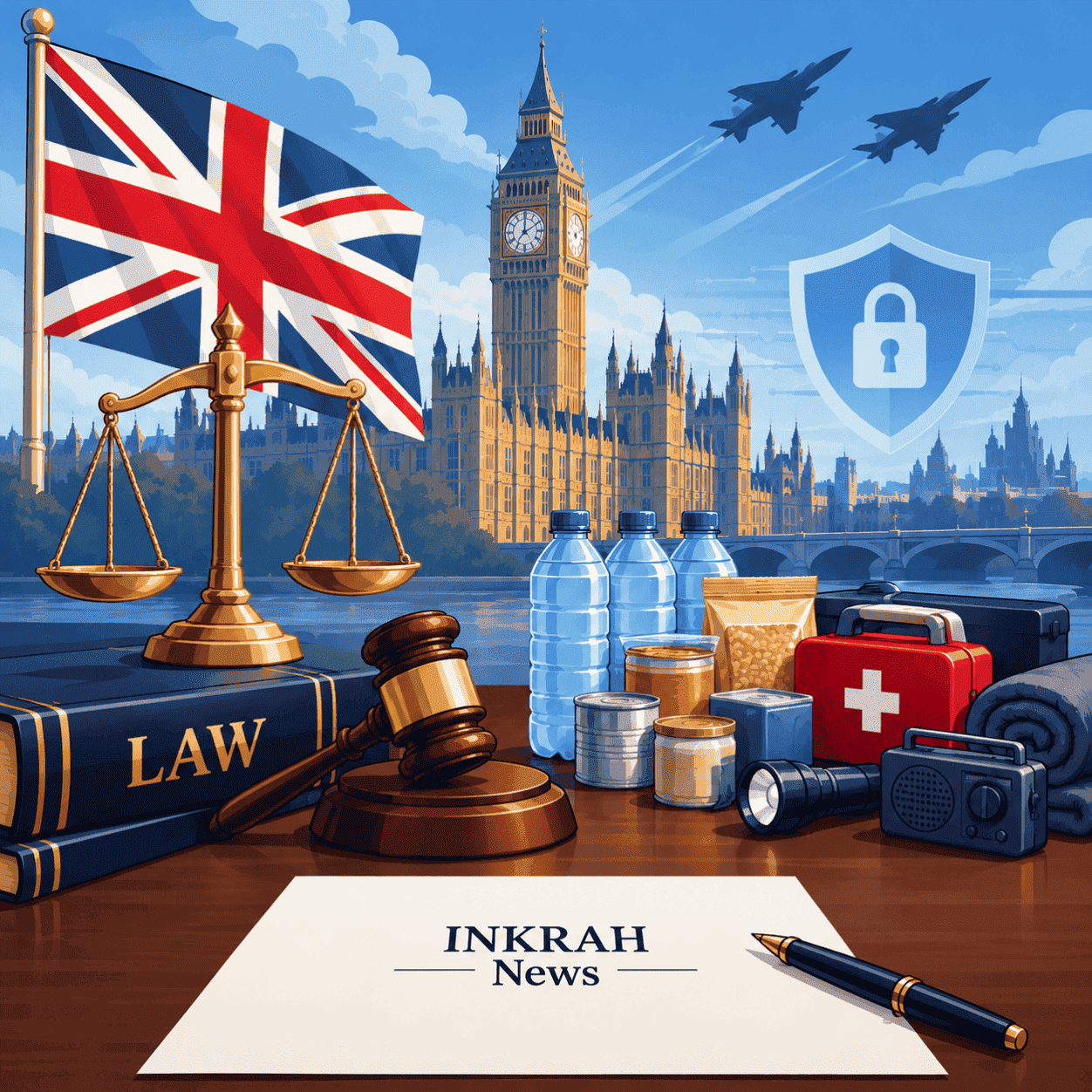
The British Government is strengthening public preparedness through a national campaign entitled Be Ready, announced on 22 October 2026. Through this programme, households across the United Kingdom are being encouraged to prepare essential supplies to cope with disruptions to public services lasting up to three days. The guidance covers drinking water, non-perishable food, first-aid supplies, and emergency communication equipment. Relevant ministries and agencies are advising the public to remain capable of meeting basic needs when electricity, water supplies, telephone networks, or internet services are disrupted. Britain's Security Minister, Dan Jarvis, has stated that public preparedness is an important part of national resilience. Britain's Defence Minister, Wes Streeting, has also highlighted the risks of cyber-attacks, hostile state actors, and threats to critical infrastructure. The Government is also considering lessons from extreme weather, flooding, wildfires, and supply-chain disruptions. The programme is designed as a three-year campaign to improve household and community preparedness. Official government information indicates that this policy focuses on managing various emergencies, meaning reports describing Britain as already on the brink of war should be read carefully.
For British residents, the Government's message carries implications that extend beyond keeping food supplies in the kitchen. Dependence on electricity networks, digital payment systems, water services, and communication infrastructure makes modern life vulnerable to simultaneous disruptions. A power cut can disable household appliances, obstruct electronic transactions, and disrupt the operations of various businesses. A cyber-attack against public service providers could trigger widespread consequences if backup systems fail to operate effectively. Extreme weather can also block roads and delay the delivery of essential goods to affected areas. The British Government wants to reduce pressure on emergency services through household self-sufficiency. Residents with adequate supplies can manage temporarily while waiting for services to be restored. The principle of preparedness has become increasingly relevant when threats can emerge from natural, technological, and national security factors. The expression better safe than sorry captures the logic behind this policy, namely that reasonable preparation can reduce losses when an emergency actually occurs.
The British Government advises households to keep approximately three litres of drinking water per person per day to cover drinking needs over three days. This requirement amounts to nine litres of drinking water per person for a 72-hour period. A family of four would need at least 36 litres of drinking water, excluding additional supplies for cooking and hygiene. Food supplies are recommended to include non-perishable products that do not require refrigeration or complicated preparation. Supporting equipment includes torches, spare batteries, portable radios, phone power banks, essential medicines, and first-aid supplies. The Government also recommends keeping cash, copies of important documents, warm clothing, and blankets. This list demonstrates that preparedness requires comprehensive planning for basic needs. Residents can gradually build up their supplies through routine shopping to keep household spending under control. This approach makes more sense than panic-buying when rumours of threats spread and supermarket shelves begin to empty.
This policy illustrates the relationship between the state's duty to protect the public and the role of residents in safeguarding their own wellbeing. The Government has an institutional responsibility to identify risks, provide reliable information, and coordinate responses to emergencies. Residents can contribute through preventive measures that suit their individual circumstances. The principle of salus populi suprema lex esto, meaning that the welfare of the people should be the supreme law, is relevant to explaining the priorities of public protection. This principle places human safety at the heart of emergency policymaking. Its implementation still requires legal certainty, proportionality, transparency, and oversight of the exercise of public authority. An advisory notice to prepare food and water must also be distinguished from a legally binding order or a declaration of war. This distinction matters because the public needs to understand the limits of its obligations and the legal basis for government action. The Government must explain threats accurately so that safety policies do not become a source of fear that undermines public trust.
News reports describing Britain as being on the brink of war also require an appropriate standard of evidence. Warnings from defence officials about hostile foreign states demonstrate serious attention to national security threats. Such statements do not, by themselves, prove that open warfare will soon take place on British territory. Threats may take the form of cyber-attacks, sabotage, disinformation operations, communication network disruptions, or pressure on strategic infrastructure. These threats are commonly discussed through the concept of hybrid warfare, which refers to the combined use of military and non-military instruments to weaken an adversary. In practice, disruptions can target services used by the public every day. Supermarket payment systems, energy networks, water suppliers, and data centres are important components of modern national resilience. The Government needs to assess the likelihood of incidents, their potential impact, and recovery capabilities before setting protection priorities. The expression alert, not alarmed captures the need to remain vigilant without creating panic. Clear terminology is essential so that the public can distinguish potential threats, ongoing disruptions, and a formally declared state of war.
Preparedness raises questions about each household's ability to meet its basic needs. Higher-income households may find it easier to purchase bottled water, non-perishable food, and emergency equipment. Lower-income families may face difficult choices between increasing their supplies and paying routine expenses such as rent, electricity, and transport. Older people, disabled residents, people in temporary accommodation, and those who depend on specific medicines require particular attention. Effective policies need to provide practical guidance for these groups. The British Government also encourages eligible residents to register with the Priority Services Register, a service that helps utility companies identify customers who may require additional support during disruptions. This initiative demonstrates the importance of linking individual preparedness with social protection systems. Neighbours, community organisations, charities, and local authorities can help reach residents who struggle to meet their needs independently. Community solidarity becomes a valuable form of social capital when formal services come under pressure. The spirit of looking after one another reminds us that social resilience grows through mutual care and collective coordination.
Economic consequences are an important consideration when the Government advises residents to prepare essential supplies for several days. Demand for bottled water and non-perishable food may rise after emergency information spreads. If households purchase goods gradually, businesses have a better opportunity to adjust their stock and distribution. Excessive buying within a short period can trigger empty shelves, price increases, and unequal access to essential goods. Retailers need clear communication to manage supplies according to realistic demand. Manufacturers and distributors must maintain reliable logistics and provide information about product availability. Disruptions to digital payment systems can also obstruct transactions when merchants lack suitable alternatives. Keeping a reasonable amount of cash can help consumers cope with electronic payment failures. The principle of caveat emptor, commonly translated as let the buyer beware, reminds consumers to make rational decisions and check information before shopping. Market stability requires a balance between household preparedness, distribution capacity, and responsible consumer behaviour.
Companies and financial institutions also face challenges related to operational resilience. Internet disruptions can obstruct banking transactions, e-commerce services, internal communication, and stock management. Attacks on information technology systems may cause widespread losses when companies lack tested recovery procedures. Business continuity planning is needed to identify priority services during a crisis. Companies can prepare data backups, alternative systems, communication channels, and manual transaction procedures where appropriate. Supply-chain managers should also map their dependence on single suppliers and distribution routes vulnerable to disruption. Business resilience cannot be measured solely by cost efficiency under normal conditions. The ability to maintain services during a crisis also determines the confidence of customers and business partners. The doctrine of good corporate governance emphasises responsibility, transparency, accountability, and measurable risk management. Companies that take emergency scenarios seriously have a better chance of protecting employees, customers, and the continuity of their operations.
Preparedness raises questions about the relationship between individual freedom and collective responsibility. The state needs public participation to address risks that may exceed the capacity of emergency services. Society needs a state that provides accurate information, fair protection, and access to assistance for vulnerable groups. Thomas Hobbes's ideas about the state's role in maintaining security help explain the need for collective protection. John Locke's thinking on the rights to life and security is also relevant to establishing the protection of citizens as a fundamental governmental responsibility. These two approaches place different emphases on authority and individual rights. Sound policy needs to balance preventive action with respect for public freedom. Excessive communication about threats can erode trust, while communication that downplays risks can leave residents unprepared. Government ethics requires honesty about uncertainty and the reasons behind each recommendation. Rational conduct and mutual trust are essential foundations for a society seeking to remain resilient in difficult circumstances.
National preparedness also requires coordination between central government, local authorities, emergency services, the private sector, and civil society organisations. Every institution needs to understand its responsibilities before a crisis occurs. Clear communication channels help reduce confusion when information changes rapidly. Emergency exercises can test staff readiness and identify procedural weaknesses. Energy, water, transport, telecommunications, and healthcare infrastructure require protection proportionate to their level of risk. Early-warning systems need reliable data and accessible communication channels. The Government must also prepare recovery mechanisms so that essential services can resume as quickly as possible. The whole of society approach treats resilience as a shared responsibility across all parts of society. Experiences in other European countries show that household preparedness guidance can form part of national resilience policy. The success of such programmes depends on consistent implementation, regular evaluation, and the ability to reach communities with different needs.
This message relates to the risks of extreme weather, cyber-attacks, infrastructure disruptions, and broader security threats. The public needs to understand that emergency preparation is a sensible preventive measure. Claims that Britain is about to enter a war still require more specific evidence and official clarification. Accurate reporting must distinguish security warnings from facts about armed conflict. The Government has a duty to maintain transparency, while the media play a role in scrutinising claims and presenting information proportionately. Residents can take practical steps without panic-buying or spreading unverified reports. National resilience grows through prepared institutions, an adaptable economy, supportive communities, and residents who can make decisions based on trustworthy information. Keep calm and be prepared is a relevant message for every country seeking to protect its population from evolving risks.