
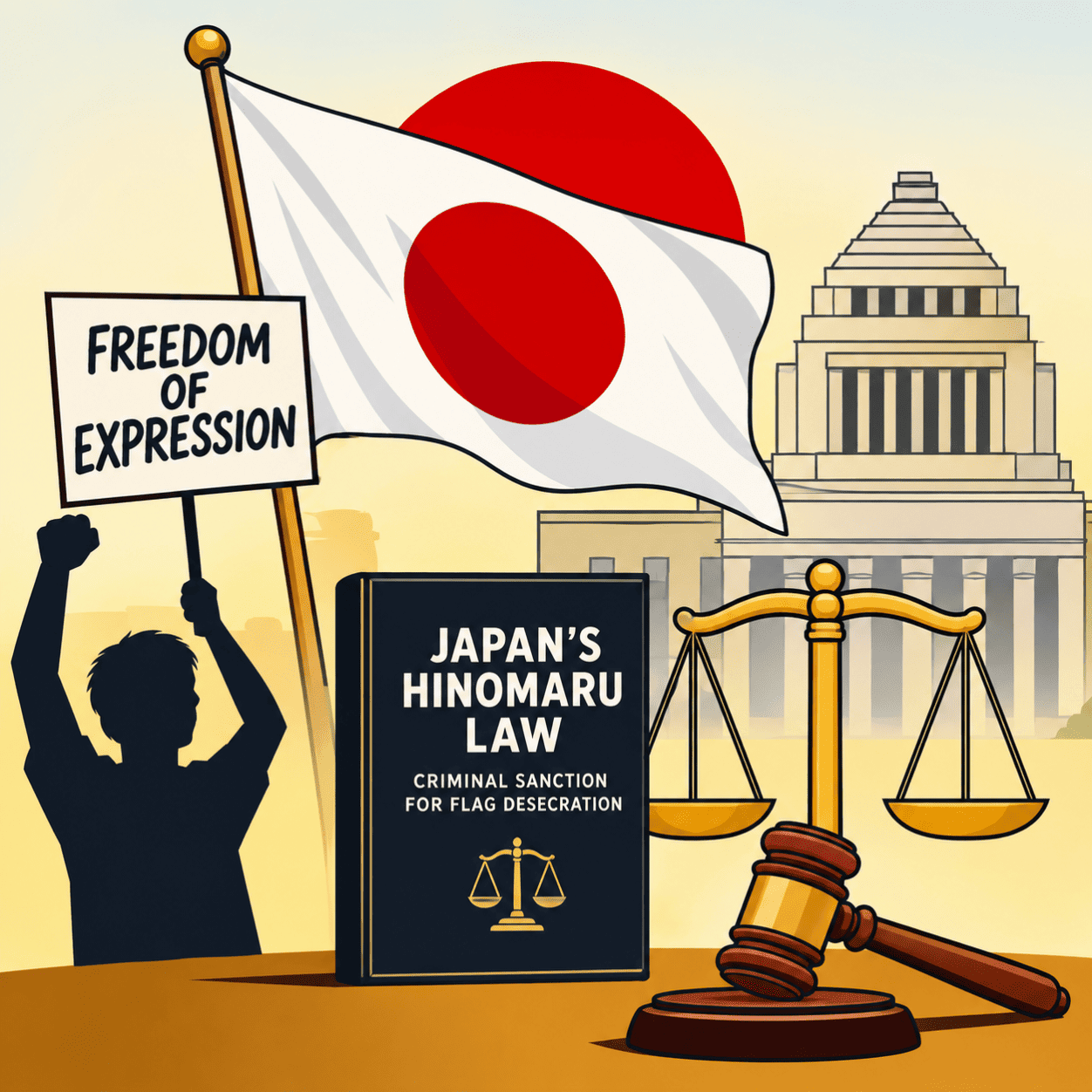
Japan has pushed a striking new chapter into its criminal law after legislation targeting the public desecration of the national flag, the Hinomaru, came into force on 13 August 2026. The measure was adopted by the Diet on 17 July after passing the lower house on 30 June, creating a new offence for publicly damaging, removing, or defacing the national flag in circumstances capable of provoking significant discomfort or disgust. A person convicted under the new provision may face imprisonment of up to two years or a fine of up to ¥200,000, placing symbolic treatment of the national flag inside the machinery of criminal punishment. The move has attracted serious attention because the Hinomaru is no longer merely a cultural emblem in this legal equation, it has become an object around which the state has drawn a criminal boundary.
The new rule gives the Hinomaru a level of penal protection that Japan previously reserved for foreign national flags under Article 92 of its Penal Code. The legislative logic is easy enough to grasp: national symbols carry historical memory, collective identity and a certain civic dignity, and the state may wish to protect those symbols from deliberate public degradation. The tricky bit lies in the language used to define the prohibited conduct, particularly the reference to acts capable of generating strong feelings of discomfort or disgust. Criminal law traditionally demands a degree of precision because nullum crimen sine lege, there can be no crime without law, and the law must tell citizens with reasonable clarity which conduct crosses the criminal threshold.
That wording places freedom of expression directly on the pitch. Article 21 of Japan’s Constitution protects freedom of speech, press and other forms of expression, while Article 19 of the International Covenant on Civil and Political Rights protects expression that may include symbolic conduct. Burning, tearing, painting or otherwise manipulating a flag can carry political meaning, artistic meaning or protest meaning, and the legal character of the conduct may depend heavily upon its communicative purpose. The real legal drama starts when the state treats an expressive act as punishable because observers find it offensive, repugnant or deeply unsettling. John Stuart Mill’s classic defence of liberty becomes highly relevant: social discomfort is not automatically a sufficient reason for coercive state intervention. Fiat libertas, let liberty prevail, becomes more than a philosophical slogan when criminal sanctions enter the picture.
The controversy has already drawn opposition from Japanese constitutional and criminal law scholars. Constitutional scholar Yoko Shida reportedly warned during Diet deliberations that the provision was extremely broad and could restrict constitutional rights, while criminal law expert Hisashi Sonoda criticised the use of discomfort as a foundation for punishment under Article 21. Human Rights Watch has also argued that the law conflicts with international standards governing freedom of expression and has pointed to the United Nations Human Rights Committee’s position that patriotic offence or deeply offensive expression does not, by itself, justify criminal punishment. Nearly 150 criminal law researchers and several bar associations reportedly opposed the legislation before its passage. That is no small legal eyebrow raise, because when academics, lawyers and rights organisations converge around the same constitutional concern, the statute deserves forensic scrutiny rather than a quick political applause.
H L A Hart’s theory of legal rules offers another useful lens for examining the problem. A criminal prohibition requires an intelligible rule capable of guiding conduct, especially when the sanction involves imprisonment. Hart’s famous distinction between the core and penumbra of legal language becomes particularly interesting when legislators employ concepts such as discomfort or disgust, terms that may shift according to culture, audience, circumstances and political atmosphere. Ronald Dworkin would push the debate further by asking whether legal interpretation should protect principle as well as institutional authority. If a protester damages a flag to condemn government policy, an artist alters the Hinomaru to interrogate nationalism, and a vandal destroys it purely to provoke public outrage, the physical gesture may look similar while the constitutional meaning differs dramatically. Lex non cogit ad impossibilia, the law does not compel the impossible, and a statute struggling to distinguish political expression from mere abuse may face a demanding interpretive test.
The philosophical stakes become sharper when national identity meets criminal justice. Lon Fuller argued that legality depends upon principles such as clarity, consistency and congruence between official action and declared rules. A criminal statute built around public emotional reaction risks placing too much weight upon the subjective response of others. One person may regard an act as legitimate dissent, another may regard the same act as contemptuous vandalism, while a third may simply shrug and walk away. That variability matters because criminal punishment is the state’s most coercive legal instrument. Cesare Beccaria’s insistence upon proportionate punishment also remains relevant: the gravity of the penalty should bear a rational relationship to the social harm being addressed. A maximum sentence of two years gives the provision real bite, so the statutory boundary cannot be treated as mere political theatre.
Japan’s new law also raises an intriguing question about the constitutional status of national symbols. The state can formally recognise a national flag, as Japan did through its 1999 Act on National Flag and Anthem, while constitutional recognition does not automatically answer how far criminal protection should extend. The Hinomaru may embody history, sacrifice, sovereignty and national belonging for millions of people, yet constitutional democracy also protects citizens who reject, criticise or satirise those very ideas. A mature legal order has to leave room for the awkward citizen, the angry dissenter, the provocative artist and the political troublemaker. Salus populi suprema lex, the welfare of the people is the supreme law, can support protection of public order, yet public welfare also includes the preservation of a civic sphere in which unpopular ideas can breathe. That is where the law gets seriously interesting, because the state is not merely protecting a piece of cloth, it is defining the legal limits of dissent.
The law’s commencement on 13 August has transformed the debate from legislative theory into an operational question for police, prosecutors and courts. Authorities must now decide which conduct falls within the offence, how intention and public circumstances should be assessed, and how the provision should coexist with constitutional freedom of expression. Japan’s judiciary possesses constitutional review authority, giving courts an important role if challenges eventually arise. The question will not simply be whether the Hinomaru deserves respect, because respect can exist as a civic value without necessarily becoming a criminal command. The harder question is whether democratic government can criminalise symbolic contempt without chilling legitimate political communication. Quis custodiet ipsos custodes?, who will guard the guardians, is an old question with remarkably modern relevance when the state itself becomes the arbiter of acceptable patriotic expression.
The Japanese debate therefore reaches beyond Japan’s borders and touches a perennial problem in constitutional law: how much offence can a democracy tolerate before tolerance itself becomes a legal casualty. National symbols can carry profound emotional power, and citizens may reasonably regard deliberate desecration as deeply offensive. Criminal law operates on a different plane, requiring legality, necessity, proportionality and sufficiently clear standards before the coercive power of the state is unleashed. John Stuart Mill would likely interrogate the restriction through liberty, Dworkin through principle, Hart through the structure of legal rules, and Fuller through the morality of legality. Japan has now placed those ideas on the same courtroom table as the Hinomaru. The legal world will be watching closely, because dura lex sed lex, the law may be stern, yet the legitimacy of stern law still depends upon constitutional discipline, rational limits and respect for the freedom that makes democratic citizenship worth having.