
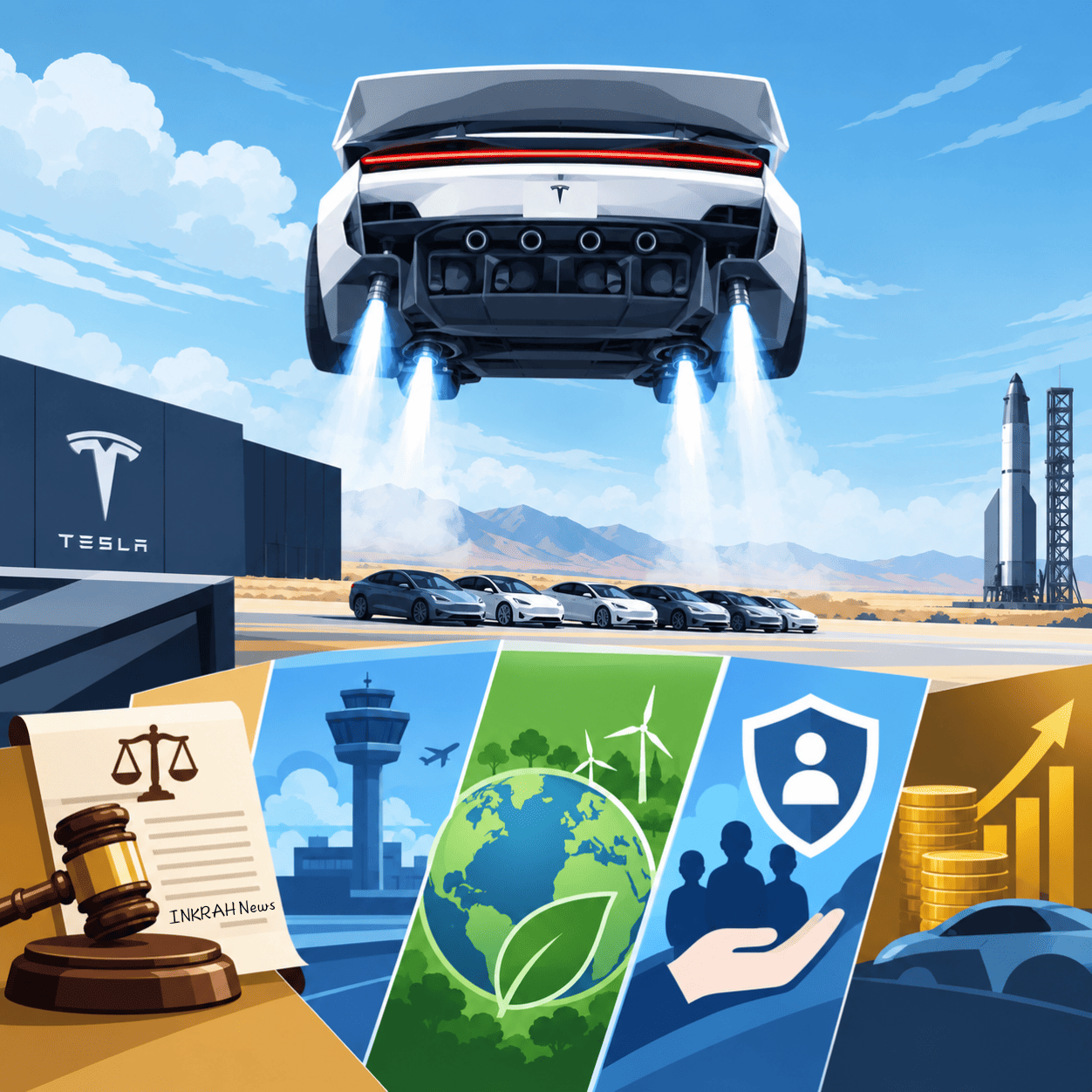
Tesla has once again attracted the attention of the international automotive industry after unveiling the latest-generation Roadster through an extreme technology demonstration at a SpaceX facility in Texas, United States, on 15 October 2026. Showcased an electric sports car capable of performing aerial manoeuvres through a high-pressure gas propulsion system. Elon Musk, the head of Tesla and SpaceX, positioned the vehicle as a symbol of the fusion of automotive engineering and space technology. The appearance of the latest Roadster revealed a sharp, aggressive and futuristic design, in line with the development of high-performance vehicles. Public attention focused on the vehicle's ability to accelerate along steep tracks, move upside down, and jump over rows of parked cars. The spectacle demonstrated Tesla's ambition to push the boundaries of electric vehicle capabilities through the integration of technology previously associated more closely with the rocket industry. Although it appeared to be a flying car from a science-fiction film, the ability to become airborne momentarily cannot be equated with the ability of an aircraft to sustain continuous flight. This distinction is important to ensure that the public can distinguish between technology demonstrations, manufacturers' marketing claims and operational capabilities that have genuinely been tested.
The main attraction of the latest-generation Roadster lies in its use of ten cold-gas thruster nozzles connected to a high-pressure compressed-air storage tank. The system is designed to generate thrust that helps the vehicle perform aerial manoeuvres for a limited duration. In the demonstration presented to the public, this technology was combined with aerodynamic mechanisms and a suction-based system to maintain the vehicle's position on an extreme track. Tesla claims that acceleration from zero to 96 kilometres per hour can be achieved in approximately 0.81 seconds. The vehicle is also projected to have a range of approximately 998 kilometres, according to the claims reported, with a maximum speed exceeding 402 kilometres per hour. All these figures should be treated as claimed specifications that still require verification through independent testing and production vehicles. Tesla is targeting production in 2028, meaning that consumers need to distinguish the capabilities of the demonstrated prototype from the final specifications of the commercial product. The principle that extraordinary claims require extraordinary evidence reminds us that remarkable technological claims demand commensurate technical proof, particularly when human safety and the use of vehicles in public facilities are involved.
Tesla is using the Roadster as a flagship product that can strengthen the company's image of innovation and maintain its brand appeal amid competition in the premium electric vehicle market. The Liputan6.com report states that the reservation deposit for the Performance variant is US$50,000, or approximately IDR885 million, based on an assumed exchange rate of IDR17,700 per US dollar. The Thrust variant was reported to require a reservation payment or financial commitment of US$250,000, equivalent to approximately IDR4.425 billion at the same exchange rate, whilst the final pricing structure needs to be confirmed directly through Tesla's official information. The distinction between a reservation deposit, the vehicle's sale price and additional technology package costs must be explained clearly so that prospective buyers do not misunderstand the value of the transaction. In economic theory, a product such as the Roadster can function as a halo product, meaning a flagship item that shapes public perceptions of a brand's technological capabilities and overall quality. Its economic value may extend beyond the profits generated by individual sales, as media attention, investor interest and the strengthening of corporate reputation can also emerge from the launch. However, the substantial financial commitment required from consumers raises questions concerning payment transparency, production certainty, refunds of reservation deposits and protection against the risk of delays. The principle of pacta sunt servanda, recognised in contract law, emphasises the importance of compliance with valid agreements, whilst certainty regarding the rights and obligations of the parties must be established clearly from the outset of the transaction.
Legal issues become increasingly complex when a vehicle designed for road use demonstrates the ability to jump or move through the air. In Indonesia, Law Number 22 of 2009 concerning Road Traffic and Transport serves as one of the legal foundations for assessing motor vehicle requirements, road safety, testing and vehicle roadworthiness before use on public roads. The application of these provisions to the Roadster will depend on the vehicle's technical characteristics, its classification as a product and the national regulations in force when the vehicle is marketed or operated. A demonstration on a closed track does not automatically establish that the vehicle satisfies the requirements for use on Indonesian public roads. If the high-pressure gas propulsion system can generate sufficient force to lift the vehicle off the road surface, regulators need to assess the risks to pedestrians, other road users, buildings and nearby vehicles. Technical inspections must also cover braking effectiveness, vehicle stability, directional control, electronic system failures and the possibility that gas discharge could create hazards for people nearby. The maxim salus populi suprema lex esto, meaning that the safety of the people should be the supreme law, is relevant to placing the public interest above the attraction of technological spectacle. The emergence of new technology requires risk-based testing, accountable supervision and safety standards that keep pace with developments in vehicle engineering.
The aviation law dimension also warrants attention because the term flying car may create the impression that the Roadster has the same legal status as an aircraft. Technically, a vehicle that briefly jumps through the use of gas thrust does not necessarily possess the characteristics of an aircraft designed for controlled and sustained flight. In Indonesia, Law Number 1 of 2009 concerning Aviation provides an important legal framework for examining flight activities, safety, airworthiness and the powers of aviation authorities, according to the relevant classification and characteristics of the vehicle. Determining whether a vehicle falls within the aviation law regime requires technical examination and regulatory assessment, rather than classification based on promotional terminology. If this technology eventually enables more substantial flight, issues concerning airspace, flight routes, restricted areas, third-party safety and liability for accidents will require adequate regulation. The 1944 Chicago Convention on International Civil Aviation also provides a fundamental framework for international civil aviation governance, whilst the application of specific provisions to hybrid vehicles of this kind will still depend on their legal classification and the relevant regulations. The precautionary principle provides a strong basis for regulators to require proof of safety before high-risk technology is granted broader operational access. This approach is consistent with the maxim ubi jus ibi remedium, which reminds us that the recognition of rights must be accompanied by mechanisms for redress when violations or harm occur.
The Roadster illustrates the changing relationship between society, technology, social status and the idea of progress. An extreme-performance car can serve as a symbol of prestige for consumers with substantial purchasing power, whilst the wider public may have a greater need for affordable, energy-efficient and safe vehicles suited to everyday mobility requirements. This phenomenon raises questions about the distribution of the benefits of innovation, particularly when the costs of researching and developing advanced technology are far more accessible to certain economic groups. John Rawls's theory of distributive justice invites policymakers to consider whether technological progress also improves the circumstances of the most economically disadvantaged groups in society. At the same time, Hans Jonas's idea of ethical responsibility towards the future reminds us that humanity's ability to create technology must be balanced by a duty to anticipate its consequences. A demonstration of a vehicle capable of jumping through the air may stimulate the public imagination, but the social legitimacy of innovation will also depend on the manufacturer's ability to explain the risks, operational limitations and demonstrable benefits. The British expression the proof of the pudding is in the eating emphasises that the true quality of an innovation becomes apparent when the product is tested in real-world use. Society should welcome engineering progress without abandoning questions about who benefits, who bears the risks and who must accept responsibility if the technology fails to operate as intended.
Environmental considerations also require an assessment that extends beyond the Roadster's identity as an electric car. The use of electricity has the potential to reduce direct exhaust emissions during vehicle operation, but the overall environmental impact remains influenced by electricity sources, battery manufacturing, raw material extraction, component lifespan and waste management. High-pressure gas storage systems, propulsion equipment and other specialised components also require examination of material requirements, manufacturing processes, maintenance and end-of-life management. Law Number 32 of 2009 concerning Environmental Protection and Management provides a normative framework for assessing pollution prevention, impact control and environmental liability in accordance with the relevant activities and applicable legal provisions. Manufacturers need to explain environmental benefits using verifiable data rather than making sustainability claims solely on the basis of battery-powered operation. A life cycle assessment can help measure environmental impacts from raw material procurement through to the end of the vehicle's useful life. The polluter pays principle is also relevant to ensuring that the costs of pollution and environmental remediation are not imposed on members of the public who do not benefit from the product's commercial returns. The success of future transport technology should be assessed through a balance between performance, safety, resource efficiency and the demonstrable ability to reduce the ecological burden.
Consumer protection is another important consideration because the Roadster is marketed through promises of exceptionally high performance and a reservation scheme involving substantial sums of money. Law Number 8 of 1999 concerning Consumer Protection regulates consumers' rights to accurate, clear and honest information, as well as protection against losses arising from the use of goods or services in accordance with applicable legal provisions. For prospective buyers in Indonesia, information concerning the final price, production vehicle specifications, limitations of the propulsion system, safety guarantees, after-sales services, spare parts availability and refund arrangements should be examined before payment is made. Uncertainty surrounding the production schedule must be explained transparently so that consumers can assess the financial risks rationally. Claims of sub-one-second acceleration and the ability to perform aerial manoeuvres should be accompanied by explanations of the testing conditions, vehicle configuration and limitations on safe use. If marketing information is misleading or contractual obligations are breached, the business operator's liability may be assessed on the basis of the facts, the terms of the agreement and the relevant statutory provisions. The principle of caveat venditor, meaning that the seller must exercise caution, emphasises that responsibility for the accuracy of product information should not be transferred entirely to the buyer. Consumers must also exercise due diligence before committing substantial funds, as enthusiasm for innovation does not eliminate the need for contractual certainty and legal protection.
The latest-generation Roadster represents Tesla's attempt to demonstrate how far electric vehicle technology can be developed through collaboration with high-pressure propulsion engineering. The demonstration in Texas showcased impressive technical capabilities, whilst the production target of 2028 indicates that the journey towards a commercial product still requires time and substantiation. The project's future success will depend on the alignment between performance claims, mechanical reliability, operational safety, regulatory certainty and consumer experience. For Indonesia, the emergence of a vehicle combining characteristics of a car and an air-propelled craft could provide grounds for strengthening coordination between road transport regulators, aviation authorities, vehicle testing bodies and consumer protection agencies. Adaptive regulations should allow room for innovation, whilst safety standards and legal accountability must remain firm. The expression move fast, but mind the rules captures the need to advance innovation quickly without neglecting legal and ethical obligations. A truly outstanding technology is not one that merely astonishes spectators, but one whose benefits can be demonstrated, whose risks can be controlled and whose impact on society can be accounted for. The Roadster will acquire greater significance if its technical audacity is accompanied by a commitment to safety, transparency of information and legal certainty.