
Commercial Debt Recovery, From the First Letter to the Final Judgment
Unpaid invoices recovered under the INKRAH letterhead: payment reminders, formal legal summons, negotiation, litigation and enforcement, each step measured, lawful and documented.
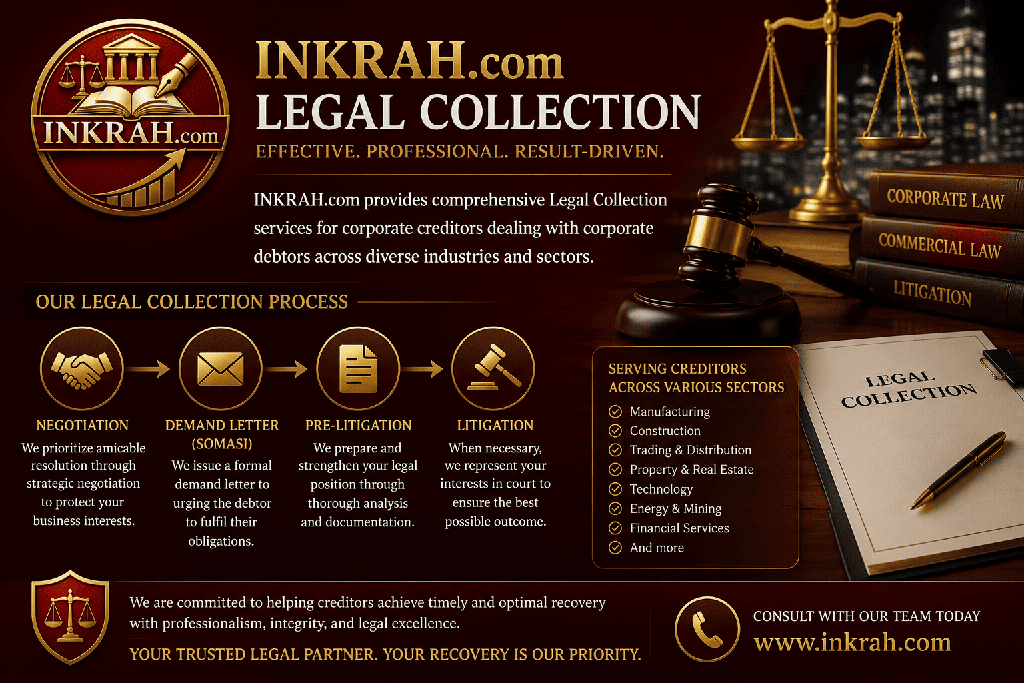
Why a Legal Institution, Not a Collection Agency
A demand that arrives from a legal institution changes the conversation. The debtor sees that the claim has been reviewed, that the creditor is prepared to go to court, and that every word written to them may later be placed before a judge. That is why INKRAH Legal Collection begins with law rather than pressure: the claim is analysed first, the correspondence is drafted to stand up in proceedings, and each stage builds the evidential record for the next.
Our approach is deliberately graduated. Most debtors pay, or propose terms, after the reminder or the summons; a smaller number settle during negotiation; and only the remainder require litigation. You decide at each stage whether to proceed, with a clear view of cost, time and likely outcome.
How INKRAH Legal Collection Works
Each stage is a decision point: you may settle, pause or escalate with full information.
1. Case Review & Documentation
We examine the contract, purchase orders, invoices, delivery records, correspondence and any security held, confirm that the debt is due and payable, check the limitation position, and agree a recovery strategy and budget with you before anything is sent.
2. Payment Reminder on the INKRAH Letterhead
A courteous but unmistakably formal reminder is issued on the INKRAH letterhead, stating the outstanding amount, the legal basis of the claim and a short deadline for payment. For many debtors, a letter from a legal institution rather than an accounts department is enough to settle the matter.
3. Formal Legal Summons (Somasi)
Where the reminder is ignored, we serve a formal summons placing the debtor in default within the meaning of Article 1238 of the Indonesian Civil Code. The summons sets out the claim, the consequences of continued non-payment and our client’s readiness to commence proceedings; a second and final summons follows if required.
4. Negotiation & Settlement
Most commercial debts are recovered at the negotiating table. We meet or correspond with the debtor or its counsel, test their position, and document any agreement properly: instalment plans, settlement deeds, acknowledgements of debt, additional security or guarantees, so that a broken promise can be enforced quickly.
5. Litigation
If negotiation fails, we act for you in court: a simple lawsuit (gugatan sederhana) for claims of up to Rp500 million, an ordinary civil claim for breach of contract (wanprestasi) in the District Court, or arbitration where the contract requires it. Where the conditions are met, a suspension of debt payment (PKPU) or bankruptcy petition before the Commercial Court may be the most effective lever.
6. Enforcement & Recovery
A judgment is only as good as its enforcement. We pursue execution through the court, including attachment and auction of assets, enforce fiduciary security and mortgage rights (hak tanggungan), and lodge and pursue claims in the debtor’s PKPU or bankruptcy proceedings.
Creditors of Every Size
Manufacturers, distributors and wholesalers with overdue trade receivables; service providers and contractors with unpaid progress claims; landlords with rent arrears; lenders and finance companies with non-performing accounts; and foreign suppliers owed money by Indonesian buyers.
- Single large claims and portfolios of smaller accounts
- Debts backed by guarantees, fiduciary security or mortgages
- Disputed debts that need a legal opinion before any demand
- Cross-border claims, with correspondent counsel where assets lie abroad
Firm, Lawful and Discreet
We never harass, threaten or shame a debtor, and we never contact family members, employers or other third parties beyond what the law allows. Personal data is processed in accordance with Indonesia’s Personal Data Protection Law, and every communication is written as if it will be read aloud in court, because it may be.
You receive a written report after every stage, with copies of all correspondence, the debtor’s response and our recommendation for the next step.
Frequently Asked Questions
What is a somasi?
A somasi is a formal written demand that places a debtor in default (ingebrekestelling) under Article 1238 of the Indonesian Civil Code. It is ordinarily the step that precedes a claim for breach of contract, and it is frequently what persuades a debtor to pay or to negotiate.
Do you only handle Indonesian debtors?
We handle debtors domiciled in Indonesia and work with correspondent counsel for debtors and assets abroad. Cross-border matters are assessed case by case, including the enforceability of foreign judgments and arbitral awards in Indonesia.
Is your collection practice ethical?
Yes. Every step is taken in the name of a legal institution and within the law: no harassment, no threats, no contact with third parties beyond what the law permits, and personal data handled in line with Indonesia’s Personal Data Protection Law. Firm, lawful pressure recovers more money than intimidation, and it protects your reputation.
How are fees structured?
Fees are agreed in writing before work begins. Depending on the size and age of the debt, we offer a fixed fee per stage, a success fee calculated on the amount actually recovered, or a combination of the two. Court fees and third-party costs are disclosed in advance.
What do you need from us to begin?
The contract or purchase order, the unpaid invoices, proof of delivery or performance, the relevant correspondence, and the debtor’s latest known address and company details. We will tell you within days whether the claim is strong and which stage to start from.
Recover What You Are Owed
Send us the contract, the unpaid invoices and the debtor’s details. We will review the claim and tell you, within days, which stage to begin from and what it will cost.