

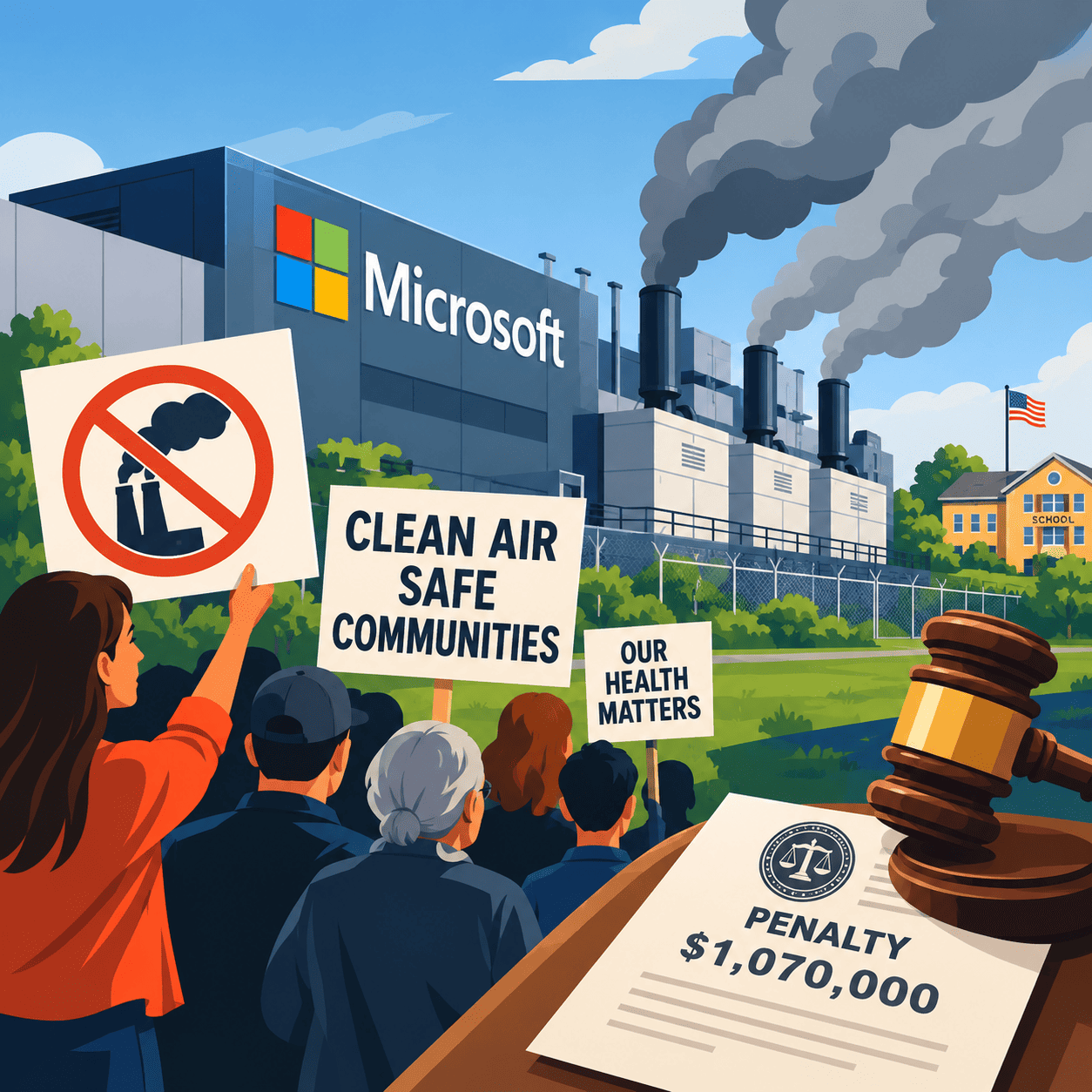
The development of a large-scale data centre in Vineland, New Jersey, United States, has entered a new phase in which the ambitions of artificial intelligence are colliding with concerns raised by the local community. The facility is being developed by DataOne and has a commercial relationship with Microsoft through an agreement to provide AI computing infrastructure capacity from the new data centre in Vineland. Nebius announced the agreement on 8 September 2025, with an initial contract value of approximately US$17.4 billion over five years through 2031. The value could rise to approximately US$19.4 billion if Microsoft takes up additional services and capacity. This scale of investment illustrates just how much computing demand is being generated by the artificial intelligence industry. Behind those billion-dollar figures lies physical infrastructure requiring energy, cooling systems, land, backup power systems, networks, and supporting facilities. Microsoft has stated in its annual reporting that expanding cloud and AI infrastructure requires increased investment and depends upon the availability of land, energy, networks, servers, and graphics processing units. The residents of Vineland are therefore confronted with a question that sits much closer to everyday life. They want to know who receives the economic benefits from the project and who carries its social and ecological costs. That question is a fair question when a technology project of such enormous value arrives close to residential communities. The dispute demonstrates that the digital revolution still has a physical footprint that people can actually feel.
Public concern intensified after questions emerged regarding the facility's energy sources and emissions. On 22 September 2026, the New Jersey Department of Environmental Protection, or NJDEP, announced a US$1.07 million penalty against DataOne. The state agency said that the facility had installed and operated 62 natural-gas-fired electricity generators without the environmental permits required under state law. An inspection conducted on 29 July 2026 identified the generators at the facility. NJDEP stated that each generator had a capacity of 1,982 kilowatts and fell within equipment requiring construction permits and certificates to operate. Natural-gas-fired generators produce carbon dioxide, nitrogen oxides, carbon monoxide, and other combustion-related pollutants. The state regulator subsequently ordered DataOne to obtain the required permits or cease operating the relevant equipment. This development gives the public debate a concrete legal dimension that goes beyond general environmental anxiety. The issue is no longer simply whether residents like or dislike the data centre. There is a specific question of administrative compliance that has already produced regulatory enforcement action. Fiat justitia ruat caelum, justice must be done though the heavens fall, provides a relevant maxim for understanding the principle at stake. Technology worth billions of dollars remains subject to environmental law and the licensing regime established by the competent authorities. Big tech still has to play by the rules, and that point is hardly controversial when environmental permits are legally required.
The issue became more sensitive because community groups and environmental organisations raised concerns about the location of the generators in relation to educational facilities. In August 2026, Stand.earth stated that an investigation it had commissioned or relied upon found 45 of the 62 generators producing emissions when examined using thermal imaging technology. The organisation said the facility was approximately one mile from two local schools. That claim needs to be treated carefully because it originates from an environmental advocacy group, whereas the regulator's officially confirmed findings concern the existence and operation of generators without the required permits. The distinction between those sources matters in responsible journalism because allegations, advocacy claims, and established administrative findings should not be blended together. Residents have also raised concerns about noise generated by the centre and its supporting infrastructure. Such disturbance differs from air pollution because its impact may be experienced continuously through changes in the ordinary quality of life. A home that once functioned as a private space can become a place exposed to industrial machinery, construction traffic, lighting, and around-the-clock facility activity. There is no such thing as a free lunch is an apt economic expression when the benefits of computing are accompanied by social costs borne by the surrounding community. Every economic benefit carries costs that may appear through land use, energy consumption, water demand, noise, or pressure upon public infrastructure. Residents therefore have legitimate grounds to ask whether those costs were properly calculated from the earliest planning stage. That question forms part of legitimate public accountability. No one likes being kept in the dark, especially when changes to the environment around one's home are happening right in front of one's eyes.
The sociological dimension of the Vineland dispute emerges from the question of meaningful public participation in major development projects. Reports concerning the project indicate that construction had already progressed before some residents understood the facility's relationship with Microsoft's computing requirements. A town hall meeting was held in January 2026 after public questions about the project increased. DataOne chief executive Charles-Antoine Beyney reportedly acknowledged that the meeting should have taken place several months earlier. That fact demonstrates why public communication matters from the earliest stage of a major infrastructure project. Communities need information about the facility's purpose, energy requirements, water sources, power-generation technology, traffic, noise, environmental risks, and complaint mechanisms. When information arrives late, the empty space can easily be filled with suspicion. The theory of social legitimacy helps explain why public acceptance of a project does not arise solely from the existence of formal permits. Acceptance also depends upon credible communication and meaningful opportunities for residents to raise concerns. Audi alteram partem, hear the other side, has a strong resonance here. People living near a project possess interests that deserve to be heard before development produces consequences that may prove difficult to reverse. No one likes being kept in the dark, and that is particularly true when the machinery of a major industrial project suddenly becomes part of the neighbourhood. Public engagement therefore should not be treated as a box-ticking exercise. It is part of the social licence that allows large infrastructure to operate with public legitimacy.
The environmental-law dimension of the dispute can also be examined through the polluter pays principle. The principle embodies the idea that those responsible for pollution should bear the costs of preventing and addressing environmental harm in accordance with the applicable legal framework. The US$1.07 million administrative penalty against DataOne demonstrates how environmental accountability can be translated into regulatory enforcement. NJDEP described the penalty as the largest enforcement action it had taken against a data centre in New Jersey. The permitting issue also relates to the preventive function of environmental regulation because permits enable authorities to assess emissions, control technologies, pollutant sources, and operational conditions before equipment is brought into service. A failure to comply with permitting requirements can deprive regulators of the opportunity to conduct that assessment at the appropriate stage. Under administrative-law doctrine, public authorities must exercise statutory powers according to the law and procedures established by the relevant legal framework. Nullum crimen sine lege is principally a criminal-law maxim and must be used within its proper doctrinal boundaries, yet its underlying concern with legal certainty helps explain why rules should be ascertainable before regulated activities are undertaken. Businesses require certainty regarding the standards they must satisfy. Communities require certainty that those standards will actually be enforced. The state requires certainty that economic growth will not turn environmental law into little more than a paperwork exercise. Rules are rules, and their practical value depends upon enforcement rather than rhetoric.
Microsoft's relationship with the facility also raises questions about corporate responsibility across technology supply chains. Microsoft is not identified as the direct owner of the Vineland facility on the available information concerning the project's structure. Nebius stated that it would provide dedicated GPU capacity to Microsoft through the Vineland data centre under a multibillion-dollar commercial agreement. That structure means that the allocation of legal responsibility must be approached with care. Direct legal liability for a particular regulatory breach must be determined by reference to legal status, conduct, contractual arrangements, operational control, and the applicable statutory provisions. Corporate responsibility from an ethical standpoint may have a broader reach. A company benefiting from a technology supply chain may be expected to conduct appropriate due diligence regarding the environmental consequences associated with its commercial partners. Environmental groups have called upon Microsoft to take action regarding the Vineland situation. That demand represents an advocacy position and should not be treated as a judicial finding that Microsoft is legally responsible for the regulatory breach. Respondeat superior also cannot automatically be applied to a commercial relationship of this nature because the doctrine operates within particular legal frameworks concerning agency and employer liability. The more precise questions concern the extent to which contractual arrangements, operational control, knowledge, economic benefit, and due-diligence obligations may establish different responsibilities for the parties involved. The devil is in the detail is an apt phrase here. Corporate structures can be complex, and legal responsibility cannot sensibly be assigned merely because one company purchases services from another. Follow the paper trail is often the more useful approach when determining who controlled what, who knew what, and who was legally obliged to do what.
From an economic standpoint, the construction of data centres offers benefits that cannot simply be brushed aside. Computing facilities support cloud services, artificial intelligence, data processing, and numerous activities within the digital economy. The Microsoft-Nebius agreement illustrates the enormous commercial value attached to AI computing capacity. Nebius stated that the contract would support the capital expenditure required to build additional infrastructure capacity. Local governments may also receive tax revenues, investment, construction activity, and demand for local services. Those benefits can carry substantial economic value for areas hosting major data-centre developments. The problem arises when external costs are imposed upon communities that have little influence over the structure of the investment. Externalities may include emissions, noise, electricity demand, water consumption, land-use changes, and pressure on public infrastructure. Environmental economics describes such circumstances through the concept of a negative externality, where the full social cost of an economic activity is not reflected in the private transaction between the parties. Ronald Coase's work highlighted the importance of property rights, transaction costs, and the ability of affected parties to negotiate when dealing with externalities. That idea becomes particularly important when a large number of affected residents face a powerful multinational corporation with vastly greater financial and technical resources. Show me the numbers is therefore a perfectly reasonable question for any project promising substantial economic growth. Investment figures should be accompanied by credible calculations of social and ecological costs. You can't have your cake and eat it if the commercial benefits are celebrated while the community is expected to quietly absorb the external costs.
The New Jersey government has responded to the broader data-centre challenge through policies concerning energy, water, and community relations. NJDEP stated that the state was advancing rules requiring data centres to contribute towards clean-energy needs and grid infrastructure. The state has also introduced greater transparency concerning energy and water consumption. In August 2026, the Governor of New Jersey signed S3379/A4096, requiring data-centre owners and operators to submit semi-annual reports on energy and water use to the New Jersey Board of Public Utilities. Those reports cover energy consumption, energy used for cooling systems and information-technology equipment, maximum daily water consumption, water sources, and primary and backup electricity resources. Such measures indicate a shift from a regulatory model based primarily on individual permits towards a more systematic transparency regime. Public data becomes an important instrument for assessing the actual footprint of large-scale facilities. Sunlight is the best disinfectant remains a popular maxim for describing the value of transparency in public oversight. The greater the resource consumption of an industry, the stronger the case for providing information that can be examined by the public. Transparency also enables investors to assess regulatory and reputational risks. Government authorities can use the information to design energy, water, and land-use policies on a more rational basis. Communities gain factual material upon which they can raise objections or express support for particular projects. Fair play in infrastructure development requires information that can be tested and verified rather than corporate slogans alone.
The philosophical dimension of the dispute reaches an older question concerning the meaning of progress and who should have a voice in determining its direction. Data centres symbolise technological progress because they underpin digital services used by millions of people. Artificial intelligence also promises greater productivity, automation, scientific research, and economic innovation. Microsoft continues to expand AI computing capacity to meet growing demand for such services. The political philosophy of John Rawls provides the concept of justice as fairness, which treats the distribution of social benefits and burdens as a question of justice. That concept can serve as a useful intellectual framework for asking whether communities hosting major projects receive benefits that are reasonably proportionate to the burdens they bear. Immanuel Kant's conception of human beings as ends in themselves also reminds us that people should not be treated merely as instruments for achieving economic objectives. That idea has relevance when residents' quality of life is placed alongside the commercial interests associated with technological expansion. Progress without justice can become a very dodgy bargain, because development that places disproportionate burdens upon particular communities can lose its social legitimacy. Technology should expand human capabilities without disregarding the rights of people living beside the infrastructure that makes such technology possible. This philosophical inquiry does not automatically dictate a particular policy outcome. It instead helps society scrutinise the reasons offered by governments and corporations when major development decisions are made. If progress leaves people behind, something has gone rather pear-shaped, and that possibility deserves serious consideration before infrastructure becomes irreversible.
The Vineland case also demonstrates why the precautionary principle matters for technology projects whose scale continues to grow. The precautionary principle calls for environmental risks to be managed where there is a possibility of serious or irreversible harm, even where complete scientific certainty is not yet available. The principle does not mean that every project must be stopped whenever concerns are raised. It calls for risk assessment, mitigation, monitoring, transparency, and effective mechanisms for correction. Data centres possess complex technical characteristics because they combine substantial electricity requirements, cooling systems, computing equipment, backup generators, communications networks, and security infrastructure. Microsoft explains that data centres maintain backup generators for emergencies and certain testing activities and that those generators remain subject to applicable air-permitting requirements. The Vineland matter demonstrates why claims of compliance should be supported by permitting records and regulatory inspections. When a regulator identifies 62 generators operating without the required permits, the issue possesses a stronger factual foundation than a dispute based solely upon social-media commentary. Enforcement must also remain proportionate so that businesses receive regulatory certainty while communities receive meaningful environmental protection. Better safe than sorry neatly captures the logic of prevention. AI infrastructure can expand rapidly without removing the need for environmental governance. Move fast and fix it later is hardly an ideal formula when the effects of major infrastructure may continue for decades. A high-tech economy still requires old-fashioned legal discipline.
The events in Vineland demonstrate that conflict between communities and data centres cannot sensibly be reduced to a simple confrontation between residents opposed to technology and companies pursuing innovation. On one side sits a global demand for computing capacity that has become fundamental to the digital economy. On the other sits the public interest in a healthy environment, meaningful information, and decision-making processes that can be scrutinised and held to account. Environmental groups have called for Microsoft and DataOne to halt certain activities and strengthen protections for nearby communities. The New Jersey government has responded through enforcement measures, reporting requirements, and broader policies concerning electricity consumers and local communities. DataOne faces the regulator's direction to obtain the necessary permits or cease operating the relevant generators. These developments demonstrate the role of law in managing the relationship between innovation, investment, and public protection. Ubi societas, ibi ius, where there is society, there is law, remains a fitting maxim for the relationship between technological development and regulatory necessity. Residents do not have to oppose innovation in order to demand environmental protection. Corporations do not have to abandon innovation in order to comply with the law. Governments do not necessarily have to choose between investment and community protection because regulatory design can seek to accommodate both through proportionate safeguards. Keep it fair, keep it lawful is a practical principle worth carrying into the next phase of AI infrastructure development. The real challenge is not whether society should have data centres. The harder question is whether society can build them while ensuring that the people living beside them are treated as rights-bearing participants rather than collateral damage of technological progress.
The Vineland dispute offers a broader lesson for governments, data-centre developers, technology companies, investors, and communities living near digital infrastructure. A data centre is essentially an industrial facility operating behind the scenes to support digital services used by people every day. Its physical footprint can be enormous and its energy requirements can rise as AI computing expands. The Washington Post has reported that the expansion of data centres across the United States is changing land use and increasing pressure on electricity grids and local resources. Reuters has also reported that Microsoft President Brad Smith has emphasised the importance of earning and maintaining community trust when the company builds data centres. Trust cannot be constructed through communications campaigns alone. Trust requires compliance with permits, transparent information, environmental monitoring, meaningful responses to complaints, and a credible distribution of local benefits. The Vineland experience shows that delayed information can deepen social conflict when a project has already moved deep into construction and operation. The principle of good neighbour becomes meaningful when it is translated into measurable procedures rather than polished corporate language. Actions speak louder than words remains a useful reminder that corporate commitments need to be demonstrated through verifiable conduct. AI expansion may create enormous economic opportunities. Those opportunities still require a robust legal framework so that technological progress does not become a one-sided burden for the communities hosting its physical infrastructure. The future is digital, but the ground beneath it is very much real, and that is the bit policymakers, businesses, and communities cannot afford to forget.