
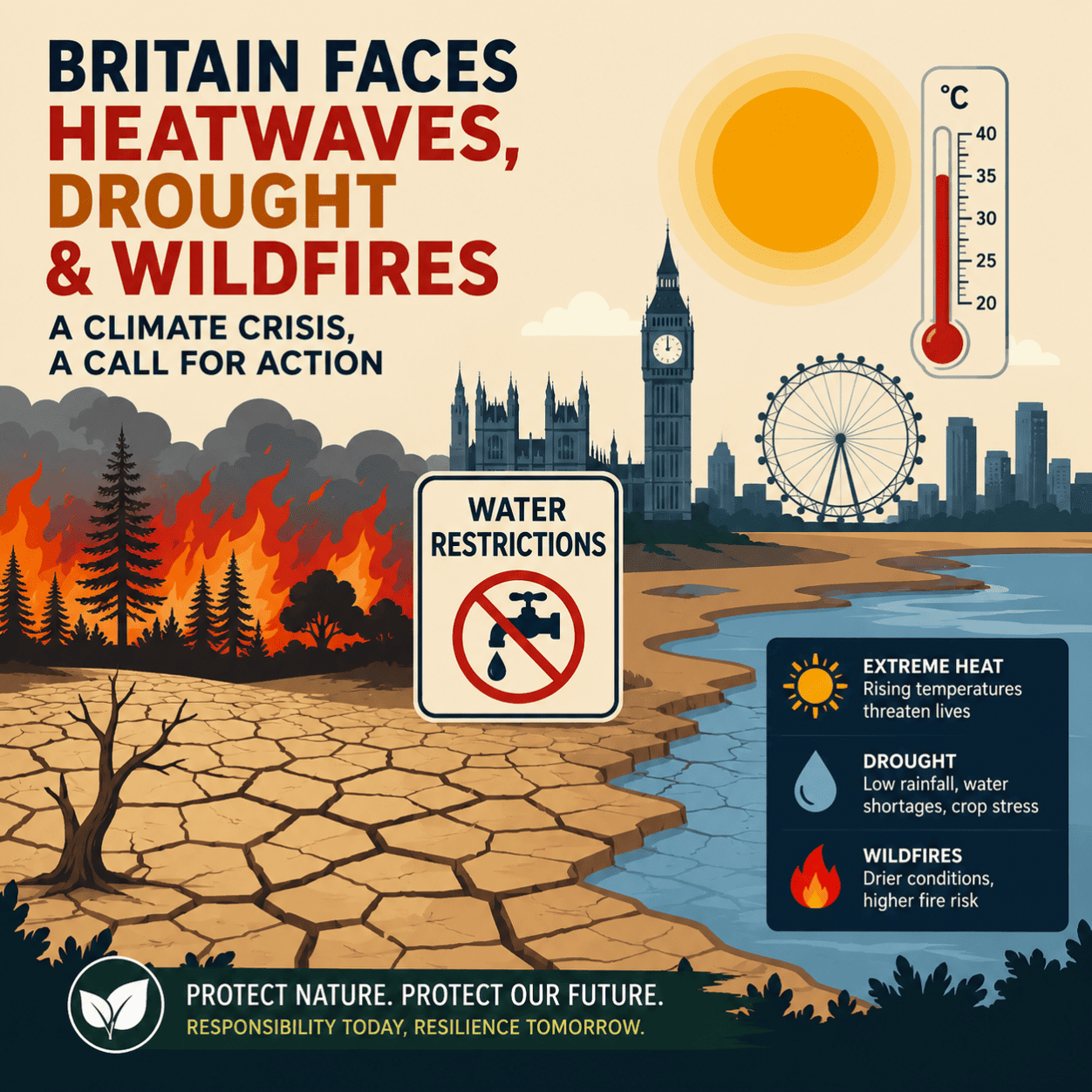
Britain is having a proper wake-up call from the weather. A fifth heatwave has gripped the country in 2026, temperatures in London have climbed to around 36°C, drought has spread across nearly three quarters of England, and wildfires have become a recurring summer menace. Around 2,877 heat-related deaths have been reported this year, whilst millions of people are facing water restrictions and farmers are watching dry soil turn into a serious threat to food production. The British summer is no longer merely a matter of scorched lawns, warm pints and moaning about the Met Office. It has become a live environmental crisis, one that reaches straight into public health, agriculture, water security and the resilience of the state. Reuters reports that the government has convened emergency discussions over heatwaves, drought and wildfires, with climate change identified as a factor intensifying the prolonged dry conditions.
The most striking feature of this crisis is its creeping normality. A reservoir running low can look like an ordinary seasonal nuisance, a field drying out can appear to be a farmer's private headache, and a wildfire on the horizon can seem miles away from the daily lives of city dwellers. Put those fragments together and the picture becomes rather grim. Water restrictions now affect millions, agricultural production faces mounting pressure, and repeated heatwaves place public services under considerable strain. The old British habit of treating extreme weather as a temporary inconvenience is becoming increasingly difficult to defend. The principle of responsibility associated with Hans Jonas offers a sharper moral vocabulary here: modern power creates modern duties, especially when human decisions possess the capacity to alter the conditions in which future generations must live. A society that can transform its climate system carries an obligation to govern that power with restraint. Sic utere tuo ut alienum non laedas, use your own property in such a way that you do not injure another, suddenly sounds less like dusty legal Latin and more like a rule written for an age of carbon emissions.
Britain's drying landscape also exposes a deeper legal question: who bears responsibility when environmental harm spreads beyond the person who caused it? The answer cannot sensibly stop at the factory gate, the power station fence or the balance sheet of a private enterprise. Smoke travels, heat accumulates, rivers shrink, crops fail and public health absorbs the bill. John Locke's theory of natural rights placed strong emphasis on the preservation of life and the conditions necessary for human flourishing, whilst the Roman legal tradition treated certain environmental resources as belonging to the common use of humanity. The modern environmental state inherits both ideas in a new form. Water, breathable air, fertile soil and a stable climate carry characteristics of a res communis, resources whose significance extends beyond individual ownership. The current British drought gives that ancient proposition a rather modern sting: if environmental assets sustain everyone, their degradation creates obligations for everyone who possesses the power to damage them. Salus populi suprema lex, the welfare of the people is the supreme law, becomes a useful constitutional reminder when heat threatens lives, water supplies and food security.
The wildfire figures add another layer to the story. Fire services in England and Wales have already responded to hundreds of wildfires this year, including a substantial surge during the early August heat. Dry vegetation, parched soils and extreme temperatures create conditions in which a tiny spark can become a full-blown emergency. Reuters has reported that Britain is facing an unusually severe combination of drought, heat and fire, whilst environmental reporting from across Europe shows the same pattern unfolding through Croatia, Greece, France and Spain. This is no longer a neat collection of isolated incidents. It resembles a chain reaction across ecological systems, with forests, farms, reservoirs, communities and public infrastructure caught in the same climatic squeeze. Aristotle's idea of phronesis, practical wisdom, feels remarkably relevant here. Good governance requires more than grand promises and glossy climate strategies; it requires the nous to prepare before the crisis kicks off. A government that waits for the flames before investing in resilience is rather like a solicitor drafting a will after the courtroom doors have opened.
There is also a distinctly legal dimension to the water question. When drought forces restrictions, the state begins deciding how a scarce resource should be distributed between households, farmers, industry and ecosystems. Such decisions carry questions of fairness, proportionality and public trust. The ancient maxim audi alteram partem, hear the other side, offers a useful reminder that environmental governance should listen to the people who live with its consequences, from farmers facing failed harvests to communities watching local rivers and reservoirs decline. John Stuart Mill's concern for liberty can be brought into the same conversation, especially where individual consumption collides with collective environmental security. A garden hose may seem harmless on its own, yet millions of such choices can become a serious pressure on a strained water system. Personal freedom still matters. So does the ecological infrastructure that makes that freedom possible. Nobody gets to enjoy a flourishing society on a dried-out planet. That is not doom-mongering; it is plain old common sense dressed in legal robes.
The philosophical challenge is ultimately about time. Political institutions tend to think in election cycles, corporations often calculate quarterly performance, and households naturally focus on the next bill. Climate systems operate on a different clock. Hans Jonas warned that technological civilisation had created forms of power capable of producing consequences far beyond the immediate moment. His ethical demand was simple in spirit: act so that the effects of human action remain compatible with genuine human life. The British drought makes that principle painfully concrete. Investment in water reuse, resilient infrastructure, sustainable agriculture, ecosystem restoration and climate adaptation may look expensive on today's spreadsheet. Rebuilding damaged communities, compensating farmers, protecting hospitals, restoring ecosystems and securing food supplies after repeated climate shocks could cost far more. The writing is on the wall, and it is written in cracked soil, emptying waterways and blackened grass. Ubi jus ibi remedium, where there is a right, there is a remedy, carries a wider environmental lesson here: rights mean little if institutions refuse to build the conditions that allow those rights to survive.
Britain therefore faces something bigger than another hot summer. It faces a test of whether environmental responsibility can move from political rhetoric into enforceable duty, public investment and everyday behaviour. The heatwave, drought and wildfires reveal the physical consequences of a warming climate, yet they also reveal a question of justice. Who benefits from environmental exploitation, who pays for environmental damage, and who inherits the consequences? The answers should matter to legislators, courts, businesses and ordinary citizens alike. Cicero's famous maxim, salus populi suprema lex, remains stubbornly relevant in an age of climate disruption. The public welfare cannot be treated as an optional extra, a nice-to-have tucked behind economic growth and short-term convenience. Britain needs water systems built for harsher summers, farms prepared for climatic volatility, landscapes capable of absorbing shocks and laws capable of holding powerful actors to account. A green transition is not merely about being virtuous or fashionable. It is about keeping society functional when nature stops giving us easy conditions. The planet is sending the invoice. Ignoring it would be a very expensive bit of cheek.