
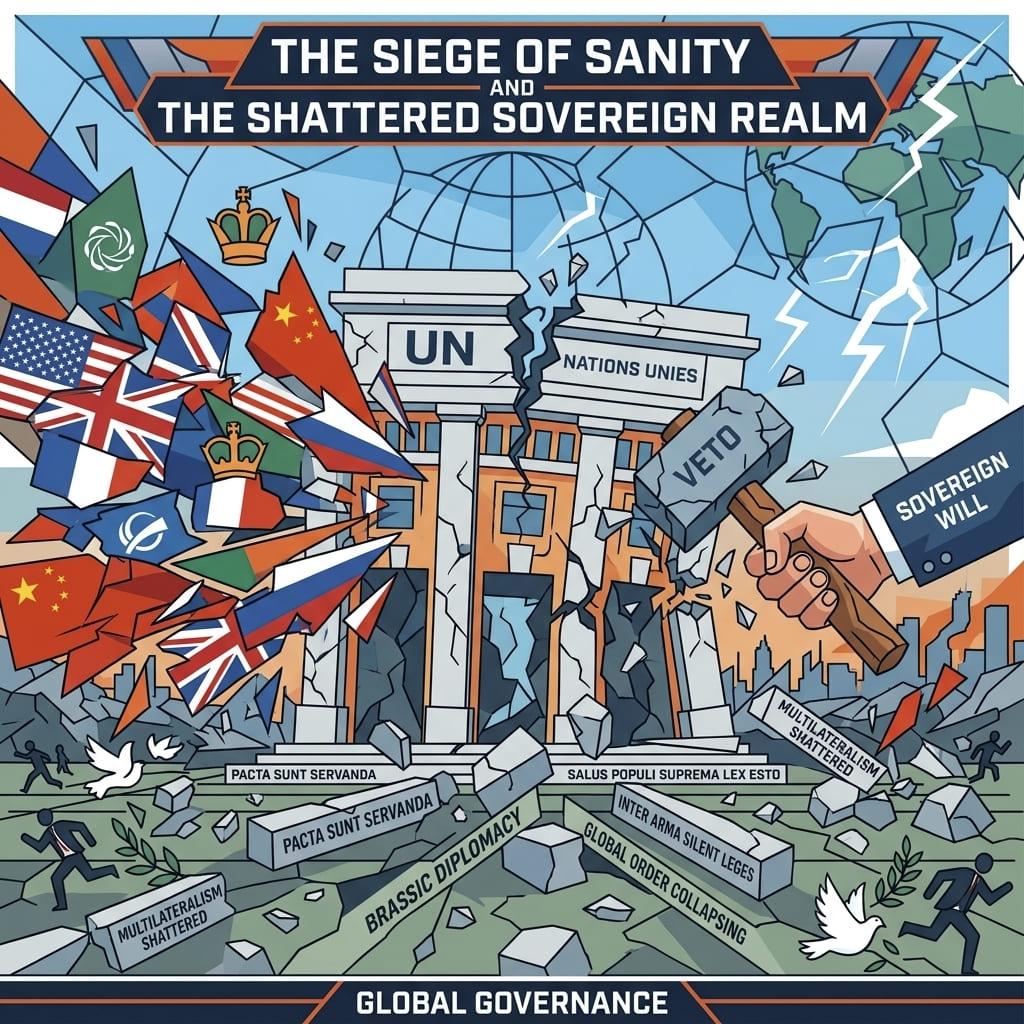
On Tuesday, 11 August 2026, inside the iconic headquarters of the United Nations in New York City, Secretary-General António Guterres convened an emergency session of the Security Council to address the escalating humanitarian catastrophe across the Middle East and Eastern Europe, where modern diplomacy frequently buckles under the heavy boots of geopolitical posturing, echoing the bleak philosophical warning of Thomas Hobbes that power dictates right in the absence of an absolute sovereign. The high-level deliberations concerning the widening theatre of regional blockades and unmitigated state aggression reveal an organization caught between noble charter ideals and the grim reality that pacta sunt servanda remains a fragile promise when powerful states choose Realpolitik over collective security. Diplomatic corridors are rife with whispers that the global governance framework is utterly brassic, struggling to maintain its fiscal and moral footing while permanent members wield their veto powers like medieval broadswords, slicing through any genuine consensus for peace. This systemic paralysis transforms international law from an active shield for the vulnerable into a mere parchment barrier, reminding every cynical observer that ubi societas, ibi jus finds itself severely tested when sovereign self-interest eclipses universal human rights.
The Crucible of Humanitarian Breakdown
Far beyond the polished mahogany tables of Manhattan, across the war-torn territories of Gaza and Ukraine monitored closely by UN human rights observers during the operational review on 12 August 2026, the devastating human cost of institutional inertia unfolds across fractured landscapes where civilians bear the relentless brunt of unchecked aggression, actualising Hans Kelsen's pure theory of law reduced to hollow enforcement mechanisms. From the maritime chokepoints of the Red Sea to the suffocating systemic exclusions faced by millions under oppressive de facto regimes, international humanitarian law faces a profound crisis of efficacy, proving that lex lata often arrives far too late to protect the persecuted from arbitrary power. Field reports compiled by UN agencies indicate that vital aid networks are critically underfunded, leaving grassroots responders utterly snookered as bureaucratic delays and hostile restrictions strangle life-saving operations on the ground. Prominent jurists and legal philosophers argue that when institutional safeguards fail to curb egregious human rights abuses, the social contract underpinning global order fractures irreparably, reinforcing the timeless axiom injuria non praesumitur, wrongs are never presumed to be permissible, yet they persist with impunity under the passive gaze of the international community.
Reforming the Global Architecture
During the special plenary address delivered at the UN Palais des Nations in Geneva on 13 August 2026, international delegates gathered for the Global Governance Reform Agenda demanded a radical overhaul of archaic post-war structures that fail to mirror contemporary geopolitical realities, vindicating Ronald Dworkin's vision of law as integrity that requires moral coherence across institutional practices. The insistence on maintaining outdated power distributions within global financial and security bodies ignores the shifting weight of emerging economies, creating an unsustainable institutional deficit where justice delayed is truly justice denied on a planetary scale. Reform efforts must transcend cosmetic spreadsheet adjustments to embrace a profound restructuring of accountability, ensuring that international tribunals and administrative organs possess the teeth to enforce compliance without fear or favour. Unless world leaders summon the collective political courage to dismantle exclusionary privileges and anchor governance in absolute equity, the global architecture risks total collapse, affirming the ultimate legal truth that salus populi suprema lex esto remains the only valid compass for a civilized world.
The Fiscal Chasm and Administrative Paralysis
At the administrative budget committee meetings held in Vienna on 14 August 2026, senior UN comptrollers reviewed the annual budgetary allocations and warned that chronic funding shortfalls threaten to completely paralyze peacekeeping missions from Lebanon to the Democratic Republic of Congo, illustrating Jeremy Bentham's utilitarian dilemma where systemic resource starvation produces maximum misery for the greatest number of vulnerable populations. Member states routinely pledge financial contributions during high-profile General Assembly summits only to default on their obligations, leaving field operations completely skew-whiff and chronically unable to pay local personnel or procure essential medical supplies. This chronic fiscal delinquency reduces multilateral declarations to empty rhetoric, exposing the painful hypocrisy of governments that posture as champions of international cooperation while starving the very institutions tasked with maintaining global order. Legal scholars analyzing this budgetary strangulation frequently invoke the ancient principle nemo dat quod non habet, asserting that an organization starved of fundamental resources cannot possibly deliver the robust security it was chartered to provide.
The Judicial Impasse at the Hague
Inside the ornate chambers of the International Court of Justice in The Hague on 14 August 2026, presiding judges heard oral arguments during the judicial compliance review regarding persistent defiance of provisional measures ordered against rogue states engaged in systematic violations of international conventions, laying bare the profound limitations highlighted by John Austin's positivist positivist critique that laws lacking coercive enforcement are merely moral recommendations. When sovereign nations openly flout binding judicial mandates regarding territorial integrity and humanitarian access, the entire edifice of international jurisprudence is rendered utterly bollocks, reducing august magistrates to impotent spectators in theatres of slaughter. Legal theorists argue that international courts must evolve beyond traditional reliance on voluntary state compliance, adopting innovative enforcement mechanisms that bypass corrupt national authorities to safeguard persecuted populations. The persistent refusal of powerful nations to submit to independent judicial scrutiny reinforces the grim reality that inter arma silent leges - in times of war, the laws remain largely silent unless backed by undeniable physical force.
The Climate Refugee Crisis and Planetary Displacement
During the emergency environmental summit convened by the UN Environment Programme in Nairobi on 10 August 2026, scientific experts and legal delegates convened the Planetary Displacement and Migration Taskforce to confront the catastrophic acceleration of climate-induced displacement across the Global South, validating Immanuel Kant's cosmopolitan vision of a universal human right to hospitality upon a shared earth. Rising sea levels and prolonged droughts in regions like the Horn of Africa have uprooted millions of vulnerable souls, yet the current international refugee regime offers zero legal protection to those fleeing environmental collapse rather than political persecution. Bureaucratic inertia within refugee agencies leaves these displaced populations completely snookered in legal limbo, devoid of recognized status or institutional assistance. Jurisprudential thinkers emphasize that failing to update international conventions to account for planetary crises exposes a fatal flaw in global governance, proving that pacta sunt servanda must expand its moral horizons if the international community wishes to avoid the total collapse of basic human dignity.
The Dawn of Cyber Warfare and Regulatory Vacuums
At the cybersecurity roundtable hosted by the UN Disarmament Commission in Vienna on 12 August 2026, technical experts and diplomats debated the regulatory frameworks for emerging digital threats, grappling with the unregulated proliferation of state-sponsored cyber attacks targeting critical civilian infrastructure, echoing Carl Schmitt's chilling observations on the state of exception where sovereign power operates entirely outside established legal bounds. Malicious digital incursions targeting hospital networks, power grids, and electoral systems continue to destabilize global peace with complete impunity, as existing international treaties remain utterly toothless against asymmetric virtual aggression. Governments engage in clandestine digital warfare while hiding behind plausible deniability, reducing diplomatic negotiations to an absolute shambles of empty denials and unverified accusations. Legal philosophers insist that cyberspace cannot remain a lawless frontier where might makes right, asserting that ubi jus, ibi remedium must be urgently applied to digital warfare through binding multilateral frameworks that hold aggressive states fully accountable for their virtual transgressions.