
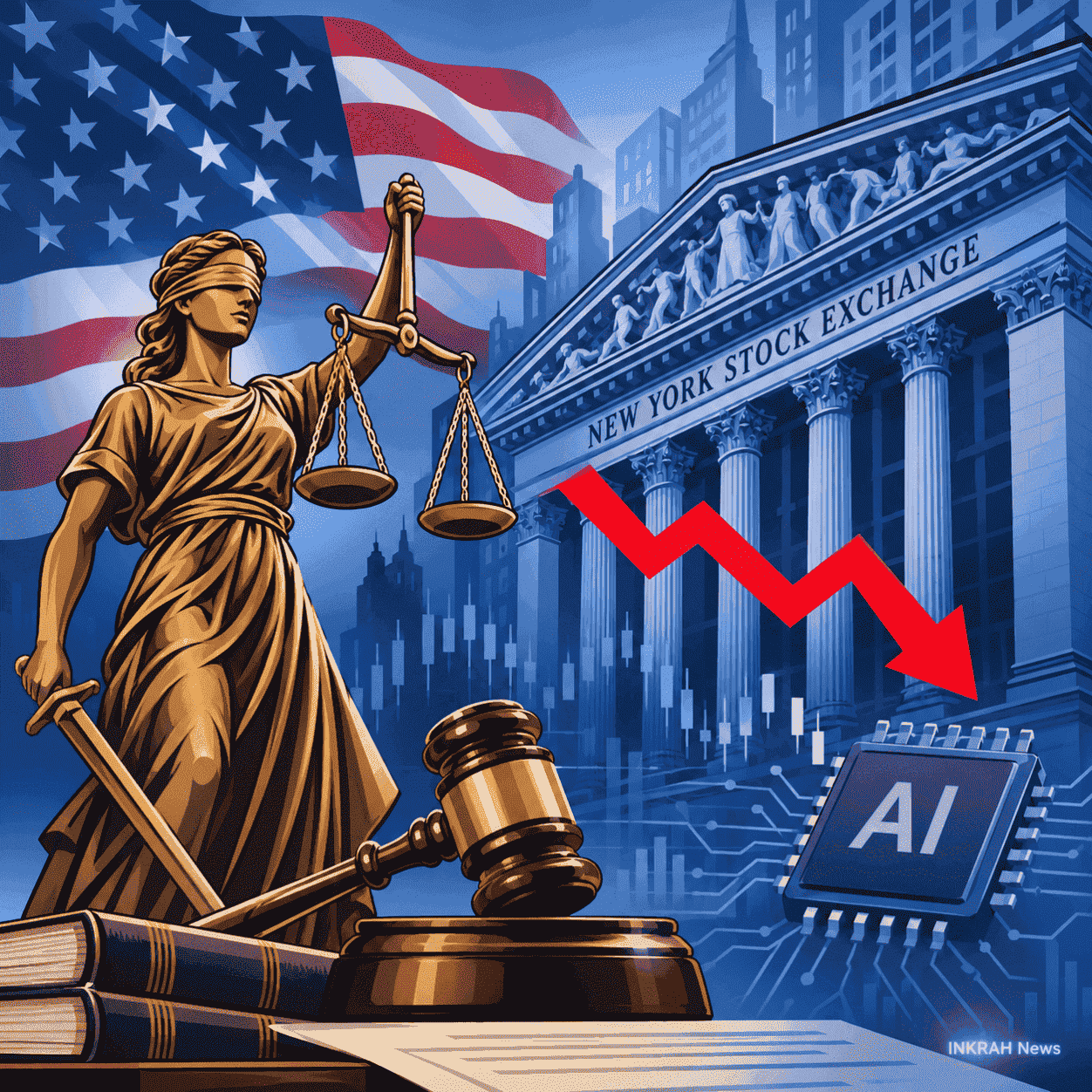
Stock trading on Wall Street, United States, on Thursday, 5 November 2026, was marked by substantial selling pressure following the midterm election results, which demonstrated a significant victory for the Democratic Party. The resulting shift in the political balance of power in Congress and several state governments immediately influenced market participants’ expectations regarding the future direction of technology industry policy. Particular concerns centred on the sustainability of investment in Artificial Intelligence (AI). Investors began factoring in the possibility of restrictions on the construction of data centres, which serve as essential infrastructure for the development of this technology. These changing political expectations spread across various investment instruments and placed considerable pressure on several major stock market indices. The Nasdaq 100 fell by 6.36% shedding 1,807.36 points, whilst the S&P 500 declined by 4.36% losing 334.89 points. These movements demonstrated just how sensitive capital markets are to changes in public policy that may affect companies’ future earnings prospects.
Selling pressure was also evident in the Dow Jones Industrial Average, which shed 1,833.16 points representing a decline of 3.44%. The downturn signalled that weakness had spread beyond technology companies to businesses operating in different sectors with distinct commercial characteristics. Investors began questioning the sustainability of growth among companies that had benefited from optimism surrounding artificial intelligence for several years. This shift in sentiment demonstrated how expectations of future earnings can change dramatically when regulatory uncertainty emerges. The situation illustrated the extent to which technology companies’ valuations depend on long-term cash flow projections. Share prices fundamentally reflect the market’s assessment of a company's ability to generate profits in the future. When these projections are revised, price corrections may arise as a consequence of the market's trading mechanisms.
The principal issue overshadowing the American technology industry concerns the possibility of restrictions on the construction of data centres. Senator Bernie Sanders of Vermont is among the prominent figures advocating a nationwide moratorium on the construction of such facilities. Concerns regarding energy consumption, water usage, environmental degradation and the potential reduction of employment opportunities have become part of the public debate. The construction of data centres requires substantial resources, including reliable electricity networks and adequate supporting infrastructure. Communities surrounding proposed construction sites have a direct interest in the environmental consequences and the shared use of natural resources. This situation demonstrates growing public demands for technological advancement to deliver balanced benefits to society. The principle of social justice places the distribution of development benefits and burdens at the centre of public policymaking. Technological progress that disregards public interests risks generating social resistance, potentially undermining the sustainability of investment.
The issue of data centre licensing also carries significant legal implications that cannot be overlooked. Governments possess the authority to regulate commercial activities through administrative law instruments, including environmental requirements, spatial planning regulations, energy consumption standards and water resource utilisation provisions. Such authority must be exercised in accordance with the principle of legality or legaliteitsbeginsel. Every governmental action must have a legitimate legal basis, a defensible objective and procedures that comply with applicable laws and regulations. The principle of good governance requires transparency, accountability, public participation and legal certainty in the issuance and review of licences. Policy changes implemented without due consideration of transitional provisions may give rise to administrative disputes and legal uncertainty for existing licence holders. The doctrine of legitimate expectation is also relevant when assessing the protection afforded to reasonable expectations created by previous governmental actions. The state retains the authority to amend policies in pursuit of the public interest, provided that implementation satisfies the principles of proportionality and legal protection.
The consequences of regulatory uncertainty extend to semiconductor manufacturers and providers of computing infrastructure. The Philadelphia Semiconductor Index recorded a decline of approximately 12%. Nvidia shares fell by 9%, Advanced Micro Devices declined by 17%, whilst Broadcom lost 10%. Qualcomm also experienced downward price pressure despite reporting earnings that exceeded analysts’ expectations. Oracle, Amazon, Alphabet and Microsoft likewise recorded trading declines. This sequence of losses demonstrated the interconnected nature of the technology industry's value chain, ranging from chip manufacturers to data centre operators and cloud computing providers. Such interconnectedness creates the risk of contagion, whereby changing expectations in one sector influence market valuations in another. The principle of systemic risk explains how disruptions within a particular segment of the financial system may develop into broader market pressures through the interconnected relationships between market participants.
Financing pressures have also become a significant concern for companies providing artificial intelligence infrastructure. CoreWeave experienced a share price decline of nearly 10%, whilst Nebius and IREN fell by approximately 15% and 17% respectively. Data centre operators Applied Digital and Cipher Digital also recorded declines exceeding 14%. Market concerns were reflected in the widening of CoreWeave's five-year credit default swap, or CDS, spread to 1,267.9 basis points. This financial instrument represents the cost of protection against an entity's potential default. An increase in CDS spreads indicates that the market assigns a higher level of credit risk to the company concerned. This situation demonstrates that technological expansion requires a sound capital structure, the ability to generate revenue and effective management of long-term liabilities. The doctrine of prudential principle is particularly relevant, as investment and financing decisions must take into account a company's capacity to withstand measurable risks and unpredictable changes in circumstances.
The developments also raise philosophical questions concerning the relationship between innovation, economic power and human interests. Artificial intelligence offers opportunities to increase productivity, improve industrial efficiency and advance scientific knowledge. However, technological development requires material resources drawn from the natural environment and the social life of communities. The principle of utilitarianism requires public policies to produce the greatest possible benefit for the greatest number of people. This principle must be accompanied by respect for human dignity and the protection of the rights of communities affected by development projects. The legal maxim salus populi suprema lex esto affirms that the safety and welfare of the people must constitute the supreme law. The state bears the responsibility of ensuring that corporate commercial interests do not override the public interest. Technological progress acquires social legitimacy when its benefits are widely distributed and the risks it generates are managed responsibly.
Policy uncertainty in the United States has the potential to affect international markets, including those across Asia. Japan's Nikkei and South Korea's Kospi have also come under pressure following declines in shares of companies associated with data centres. Global trade interconnectedness means that changes in market sentiment in the United States can influence cross-border investment decisions. Semiconductor manufacturers, electronic component suppliers and computing industry participants across Asia remain closely linked to the global technology supply chain. This situation requires governments and businesses to pay greater attention to industrial resilience and the diversification of financing sources. From the standpoint of economic law, regulatory certainty is one of the essential prerequisites for establishing a healthy investment climate. The legal maxim ubi societas ibi ius reminds us that every form of social activity, including technology-based economic activity, requires a legal framework capable of regulating the interests of the parties involved. Investment stability requires a balanced relationship between freedom of enterprise, governmental authority and the protection of public interests.
The Wall Street turmoil of November 2026 offers an important lesson: the growth of the technology industry cannot be assessed solely through market optimism and rising share valuations. Sustainable investment requires policy certainty, financial viability, public acceptance and compliance with applicable legal requirements. Governments must formulate policies capable of accommodating innovation whilst safeguarding environmental capacity and the public interest. Companies are likewise expected to strengthen corporate governance, financing transparency and business risk management. Investors must place corporate fundamentals at the centre of their decision-making, including an assessment of revenue-generating capacity and capital structure resilience. The principle of pacta sunt servanda remains essential to ensuring the certainty of contractual relationships in investment activities. Meanwhile, the doctrine of rebus sic stantibus serves as a reminder that fundamental changes in circumstances may give rise to questions concerning the performance of certain legal obligations, subject to the applicable legal requirements. The future of the artificial intelligence industry will be significantly shaped by the ability of all stakeholders to establish a balance between innovation, social responsibility, legal certainty and economic sustainability.