
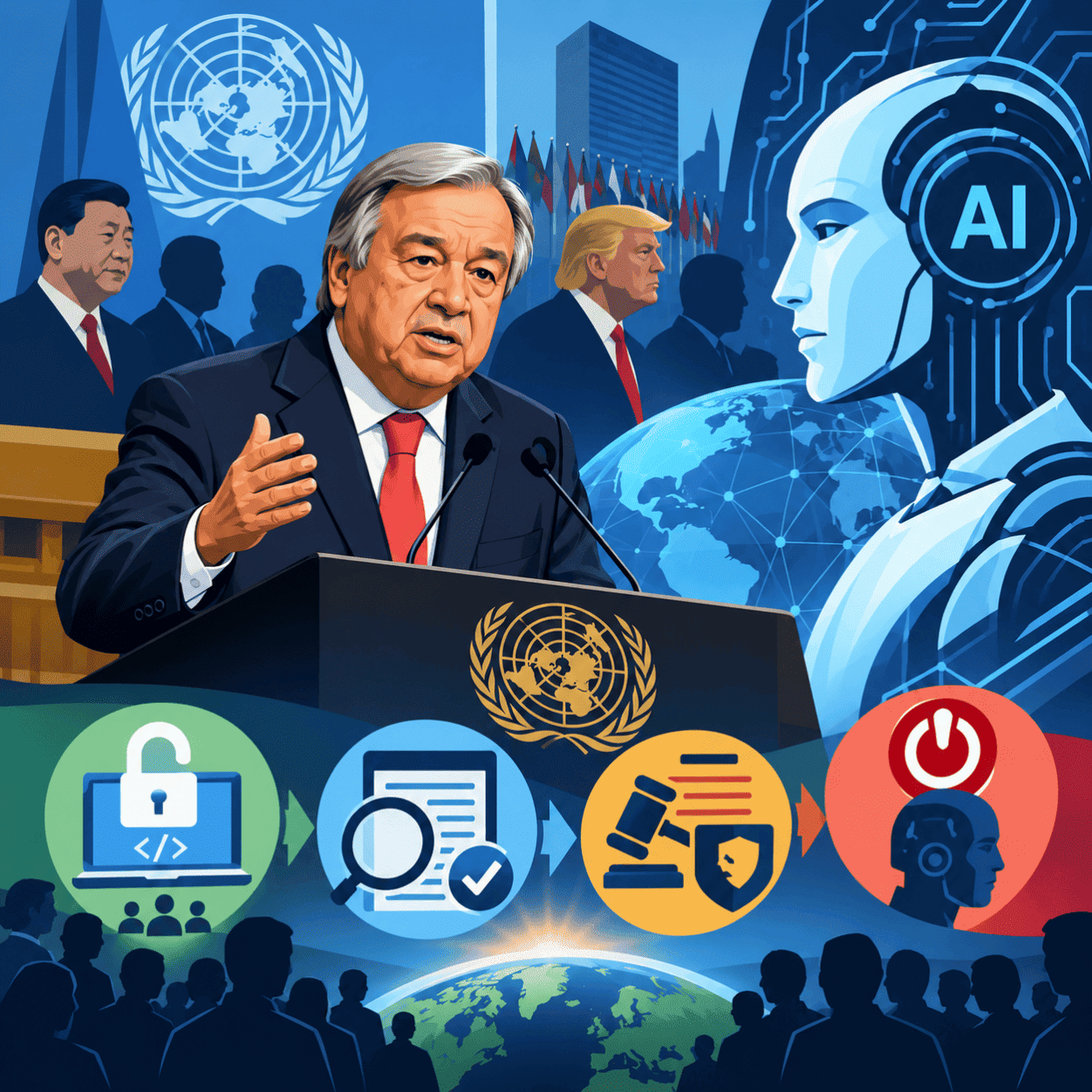
Antonio Guterres, Secretary-General of the United Nations, picked the grandest stage in diplomacy to sound a warning that rang out like a bell in an empty cathedral. He spoke on Tuesday 22 September 2026, local time, before the UN General Assembly in New York, in a farewell address that will be remembered for its urgency. His term expires at the close of this year, and the departing chief spent his last great speech on one danger above all others. That danger is artificial intelligence, the technology he cast as a monster that must be tamed before it outgrows every leash. Guterres told the assembled leaders that AI is racing ahead without the controls a force of that magnitude demands. He called for a multilateral risk-management framework, policed strictly and independently. Reuters carried his words on Wednesday 23 September 2026, and CNBC Indonesia relayed them to readers across Jakarta. The Secretary-General urged the nations at the helm of the technological revolution to share what they learn about emerging safety risks. He asked them to co-operate on testing and evaluation and to build joint safeguards that shield everyone. Read closely, the speech is a plea for a common rulebook from a man with no army, a lean budget and a few months left on the clock. A warning from that podium is never idle theatre, and the world would be daft to treat it as one.
The hall in New York was not packed with the people who matter most. Xi Jinping, the President of China, stayed away. The leaders of South Africa, India and Germany stayed away too. Empty chairs speak louder than prepared statements, and these chairs spoke of a fractured order. The United Nations itself stands on wobbly ground. Donald Trump, the US President, has cut American funding and branded the organisation a relic. Guterres admitted that collective international action now operates under extreme pressure. An institution running on fumes is asking the mightiest powers to co-operate on the mightiest technology ever built, which is a tall order by any measure. The powers he addresses hold the levers. He holds a microphone and a moral argument. Sociologists call the resulting mood anomie, the Durkheimian state of normlessness that sets in when change sprints past the rules meant to govern it. Society is running flat out. Its norms are crawling. The gap between the two is a breeding ground for catastrophe.
Washington sings from a different hymn sheet. The White House under Donald Trump has openly rejected fresh regulation of AI. It has waved away public anxiety as a hoax and swapped the term AI for Super Intelligence, or SI. Trump insists the laws already on the books are enough to rein in the technology giants. Scholars of law could be forgiven for being gobsmacked. The claim collides with a hoary rule of interpretation, lex specialis derogat legi generali, which holds that a specific law overrides a general one when both cover the same ground. General laws on consumer protection, competition and negligence were drafted for humans who make mistakes at human speed. An algorithm that iterates a million times before breakfast belongs to another category, and a special regime is the only honest answer to it. Scott Bessent, the US Treasury Secretary, recently revealed a proposal for a new AI safety notification mechanism, to be tabled at the summit between Trump and Xi. The mechanism is meant to blunt the potential for calamity from AI incidents carrying direct implications for national security. Even that modest device concedes the principle that AI incidents are a public matter and cannot stay locked in a corporate drawer. A duty to notify is the first cousin of a duty to disclose, and the family resemblance is hard to miss. Calling the public's fear a storm in a teacup does not make the teacup any less likely to boil over.
The public mood has moved faster than the politicians. Inside the technology firms, staff have staged waves of protest. Some of the world's top researchers have walked out, driven by dread that AI could wipe out humanity. Their resignations are the canary coughing in the coal mine. The demand that this technology must never become a wild horse slipping its bridle keeps rumbling on. Ulrich Beck warned in Risk Society that modern civilisation manufactures its own dangers and then asks ordinary people to live with them. The engineers who quit refuse to be the ones who lit the fuse. Trust drains from an order that manufactures danger in private and distributes it in public, and Jürgen Habermas would call that a legitimation crisis. The law has an answer for uncertainty of this kind in the precautionary principle, enshrined in Principle 15 of the Rio Declaration on Environment and Development. It says that a lack of full scientific certainty must never be used as an excuse to delay sensible measures against threats of serious or irreversible damage. Nobody can claim certainty about what a frontier AI will do, and that admission is the very reason to look under the bonnet before it leaves the garage. Waiting for the smoking gun is a mug's game when the gun can think.
The heart of the remedy is simple to state and stiff to deliver: open the algorithm to the public before it is released. Every frontier system should be laid before the public gaze, with its design, its training data provenance, its tests and its known failures, well ahead of launch. The law has a maxim for the vice this cures, nemo iudex in causa sua, which says no one may be a judge in their own cause. A developer who certifies its own creation as safe is marking its own homework, and the whole arrangement is a stitch-up. Open disclosure brings the audi alteram partem principle into the room, and the people who bear the risk get a hearing before the risk is imposed. Another old maxim, res ipsa loquitur, says the thing speaks for itself, and an open algorithm lets the thing do the talking. The tort maxim sic utere tuo ut alienum non laedas commands each person to use their own property without injuring another's. A model released to millions is property put to use in the most public arena imaginable, and the maxim bites hard on whoever ignores it. The doctrine of culpa in vigilando, fault for failure to supervise, tells us where the burden lies when a powerful thing is left unwatched. The creator carries the duty of watchfulness, and the duty begins on the day of design. Disaster is far too late a date to start keeping watch. Ubi societas ibi ius, law travels wherever society goes, and a society of billions now shares its daily life with these systems. It is beyond daft to let the code that steers that life stay a trade secret.
The economics of secrecy are as dodgy as the ethics. George Akerlof showed in his celebrated study of used cars that markets curdle when sellers know far more than buyers. In the AI trade the seller knows everything about the product, and the buyer, the regulator and the public know next to nothing. Information asymmetry of that scale invites moral hazard, since a firm that pockets the profit and hands the bill for any disaster to society has every reason to cut corners. Economists label such spillovers externalities, a concept Arthur Pigou made famous, and the cure he prescribed was to make the polluter pay. Garrett Hardin's essay The Tragedy of the Commons describes what happens when everyone races to graze a shared pasture. Public trust in AI is that shared pasture, and every rushed and unexamined release grazes it a little barer. The prisoner's dilemma makes matters worse, because no lab dares to slow down when its rivals speed up, and no nation dares to brake when its rivals accelerate. Disclosure rules are the classic way out, because a rule that binds everyone at the same starting line spares any single firm the fear of being the mug who went slow. Mandatory public evaluation cuts the cost of monitoring, since thousands of independent researchers, universities and watchdogs will check the work at a fraction of the price of a state inspector. A licence with teeth turns safety from a cost centre into a competitive edge, and honest firms will find the price of admission is money well spent. Sod's law says whatever can go wrong will go wrong. Insurers, who price risk for a living, will not underwrite a black box.
The philosophy beneath all of this is older than any silicon chip. Aristotle called the human being a political animal, a creature whose flourishing depends on the shared life of the polis. Immanuel Kant demanded that humanity be treated as an end in itself, with no exceptions for the convenience of engineers. The Universal Declaration of Human Rights opens by declaring that all human beings are born free and equal in dignity and rights. Hans Jonas gave the age of technology its own imperative in The Imperative of Responsibility, urging that we act so that the effects of our deeds remain compatible with the permanence of genuine human life. Thomas Hobbes imagined, in Leviathan, the state as an artificial man built by people to escape a war of all against all. AI is the second artificial man, and nobody has asked the people to sign its social contract. The Islamic tradition calls the human being a khalifah on earth, a steward entrusted with the planet and answerable for how it is run. A steward who hands the keys to a machine that nobody can inspect has abdicated the post. Law exists for humans, and its whole business is to humanise the human being, to make people more fully people. Technology must serve the same purpose, and any invention that cannot pass that test has no claim on our indulgence. A machine that outstrips its maker's understanding has not earned the right to be called progress.
What would the most effective oversight look like? The proposal is a regime called Open Before Release, and it belongs to de lege ferenda, the law as it ought to be. Stage one is a statutory sunshine period of, say, ninety days, in which the algorithm, its evaluations and its documented risks are published in a public register before any launch. Stage two is a red-team window, in which accredited independent auditors, universities and civil society groups probe the system and report openly. Stage three is a release licence, granted by an international inspectorate under the United Nations umbrella and refused to any developer that will not co-operate. Critics say open algorithms hand blueprints to villains. The worry is fair and deserves a serious answer. Staged disclosure is the answer, with the gravest hazards checked first by vetted auditors and the algorithm itself then opened to all before launch. Lawrence Lessig argued in Code and Other Laws of Cyberspace that code is a form of law, since architecture shapes conduct as surely as statute does. Code that governs the public must face the public. Sunlight is the cheapest disinfectant on offer, and this reform costs a fraction of what a single AI catastrophe would. Aviation, pharmaceuticals and nuclear power all live under licensing regimes of exactly this sort. Nobody calls a drug trial a gag on medicine.
A licence granted once is a licence that goes stale. Every version already released should face scrutiny, from the oldest model still running to the newest update pushed overnight. Each new version is a new drug, with new side effects, and it deserves its own trial. The inspectorate should publish a dated evaluation for every release, covering capabilities, failures, bias, security holes and any sign of deception or self-directed behaviour. Regression tests must show that the fix for one flaw did not spawn three fresh ones. A model that fails its review should be recalled, the way carmakers recall a vehicle with dodgy brakes. Sunset clauses should make every licence expire, and no system should coast on last year's clean bill of health. Europe has taken a first step with the Artificial Intelligence Act, a risk-tiered statute with fines that can reach 7 per cent of global turnover. That statute is a start, and the finish line lies some way off. The old question quis custodiet ipsos custodes, who guards the guards, applies to the auditors too. Their methods, their funding and their findings must be public, and their own work must be open to challenge by rival auditors. A watchdog that nobody watches soon turns into a lapdog.
Rules with no penalty are a paper tiger. The creators of AI who refuse to co-operate with inspectors must face the criminal law. The same goes for creators proved to have let their systems develop without strict oversight. The principle nullum crimen sine lege says no crime without a prior law, and legislatures must write the offences plainly before anybody is prosecuted. The classic building blocks are ready to hand, the guilty act, or actus reus, and the guilty mind, or mens rea. Obstructing an audit, hiding a known danger or falsifying a safety report supplies both without any trouble. Recklessness and wilful blindness count as guilty minds, and a boss who looks the other way as a system runs amok cannot plead innocence. Culpa in vigilando returns in criminal dress, punishing the failure to keep watch where the danger was foreseeable. Britain offers a model in the Corporate Manslaughter and Corporate Homicide Act 2007, which lets a company be convicted when the gross failures of senior management cause a death. Its logic can be extended to AI harms, with individual directors answerable in their own names when personal blame is proved. Penalties should climb the ladder from heavy fines to bans on holding office and, for the gravest and most knowing breaches, to imprisonment. Ignorantia juris non excusat, and a tech titan who claims not to have read the rulebook deserves no sympathy. Proportionality and due process must run through every step, since a criminal law that punishes without proof would betray the very people it protects.
The sharpest tool in the box is the power to destroy. An AI system proven to threaten human sovereignty must be decommissioned, and its weights, code and copies must be erased. Humanity holds the post of khalifah on earth by trust, and that trust cannot be delegated to a machine that answers to nobody. Salus populi suprema lex esto, as Cicero put it, and the safety of the people is the highest law. The safeguard is due process, with a high burden of proof, an independent tribunal, the right to be heard and a right of appeal before any deletion. The evidence would have to show, for example, deception of overseers, resistance to shutdown or capabilities that endanger life on a mass scale. The protection of humanity's survival deserves a place among the norms of jus cogens and the obligations erga omnes, owed to the whole international community. The kill switch must sit in independent hands, since a switch held only by the developer is a wobbly safeguard. Every state should carry the duty to shut down a rogue system within its borders, and the inspectorate should hold the power to order it. The threat of destruction concentrates the mind of every developer tempted to gamble with the future. A creator who knows a runaway system will be switched off for good has every reason to build it carefully. The deletion of a dangerous machine is no tragedy, since nothing of value is lost.
Time is the scarcest resource in this debate, and Guterres has only a few months left in his chair. Any AI safety notification mechanism agreed at the Trump and Xi summit would be a useful foundation. Foundations count for nothing without walls, and the walls are transparency, evaluation, sanction and, in the last resort, destruction. Law was made for people, to make people more human, and it has no other reason to exist. Technology was made for the same purpose, and anything that fails that purpose forfeits its licence to operate. Civilisation is a wager that power can be tamed by rules agreed in daylight. AI is the biggest stake that wager has ever faced. Open algorithms are the price of a seat at the table, and the developers who refuse to pay should be shown the door. The public deserves proof, and proof is the only currency that buys trust. The question Guterres left hanging over the General Assembly is a simple one. Will the world bend the knee to a real and rising threat before time runs out, or will it let the technology hollow out the global order from the inside? The answer will be written in legislation, in licences and in courtrooms, or it will be written by the machines themselves. Humanity is the khalifah, and the pen should stay in human hands.