
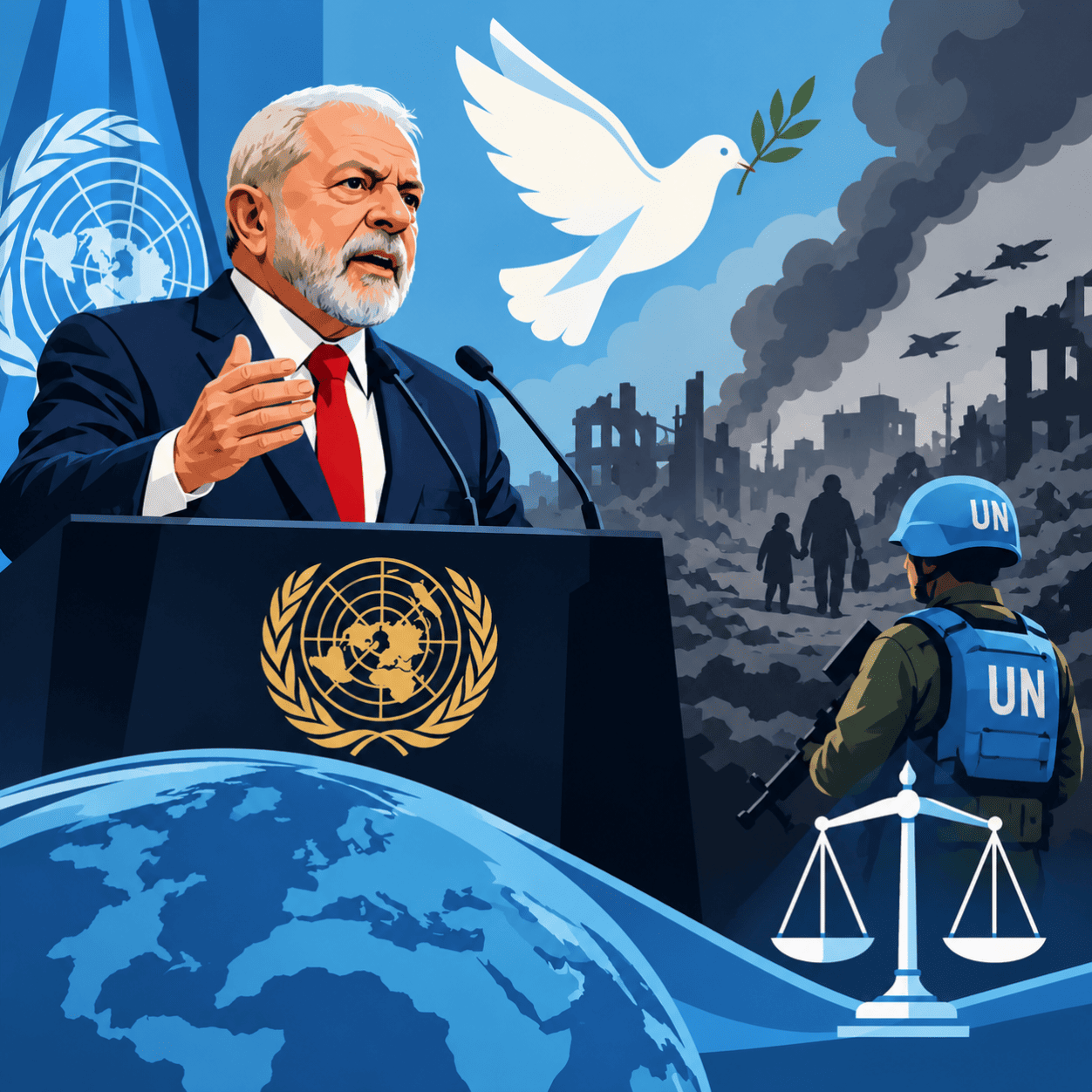
Luiz Inácio Lula da Silva stepped before the United Nations General Assembly in New York on 22 September 2026 with a message that carried the weight of frustration rather than ceremony. The Brazilian president was opening his tenth general debate since first taking the podium in 2003. He described the United Nations as facing one of its most critical moments since its creation. Lula said the organisation had failed in one of its central missions, freeing humanity from the suffering produced by war. His remarks placed the credibility of multilateralism under a harsh spotlight. The setting was the General Assembly Hall during the opening of the 81st session. The official programme placed the general debate between 22 and 26 September and again on 28 September. Lula’s criticism therefore arrived at a moment when governments were gathered precisely to discuss whether the international system can still deliver meaningful collective action. His argument was blunt, human-centred and deeply political. The basic question hanging over the chamber was rather stark, what is the value of an international organisation if armed conflict can continue while diplomatic machinery struggles to stop it.
Lula argued that humanity has become hostage to the failure of the Security Council to fulfil its responsibilities. That accusation goes straight to the institutional heart of the UN system. The Security Council holds the primary responsibility for maintaining international peace and security under the Charter. Article 39 empowers the Council to determine whether a threat to the peace, breach of the peace or act of aggression exists. Articles 41 and 42 provide a ladder of possible measures ranging from economic and diplomatic restrictions to military action. The legal architecture therefore contains enforcement mechanisms that reach far beyond speeches and resolutions. The difficulty lies in political authority, collective agreement, operational capacity and the willingness of states to place military resources at the disposal of the organisation. Article 43 envisages member states making armed forces and facilities available through special agreements. Article 47 assigns strategic responsibilities to the Military Staff Committee for forces placed at the Council’s disposal. On paper, the machinery has considerable muscle. In practice, the system has historically depended heavily upon the political will of states and the decisions of the Council. That gap between legal design and institutional performance is one reason Lula’s criticism resonates beyond Brazil.
There is a powerful legal distinction between peacekeeping and peace enforcement that matters enormously here. Traditional UN peacekeeping rests upon consent of the parties, impartiality and the non-use of force except in self defence or defence of the mandate. The organisation itself states that peacekeeping operations are not enforcement tools. Robust peacekeeping can receive authorisation to use force for specific purposes such as protecting civilians or deterring attacks against a political process. Peace enforcement under Chapter VII operates on a different legal footing and can involve military force at the strategic or international level without the consent of the parties. This distinction makes the proposal for genuinely empowered international forces legally imaginable within the Charter system under appropriate Security Council authorisation. It does not make every proposed intervention automatically lawful. Any mandate would require carefully defined authority, objectives, geographical limits, rules of engagement and accountability mechanisms. The doctrine of ultra vires would become highly relevant if an international force exceeded the authority granted to it. The maxim fiat justitia ruat caelum also captures an enduring legal aspiration, justice must remain meaningful even when political circumstances become uncomfortable. A serious reform debate therefore needs to ask how force can be authorised without allowing the language of peace to become a blank cheque for military intervention.
The idea of giving an international peace force genuine capacity to disarm an aggressor state deserves careful examination as a possible institutional reform. Such a force would require a mandate capable of stopping continuing attacks rather than merely observing them. It could, under an appropriately authorised Chapter VII framework, receive powers to neutralise specified military capabilities used in an aggression. Its mandate could also include protecting the attacked state from further assault. A separate element could restrain retaliatory operations by the victim state when those operations exceed the limits recognised by international law. Such a system would seek to break the cycle in which one armed attack generates another and another. Yet Article 51 of the Charter preserves the inherent right of individual and collective self defence when an armed attack occurs. The International Court of Justice has also treated necessity and proportionality as central requirements governing lawful self defence. Any international mechanism designed to restrain retaliation would therefore need to preserve the victim state’s existing legal rights while providing an effective collective security response. The policy challenge is to create a force strong enough to stop aggression while keeping its own power legally controlled. That is a very different proposition from giving an international army unlimited authority to decide who deserves military punishment.
Such a force would also raise a difficult question about command. A military organisation capable of disarming states would need an unmistakable chain of authority. Troops could not be left guessing whether a political resolution carried operational consequences. The Security Council would need a system capable of translating legal decisions into rapid military orders. Article 47 already contemplates a Military Staff Committee dealing with military requirements, command questions and strategic direction. Article 45 also refers to immediately available national air force contingents for urgent international enforcement action. These provisions show that the Charter contains concepts resembling a collective military capacity. The missing piece is a fully operational standing system with predictable resources and political authority. Such a structure could require permanent multinational units, common training, integrated logistics and agreed rules for the use of force. It would also require transparent oversight so that military power remained subordinate to law. The old maxim nullum crimen sine lege belongs to criminal law, yet its deeper instinct remains useful here, coercive power requires clear legal boundaries. Without those boundaries, a peace force could become another source of insecurity rather than a safeguard against it.
The sociological question is just as serious as the legal one. War does not remain confined to front lines marked on military maps. Families lose homes, children lose schools, workers lose livelihoods and communities lose the social trust needed to rebuild. Displacement can fracture neighbourhoods and place enormous pressure on receiving societies. Public institutions can become associated with fear when citizens see armed power operating without effective protection. A credible international force could potentially alter those social calculations by making aggression materially harder to sustain. Its legitimacy would depend on whether ordinary people saw it as protection rather than occupation. That is why impartiality matters so much in UN peace operations. The UN itself warns that impartiality must not be confused with inactivity. A peace operation can apply its mandate firmly while maintaining a principled relationship with the parties. Social legitimacy would be destroyed if communities came to believe that international troops served the strategic interests of a particular bloc. The real test would be whether people living under the shadow of war could look at the blue helmet and think, this means safety, rather than here comes another army.
The economic consequences of prolonged warfare add another layer to Lula’s complaint. Armed conflict burns public money at extraordinary speed while destroying productive capacity that took decades to build. Roads, ports, power networks, hospitals, schools and factories can become military targets or collateral damage. Businesses face disrupted supply chains, higher insurance costs and unstable access to markets. Governments then divert scarce fiscal resources towards military expenditure and emergency relief. The opportunity cost can be brutal. Money that could support education, healthcare, housing and infrastructure is channelled into weapons, mobilisation and reconstruction. A credible collective security mechanism could potentially reduce those costs if it succeeded in deterring interstate aggression or bringing wars to an earlier close. The economic case for peace therefore reaches far beyond humanitarian sentiment. Stability allows capital, labour, trade and public institutions to operate with greater predictability. From that angle, spending on credible international security may be viewed as a form of preventive investment rather than a luxury. The catch is that a standing international force would itself require substantial and reliable funding, which means member states would have to confront the bill rather than waving a diplomatic wand and hoping the numbers sort themselves out.
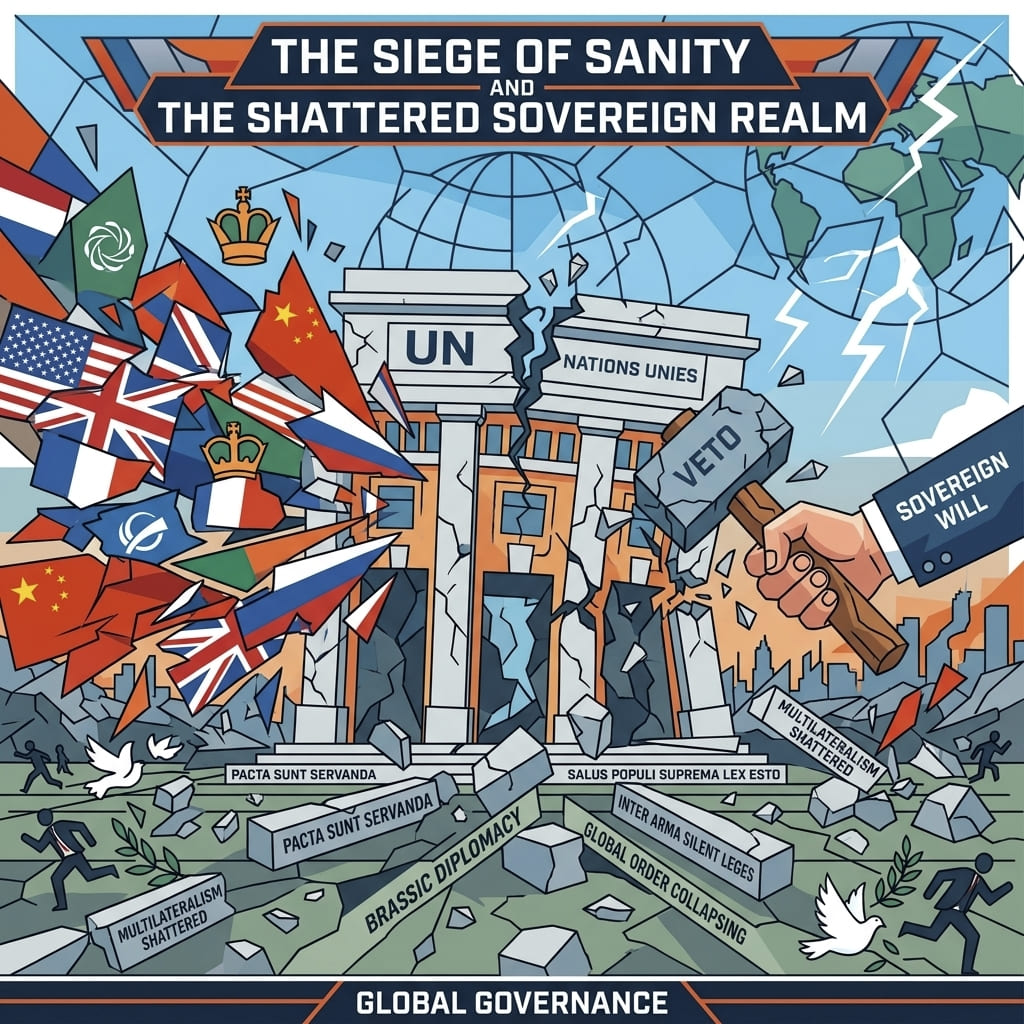
There is also a philosophical question hiding beneath all the machinery. What does a civilisation owe to human beings when states choose organised violence? International law was built around the idea that sovereign power cannot be entirely detached from obligations. The Charter emerged from the devastation of the Second World War and sought to establish a system in which force would face collective restraints. The UN General Assembly President in 2026 described the organisation as imperfect yet irreplaceable while warning that people outside the UN walls are asking whether it works. That tension goes straight to the moral foundation of multilateralism. A civilisation that can send spacecraft across oceans of darkness can also decide whether human beings should keep destroying one another with increasingly sophisticated weapons. The phrase pacta sunt servanda reminds states that international commitments are meant to be honoured. The broader philosophical principle is even simpler, human life should not become cheap merely because governments disagree. Peace is therefore more than the absence of gunfire. Peace represents the institutional choice to make human cooperation more valuable than perpetual armed competition.
Lula’s remarks also fit a wider moment of concern about the effectiveness of the international order. At the opening of the same General Assembly debate, UN Secretary General António Guterres described deepening global fault lines and prolonged wars with devastating consequences. He referred to attacks on civilians, violations of human rights and the weaponisation of hunger. He also pointed to widening geopolitical divisions and declining trust. Those remarks provide an important institutional backdrop to Lula’s criticism. The Brazilian president was not speaking into an empty room. He was addressing an organisation whose own leadership was publicly acknowledging serious pressures on international cooperation. The question is how those pressures should be answered. One route involves strengthening diplomacy, mediation, humanitarian action and existing peace operations. Another involves structural reform of the Security Council and its decision making. A further proposal involves developing more credible collective enforcement capabilities for situations where aggression threatens international peace. None of those routes is free from legal, political or financial complications. The debate deserves straight talking rather than diplomatic theatre because the human cost of institutional paralysis is measured in lives rather than press releases.
A genuinely empowered international peace force would need safeguards against abuse as carefully as it would need military strength. Its mandate would need to identify the triggering conditions for intervention with precision. The legal basis would need to come from the Charter and a properly constituted decision by the competent UN organ. Its commanders would require rules that distinguish military objectives from civilians and that impose necessity and proportionality requirements. Independent investigations would be needed where personnel allegedly breached international law. Member states would need to know how troops are recruited, funded, disciplined and withdrawn. Victim states would need assurance that collective protection does not erase their lawful rights. Aggressor states would need a clear legal route back towards compliance rather than facing an open ended programme of punishment. Civilians would need effective mechanisms for reporting misconduct and seeking remedies. This is where the doctrine of the rule of law becomes crucial, ubi jus ibi remedium, where there is a right there should be a remedy. A force created to defend civilisation cannot credibly operate through methods that undermine the very legal order it claims to protect.
The deeper lesson from the debate is that peace requires institutions capable of acting before violence becomes normalised. Lula’s complaint places the credibility of the United Nations against the lived reality of people trapped by war. The Charter already provides legal routes for sanctions and, under defined conditions, collective military action. The UN already operates peacekeeping missions whose personnel carry dangerous responsibilities in conflict zones. Yet traditional peacekeeping was never designed to function as a standing world police force capable of imposing military defeat upon an aggressor. A new model would therefore require political agreement, treaty practice, funding, operational planning and legal safeguards. The proposal to disarm an aggressor while preventing uncontrolled retaliation could form part of that debate if it respected the Charter and the law of self defence. The aim would be deterrence, civilian protection and restoration of lawful peace rather than permanent military confrontation. Human civilisation has already demonstrated that cooperation can produce science, trade, medicine, culture and institutions on a staggering scale. Spending endless resources on wars between human beings is a spectacularly poor use of that civilising capacity. The phrase si vis pacem para pacem offers a useful inversion of the ancient maxim, if you want peace, prepare for peace. The real challenge for the United Nations is whether its members are willing to give that principle enough legal authority, political courage and practical muscle to make peace more than a nice line in a speech.