

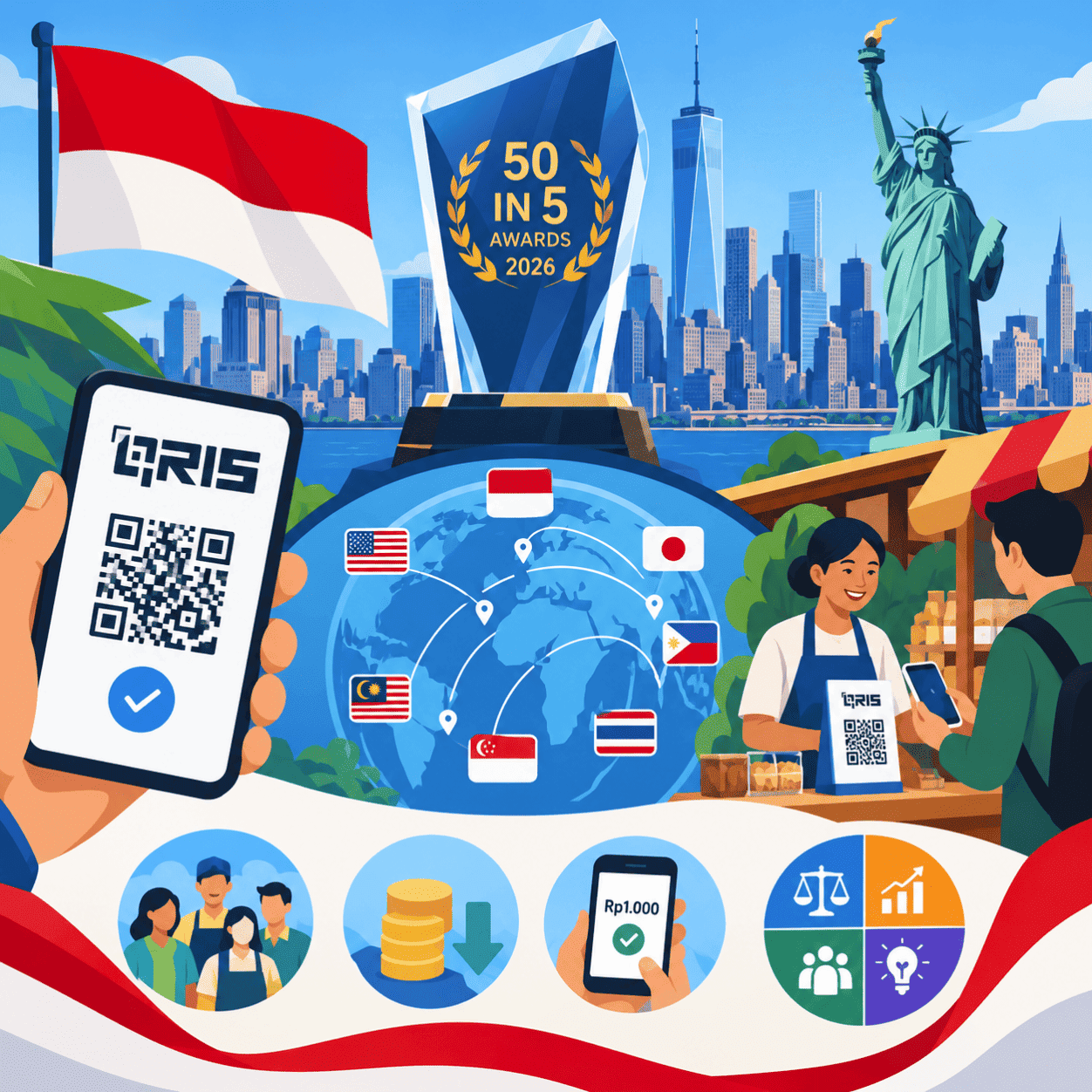
Indonesia's home grown payment invention has just bagged itself a rather smashing trophy on the world stage. On Monday, 21 September 2026, Bank Indonesia's Deputy Governor, Filianingsih Hendarta, stood proudly in New York to collect the 50-in-5 Awards 2026 in the Collaboration category on behalf of the entire archipelago. The gong was handed over by Lindsey Crumbaugh, Chief Investment Officer at Co-Develop, during the 50-in-5 Milestone Event staged alongside the 81st session of the United Nations General Assembly, widely known as UNGA 81. Quick Response Code Indonesian Standard, the payment system every Indonesian now taps and scans without a second thought, has officially been crowned a global public good worth shouting about. The award recognised the cross border version of the system, dubbed QRIS Antarnegara, for stitching together payment networks across several nations without forcing anyone to rip up their own domestic infrastructure. Given the fanfare, it is fair to say the invention has gone from a local convenience to a properly international calling card for the country. Filianingsih herself did not mince her words, declaring that genuine interoperability never demands identical systems, only a shared purpose, mutual trust and agreed standards binding separate networks together.
The 50-in-5 Awards 2026 sits inside a wider push run by the Digital Public Goods Alliance together with Co-Develop, a campaign built to help fifty nations design, launch and scale safe, inclusive and interoperable digital public infrastructure before 2028. Winning the Collaboration category places Indonesia among the small clique of countries whose payment architecture is judged genuinely capable of crossing borders without losing its soul. Judges rewarded partnerships managing to implement or expand digital public infrastructure in a way other nations can realistically copy. Bank Indonesia did not build this alone, roping in the government, the Indonesian Payment System Association known as ASPI, domestic payment industry players and the authorities plus payment industries of every partner nation involved. Six partner nations already sit inside the QRIS Antarnegara family, namely Thailand, Malaysia, Singapore, Japan, South Korea and China. Each partnership required patient negotiation, technical calibration and a fair dollop of diplomatic charm, given every partner nation guards its own payment rulebook rather jealously. The trophy, in short, rewards years of unglamorous plumbing work finally paying off on a rather glamorous stage.
Peering under the bonnet, QRIS itself is built on the EMVCo international standard, the same open architecture used by card networks worldwide, adapted specifically to suit Indonesian conditions and later stretched to suit its neighbours too. Its legal skeleton rests on Peraturan Bank Indonesia Nomor 20/6/PBI/2018 concerning electronic money and Peraturan Anggota Dewan Gubernur Nomor 21/18/PADG/2019 concerning the implementation of the national Quick Response Code standard, with consumer safeguards bolted on through Peraturan Bank Indonesia Nomor 22/20/PBI/2020. Three flavours of transaction exist under this single umbrella. Static Merchant Presented Mode lets a tiny warung display one printed QRIS sticker, the customer scans it, types the amount, punches in a PIN and taps pay, a set up so cheap and cheerful that micro traders adore it. Dynamic Merchant Presented Mode flips the script slightly, letting an EDC machine or a cashier's till generate a fresh code for every single transaction, a rig better suited to busier shops and mid sized retailers. Customer Presented Mode goes the other way entirely, with the shopper flashing a code straight from their own payment app for the merchant's scanner to gobble up, a method beloved by transport operators, car parks and modern retail chains chasing speed above all else. Money moving through any of these three lanes need not even come from a bank account, since QRIS happily draws on electronic wallets, debit facilities, credit lines or server based electronic money, making the standard a channel rather than a single type of account.
Numbers rarely lie, and the figures behind QRIS Antarnegara make for properly impressive reading. Since the cross border scheme first went live in 2022 through to July 2026, foreign visitors using their home country apps inside Indonesia racked up 21 million transactions worth Rp5.90 trillion. Indonesians travelling the other way, tapping their own apps at merchants in partner nations, managed 4.67 million transactions worth Rp1.73 trillion across the same stretch. Do the maths and inbound spending from tourists outstrips outbound spending by Indonesians by a full Rp4.17 trillion, a gap that flatters the nation's tourism and trade accounts rather nicely. Foreign holidaymakers clearly find scanning a familiar app at an Indonesian street stall far less daunting than fumbling with unfamiliar cash, and the figures back that hunch up handsomely. Every rupiah earned this way lands as fresh foreign exchange without a single note physically crossing a border, a quietly elegant bit of monetary alchemy. Bank Indonesia will fancy this data as solid proof that connectivity, done properly, pays its way rather than simply looking good on a press release.
Domestic reach only sweetens the cross border story further. By July 2026, QRIS had spread its tentacles across 45.46 million merchants nationwide, with a whopping 96.69 per cent of them classed as micro, small and medium enterprises, the backbone of Indonesian commerce commonly shortened to UMKM. A street vendor flogging fried snacks from a rickety cart can now welcome a Japanese tourist's yen denominated wallet or a Korean visitor's won backed app without installing a single extra gadget or opening a foreign bank account. Sociologically, this is precisely the sort of abstract system sociologist Anthony Giddens described as disembedding trust from face to face relationships and relocating it inside standards, licences and institutional guarantees, letting a Jakarta noodle seller and a Tokyo salaryman transact with total confidence even when neither speaks a word of the other's language. Cash once acted as the great social leveller, and a QR sticker now performs a strikingly similar democratic trick while adding speed and traceability into the bargain. Financial inclusion, long treated as a lofty policy goal gathering dust in speeches, quietly becomes lived reality every time a becak driver or a night market grill master accepts a scan instead of turning a customer away for lack of small change. Small traders gain access to a payment infrastructure once belonging exclusively to shopping malls and department stores, closing a social gap decades of banking policy alone struggled to shift.
Lawyers examining the scheme tend to land on a fairly settled conclusion regarding the nature of a QRIS transaction. The relationship binding a customer, a merchant and the various payment service providers, known formally as Penyelenggara Jasa Sistem Pembayaran, rests firmly on civil law footing born from a cluster of agreements rather than any single unified contract. Every provider wishing to plug into the network must first secure Bank Indonesia's blessing under the licensing conditions spelled out inside the governing PADG regulation, a gatekeeping function designed to keep rogue operators well away from the public's money. This licensing regime echoes the old legal maxim pacta sunt servanda, agreements must be honoured, since each provider effectively signs up to a chain of binding obligations the moment it joins the standard. Consumer protection rules layered on top guarantee redress mechanisms should a transaction misfire, aligning the scheme with the principle that no financial innovation should outpace the rights of the ordinary person tapping their phone. Regulators clearly favoured a light touch harmonisation model over rigid uniformity, as each partner country retains its own domestic legal architecture and agrees only on the connecting standards, a design choice consistent with the doctrine of lex specialis derogat legi generali, whereby a specific technical standard governs the specific transaction it was built for without disturbing each nation's broader payment law. Sovereignty, put plainly, survives the handshake perfectly intact.
Viewed through the lens of Law and Economics, QRIS reads almost like a textbook illustration of Ronald Coase's teachings on transaction costs. Before a unified standard existed, merchants juggled a pile of competing QR stickers from rival providers, forcing customers to hunt for the right logo before paying, a friction that quietly taxed every single sale with wasted time and confusion. A single interoperable standard collapses that friction toward zero, letting supply and demand meet with barely any transactional drag, precisely the efficient outcome Coasean bargaining predicts once obstacles to exchange get cleared away. Regulatory design in this scheme behaves as an efficient rule allocating rights and duties among providers, merchants and customers in a manner that lowers total social cost rather than simply shifting cost from one party onto another. Perhaps the most striking economic feat sits in QRIS's ability to process transactions worth as little as Rp1,000, a threshold so low that even the humblest purchase, a single fried banana or a cup of iced tea, can be settled cashlessly without punishing the buyer with fees dwarfing the purchase itself. Conventional card networks abroad routinely impose minimum spends or flat fees that make micro payments commercially pointless. Indonesia's own invention smashed that barrier flat, turning welfare economics from theory into something a street hawker can literally bank on daily. A rule that cheap and that inclusive amounts to genuine market design in service of the little person, a proper policy achievement rather than a footnote buried inside a central bank circular.
Step back far enough and QRIS starts to look like applied moral philosophy dressed up as fintech plumbing. Jeremy Bentham's old utilitarian yardstick, chasing the greatest happiness for the greatest number, finds an oddly perfect modern illustration in a system letting tens of millions of tiny traders and shoppers each gain a sliver of convenience that adds up to a genuinely national uplift in welfare. Filianingsih's own words about connecting systems in order to connect people echo the Latin notion of bonum commune, the common good, an ideal older than any central bank yet perfectly suited to a payment rail crossing six countries and counting. John Rawls might have nodded approvingly too, given a standard so cheap that even a Rp1,000 transaction clears without punitive charges tilts fairness toward exactly the sort of least advantaged trader his theory of justice was built to protect. Technology refuses to remain a neutral tool, instead becoming a quiet instrument of social justice every time it lets a pavement vendor compete on equal footing with a glitzy shopping mall. National pride and universal ethics rarely line up so neatly. Even so, QRIS lets Indonesians feel properly chuffed about an invention that also happens to tick every box a moral philosopher could reasonably demand. Few pieces of financial infrastructure anywhere can claim to be a diplomatic triumph, a legal marvel and a philosophical case study all in one, and Indonesia's QR code now rather cheekily claims all three titles.
Bank Indonesia has already signalled where the next chapter heads, promising to keep widening QRIS Antarnegara toward nations sharing strong economic, trade, tourism and people to people ties with Indonesia. Getting the standard properly embraced by the wider world demands several concrete moves rather than warm words alone. Harmonising licensing procedures with each new partner regulator needs to happen faster, trimming the paperwork currently slowing every fresh country from joining the club. Payment providers on both sides require stronger incentives, financial and reputational, to enable Customer Presented Mode widely rather than leaving dynamic QR features locked behind unfinished product roadmaps. Digital literacy campaigns aimed at both merchants and tourists would help spread confidence in scanning unfamiliar codes, particularly among older traders still wedded to cash under the till. Cybersecurity safeguards must scale in lockstep with adoption, since a payment rail this popular becomes an irresistible target for fraudsters the moment it becomes ubiquitous. Pulled off properly, a humble QR code born from Indonesian ingenuity stands a genuinely fair chance of becoming the template the rest of the developing world borrows wholesale, proof that a Rp1,000 street snack and a UN General Assembly stage can, rather remarkably, share the very same piece of clever plumbing.