
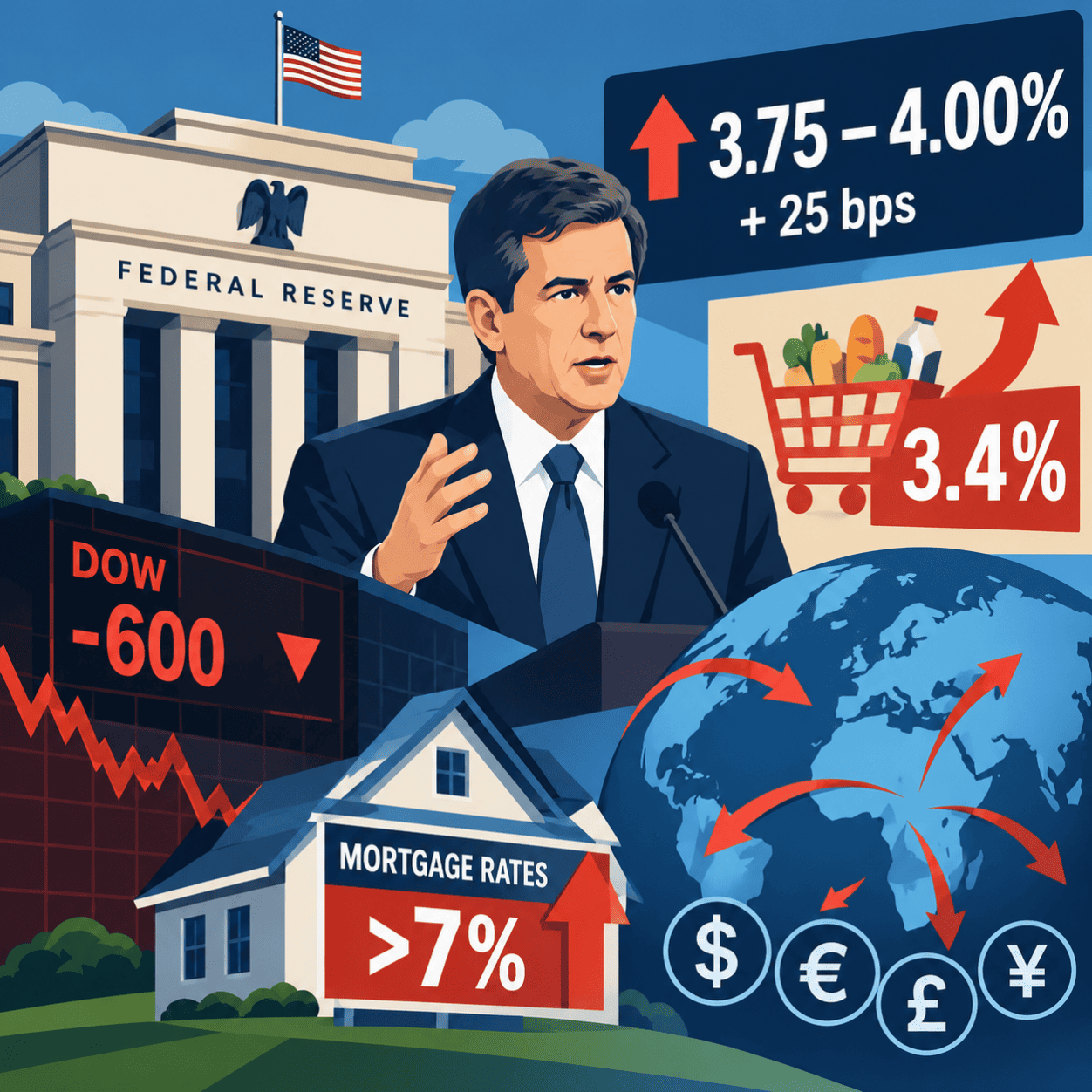
Washington got a proper jolt on Wednesday, 16 September 2026, when the Federal Reserve announced a twenty five basis point hike to its benchmark rate, lifting it to a range of 3.75 to 4.00 percent. The decision landed in the small hours of Thursday for anyone watching from Jakarta, following two solid days of closed-door haggling inside the Federal Open Market Committee. It marks the first upward move in borrowing costs since July 2023, breaking a stretch of more than three years in which the world's most powerful monetary authority had either held firm or trimmed rates. Chair Kevin Warsh, fronting his first rate decision since taking the reins, stood before the press and made no bones about the reasoning: inflation remains stubbornly hot, and the Committee is no longer content to sit on its hands and hope the heat fades on its own. The vote itself was unanimous, twelve votes to nil, a rare show of solidarity from a body not always famous for singing from the same hymn sheet. Behind the technical jargon of basis points and dot plots sits a genuinely human story about mortgages getting pricier, pension pots wobbling, and households from Ohio to Surabaya recalculating their monthly budgets. This piece sets out who did what, when it happened, where the decision was thrashed out, and digs into the why and how that the headline numbers alone cannot capture. It also threads through the legal, sociological, economic, and philosophical sinews holding the whole apparatus together, because a quarter-point rate rise is never merely a quarter-point rate rise. There is a doctrine of central banking at play here, a doctrine that stretches back to ex ante debates about credibility and commitment, and it deserves rather more than a passing glance. Readers wanting the full picture, not just the ticker-tape version, ought to stick around for the rest of this account.
Context matters enormously, and the Fed's own recent history reads like a rollercoaster with more dips than a Blackpool fairground ride. Throughout 2025 the Committee kept rates parked at 4.25 to 4.50 percent all the way until August, a period of watchful waiting that frustrated hawks and doves alike in roughly equal measure. September, October, and December of that year brought three consecutive trims, hauling the range down to 3.50 to 3.75 percent as policymakers judged the economy needed a bit of breathing room. From January through July 2026 the Fed sat tight again, holding the line while inflation data and tariff-driven price pressures continued to simmer away in the background. That long pause makes the September 2026 hike all the more striking, a proper about-turn rather than a gentle nudge. Central banks generally loathe whipsawing markets with sudden reversals, preferring instead a steady as she goes approach that lets households and firms plan with some confidence. Warsh's Committee evidently judged that the cost of dithering had grown too steep to bear any longer. Price stability sits at the very heart of the Fed's statutory mandate, a mandate Congress carved out under the Federal Reserve Act, and that mandate carries the weight of salus populi suprema lex esto, the welfare of the people being the highest law, even when the immediate medicine tastes bitter. Warsh told reporters plainly that underlying inflation needs to be moving towards target "clearly and at a sufficient pace," adding that the Committee judged that standard had simply not been met. Such candour from a Fed chair is no small thing, given how carefully these institutions usually guard their language. Households scrolling through the headlines over their morning coffee were left in little doubt that the central bank meant business.
Warsh's framing deserves a closer look, because it reveals a doctrine of central banking that runs far deeper than the arithmetic of interest rates. Price stability, in the classical telling favoured by monetarists from Milton Friedman onwards, functions as the bedrock on which every other economic ambition gets built, from full employment to sustainable growth to a currency people can actually trust. Without that bedrock, contracts become guesswork, savers get fleeced by stealth, and the whole edifice of commercial law starts to wobble, since every promise to pay a fixed sum tomorrow is quietly eroded by rising prices today. Lawyers steeped in the law and economics tradition, the Chicago school crowd chief among them, have long argued that predictable rules beat discretionary tinkering, a debate that traces straight back to the "rules versus discretion" argument formalised by Kydland and Prescott in their work on time inconsistency. Their insight was blunt: a central bank that keeps changing its mind to chase short-term political favour ends up trusted by nobody, and inflation expectations become unanchored precisely because everyone assumes the next promise will be broken too. Warsh's insistence on hard evidence before easing again reads as a direct nod to that doctrine, a refusal to let short-term comfort undermine long-term credibility. Sociologically speaking, the announcement lands hardest on ordinary folk rather than hedge fund managers tucked away in Greenwich or Connecticut, because wage earners feel the squeeze of higher borrowing costs on mortgages and car loans long before any benefit trickles down through slower price growth. Philosophically, there is a distributive justice question lurking beneath the technocratic language, since tighter money disproportionately burdens those already stretched thin, while savers and bondholders often come out rather chuffed. The Fed does not set fiscal policy, and it never should, a separation Congress deliberately baked into the system precisely so that elected politicians cannot lean on the money printer to paper over budget shortfalls. That separation between monetary and fiscal authority is not some dusty formality; it is a constitutional-economic safeguard against the sort of runaway inflation that has toppled governments elsewhere in the world.
The unanimity of that twelve to nil vote deserves rather more scrutiny than most headlines gave it. FOMC decisions rarely arrive without at least a dissent or two scribbled into the minutes, given the Committee draws regional bank presidents and Board governors with genuinely different reads on the economy, from the industrial Midwest to the tech-heavy coasts. A clean sweep signals either a data picture so stark that argument became pointless, or a Chair skilled enough to herd fiercely independent cats into a single pen, and quite possibly both at once. Independence here carries real legal weight, because the Federal Reserve operates at arm's length from the White House and Treasury by design, a structure Congress erected under statute rather than under any presidential whim. The doctrine of central bank independence rests on a fairly simple premise: politicians facing re-election every couple of years have every incentive to juice the economy with cheap money right before polling day, a temptation economists call the political business cycle, and handing that lever to elected officials directly would be asking for trouble. Quis custodiet ipsos custodes, who watches the watchmen, is the obvious retort levelled at any unelected body wielding this much power over ordinary lives, and the honest answer is that Congress retains oversight through hearings, mandate reviews, and the power to legislate change if the Fed ever strayed ultra vires, beyond its lawful powers. That accountability structure is imperfect, sure, yet it beats the alternative of a central bank answerable to whichever party happens to hold the Oval Office that particular Tuesday. Keeping the printing press away from short-term political pressure is precisely the sort of belt and braces arrangement democracies need if they want their currency taken seriously abroad as well as at home. The unanimous vote, read through that lens, looks less like groupthink and rather more like an institution closing ranks to defend its own credibility at a moment when credibility is exactly what markets are testing.
Turn to the dot plot and the forward guidance sharpens considerably, revealing a Committee bracing for further tightening rather than declaring victory and packing up. Sixteen of eighteen officials pencilled in at least one more quarter-point hike before the year runs out, with four of that number eyeing two additional increases for good measure. Only two policymakers reckoned the Fed ought to call it a day after this single move, a distinctly hawkish tilt for a body that had spent much of the prior eighteen months leaning dovish. Warsh himself declined to submit a personal rate projection, a quiet break from tradition that left commentators guessing at his own preferred path, though his public remarks left little room for doubt about his broader stance. Looking further out, the dot plot shows no additional hikes pencilled in for the following years, offering markets a small crumb of comfort, with one trim projected for 2028 and at least one more for 2029. Forward guidance of this sort functions almost like soft law in the monetary sphere, shaping expectations and behaviour without ever carrying the binding force of statute, yet moving markets by hundreds of billions of dollars within minutes of publication regardless. Economists steeped in rational expectations theory would say this is precisely the point: a credible signal about future policy changes present behaviour today, since borrowers and lenders price in tomorrow's rates the moment the dots hit the screen. That mechanism only works, though, if the institution issuing the signal has banked enough trust over decades to be believed, which loops straight back to the independence doctrine discussed above. Break that trust once through political capture or erratic messaging, and forward guidance becomes just noise, a lesson central bankers from Buenos Aires to Ankara have learned the hard way. Warsh's Committee, whatever else one makes of the decision, appears determined not to squander that inherited credibility on its watch.
The inflation numbers underpinning all this paint a genuinely uncomfortable picture for anyone hoping for an easy fix. Headline inflation ran at 3.4 percent year on year as of August 2026, comfortably above the Fed's long-stated 2 percent target and stubborn enough to force the Committee's hand. The quarterly economic projections nudged the Personal Consumption Expenditures price index forecast up to 3.7 percent, a full tenth of a point higher than the 3.6 percent pencilled in back at the June meeting. PCE inflation carries special weight inside the Eccles Building because it strips out some of the volatility that plagues the more widely quoted Consumer Price Index, giving policymakers a cleaner read on underlying price pressure across the economy. Officials now reckon inflation will not settle back at target until 2029, a full year later than their previous estimate, a delay that speaks volumes about how entrenched these pressures have become. Growth projections actually ticked up slightly to 2.3 percent from an earlier 2.2 percent, and unemployment forecasts improved too, dropping to 4.1 percent by year end from a prior estimate of 4.3 percent. That combination of resilient growth alongside sticky inflation is precisely the scenario that gives central bankers grey hairs, because a red-hot labour market gives firms cover to keep raising prices without fear of losing customers or workers. Sociologically, a tight labour market usually cuts both ways for ordinary households, delivering fatter pay packets on one hand while eroding purchasing power on the other through relentless price rises. Economists call this the wage-price spiral risk, a dynamic that once it takes hold becomes brutally difficult to unwind without genuine hardship, and it is exactly the spiral Warsh's Committee is trying to head off at the pass. The improved unemployment outlook essentially gave policymakers the political and economic cover to act now rather than wait, since the usual worry about hiking rates into a weak jobs market simply did not apply this time round.
History offers a useful yardstick here, because the Fed rarely, if ever, contents itself with a single lonely rate move. Policymakers tend to travel in packs of decisions, either grinding rates higher across several consecutive meetings when inflation runs hot, or trimming steadily when growth looks wobbly and demand needs a leg up. That pattern reflects something close to a doctrine of gradualism baked into central banking practice, the theory being that sudden, isolated moves risk spooking markets without giving the economy time to digest the change. What makes September 2026 unusual is not the hike itself so much as the reasoning stitched around it, since the Fed has historically preferred to look through supply-driven inflation rather than chase it with higher rates. Oil price spikes tied to the ongoing conflict involving Iran, alongside the lingering bite of tariffs on imported goods, are textbook supply shocks that classical central banking doctrine would normally advise riding out rather than fighting head-on. Officials nonetheless concluded in recent days that the cost of continuing to shrug off these price pressures had grown too large to stomach, particularly once the labour market showed genuine signs of steadying rather than cracking. That calculation reflects a proper cost-benefit reckoning of the sort law and economics scholars would recognise instantly, weighing the near-term pain of higher borrowing costs against the longer-term damage of expectations spiralling out of anchor. The Committee's decision to trim its unemployment forecast by two-tenths of a point from June gave officials the confidence that the economy could absorb tighter money without tipping into a proper downturn. The central worry now gnawing at policymakers is that elevated energy prices, left unchecked for too long, could bleed into broader expectations and infect price-setting behaviour across sectors that have nothing whatsoever to do with oil. That contagion risk, more than any single data point, appears to have tipped the balance towards action rather than patience.
Markets, unsurprisingly, threw a bit of a strop the moment the announcement hit the wires. The Dow Jones Industrial Average, that grand old barometer of thirty blue-chip names, tumbled 631.21 points, a drop of 1.21 percent, closing at 51,461.90, with Goldman Sachs shares doing much of the heavy lifting on the way down. The broader S&P 500 slipped a more modest 0.45 percent to finish at 7,551.81, a reminder that not every corner of the market panicked equally hard. Currency traders had their own field day, sending the US dollar index up roughly 0.65 percent on the news, a classic reaction to a central bank signalling it intends to keep money tighter for longer. Two-year Treasury yields, the maturity most sensitive to near-term Fed expectations, rose six basis points as bond traders priced in genuine odds of yet another hike before the calendar flips to 2027. Ten-year Treasury yields settled around 5.01 percent, a level that would have seemed extraordinary just a few years back, while gold futures dropped 1.2 percent as rising yields made non-yielding bullion look rather less appealing by comparison. Borrowing costs for ordinary Americans took a hit too, with the average thirty-year fixed mortgage rate spiking to 7.19 percent, up roughly 38 basis points since Warsh's now-famous Jackson Hole speech and more than a full percentage point above where things stood a year earlier. Curiously, Treasury yields actually eased back somewhat after the initial announcement, a move that suggests bond investors read the decision as the Fed getting properly serious about inflation rather than losing the plot entirely. Bond prices and yields move in opposite directions as a matter of basic mechanics, so that dip in yields post-decision reflects investors buying bonds on the belief that decisive action now reduces the odds of far nastier rate rises down the road. Brad Conger, Chief Investment Officer at Hirtle & Co., captured the mood rather neatly, noting that inflation has become a worry so widespread that the sheer uncertainty around it has been gumming up decision-making at companies across the board. His comment underscores a point economists have long made about uncertainty itself carrying real costs, quite apart from whatever inflation figure eventually prints, since firms sit on their hands rather than invest when the ground keeps shifting beneath them.
None of this stays neatly boxed inside American borders, and that is precisely where the story gets its global teeth. The dollar's role as the world's dominant reserve currency, a status French officials once grumbled about as an "exorbitant privilege," means Fed decisions ripple outward with a force few other central banks could ever hope to match. A stronger dollar index makes debt denominated in dollars considerably more expensive to service for governments and firms across Asia, Africa, and Latin America, many of whom borrowed heavily in dollars precisely because it was cheap to do so during years of looser American policy. Capital tends to chase yield, and when US Treasury yields climb, money that had been parked in emerging markets often heads straight back to the perceived safety of American assets, draining liquidity from economies that can ill afford the exodus. Economists studying the "impossible trinity," the Mundell-Fleming trilemma that says a country cannot simultaneously maintain a fixed exchange rate, free capital movement, and independent monetary policy, would recognise this dynamic instantly, since Fed tightening forces central banks everywhere to choose between defending their currency, controlling capital flows, or sacrificing their own policy independence. Indonesia's own monetary authority, Bank Indonesia, watches these Fed announcements with more than passing interest, because a firmer dollar and higher US yields typically pressure the rupiah and complicate the domestic inflation picture regardless of what is happening at home. Emerging market central banks frequently find themselves forced into defensive rate hikes of their own, not because domestic conditions demand it, but simply to keep capital from fleeing towards higher American returns, a phenomenon some economists have dubbed policy contagion. That dynamic raises a genuinely thorny philosophical question about sovereignty in a globalised financial system, since smaller economies effectively import American monetary policy whether their own circumstances warrant it or not. Memories of the 2013 "taper tantrum," when merely the suggestion of tighter Fed policy sent emerging market currencies into a tailspin, still haunt policymakers from Jakarta to Johannesburg, and September 2026's hike revives exactly those old anxieties. Central bank cooperation and swap lines exist precisely to soften these blows, yet they remain a patchwork solution to what is fundamentally a structural imbalance in the global financial architecture. The lesson, unpalatable as it may be, is that no economy today enjoys true monetary sovereignty while the dollar sits at the centre of the system, a reality that keeps finance ministries the world over rather more anxious than they let on in public.
Stitching all these threads together leaves a picture considerably richer than a bare headline about a quarter-point rate rise. The legal architecture protecting Fed independence exists precisely so decisions like this one can be made on the merits rather than on electoral calculus, a safeguard tested every time inflation runs hot enough to force unpopular medicine. The sociological fallout lands unevenly, hitting mortgage holders and wage earners well before it reaches the balance sheets of the already comfortable, a distributive pattern that raises genuine questions of fairness even among economists who broadly support the decision. The economic reasoning draws on decades of scholarship about credibility, expectations, and the perils of discretionary policy untethered from clear rules, a body of work that Kydland, Prescott, Friedman, and countless successors helped build brick by brick. Philosophically, the episode forces a reckoning with how much power an unelected technocratic body ought to wield over ordinary lives, a tension democracies have never fully resolved and probably never will, resolved instead through the imperfect compromise of statutory independence paired with congressional oversight. Pacta sunt servanda, agreements must be honoured, might sound like an odd adagium to invoke for monetary policy, yet it captures something real about the implicit promise a central bank makes to defend the value of its currency, a promise Warsh's Committee plainly intends to keep even at real short-term cost. The global spillover effects remind everyone that in a dollar-dominated system, American monetary choices function almost like a second, unwritten foreign policy, shaping conditions in economies that never got a vote on Warsh's appointment. Brad Conger's closing observation about uncertainty gumming up corporate decision-making deserves the final word here, because it captures something the dot plots and basis points cannot: businesses and households alike crave predictability far more than they crave any particular rate level, and restoring that predictability is precisely the prize Warsh's Fed is gambling everything to win back. Whether the gamble pays off will depend on data still months away from being printed, on oil prices still hostage to events in the Middle East, and on a labour market whose current steadiness could prove either durable or fleeting. What is beyond dispute, for now, is that the Fed has served notice it will not go quietly into a period of elevated prices, and the rest of the world, whether it likes it or not, has little choice but to brace for the consequences.