

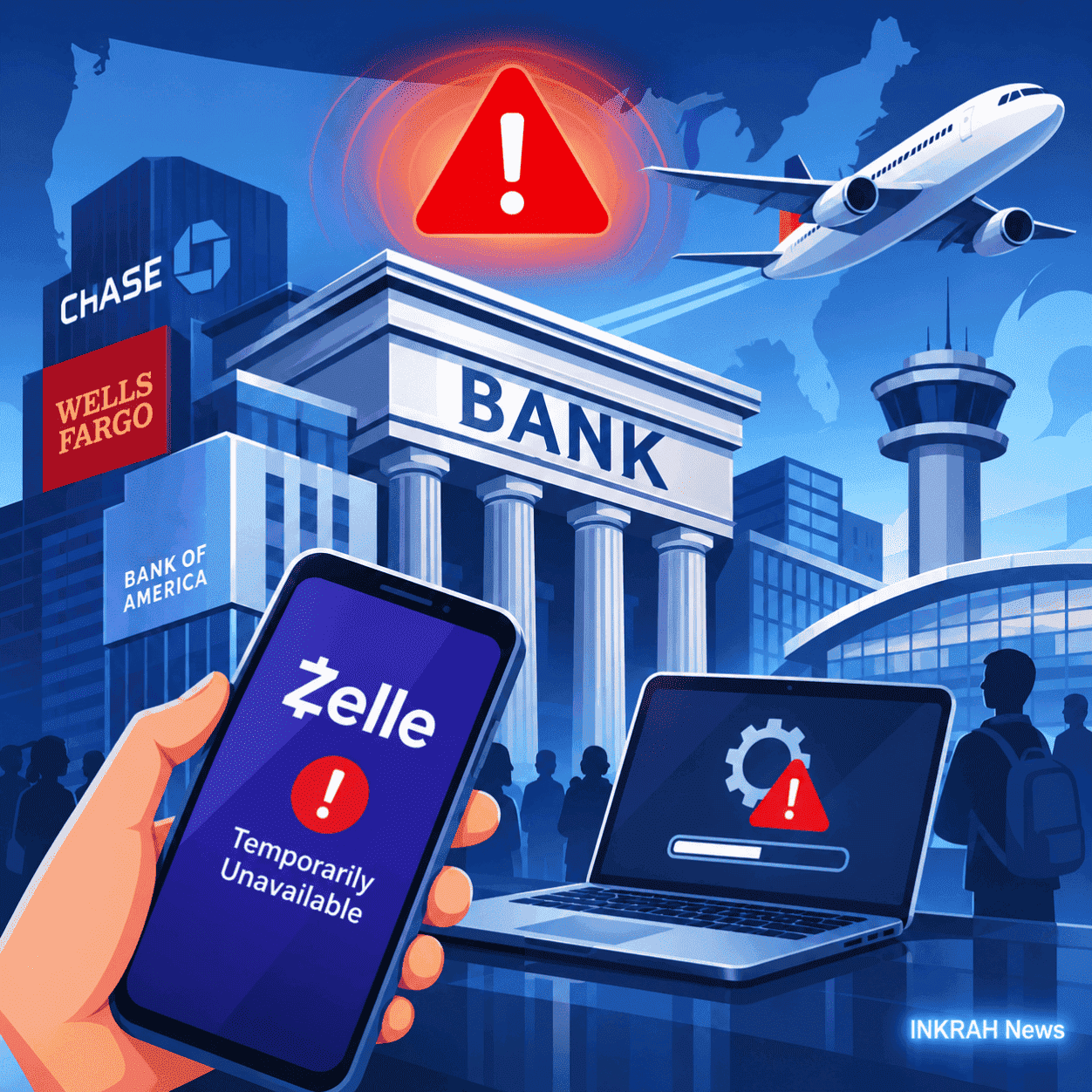
On Monday, 16 November 2026, the United States experienced technological service disruptions that spread into the banking sector and hindered the public's financial transactions. A number of JPMorgan Chase customers reported difficulties accessing their accounts and using digital banking services due to technical problems affecting the company's systems. The impact was also felt by users of Bank of America, U.S. Bank, Wells Fargo, Truist, and the Zelle interbank payment network. The Guardian reported that the disruption caused transaction delays and made it difficult for some customers to send and receive funds. This incident illustrates how closely interconnected banking operations have become within a modern financial ecosystem that relies on electronic data exchange. A disruption at a single institution can spread through transaction channels linking various financial service providers. The incident occurred while the United States was also facing a series of technological infrastructure problems, ranging from disruptions to Microsoft services to the temporary suspension of commercial flights due to problems with aviation communication systems. This sequence of events places technological reliability at the centre of a strategic issue directly connected to economic stability, public safety, and public confidence in institutions responsible for essential services.
The chronology of the banking disruption centred on technical problems experienced by JPMorgan Chase, which affected transactions involving other financial institutions. Chase stated that some transactions were taking longer to complete than usual. The company also said that customers continued to have access to their accounts and funds, whilst its technical teams were working to restore services. Chase denied that the incident constituted a systemic disruption or resulted from a cyberattack. This statement is important because operational disruptions, data breaches, and cyberattacks are distinct categories of risk, each carrying different legal characteristics and consequences. Bank of America and Citigroup were reported to have experienced no direct disruption to their banking services, although customers conducting transactions with Chase could still encounter difficulties. U.S. Bank also explained that its internal systems had not been directly affected, whilst Zelle transactions involving other financial institutions could experience delays. This situation demonstrates how the source of a disruption can originate at a single operational point, whilst its effects spread through the institutional relationships that form the payment network.
The Zelle network became one of the most significant elements illustrating how technical problems at a single bank can affect the financial activities of a wider population. This electronic peer-to-peer payment service enables users to transfer funds and is used by customers of several major financial institutions across the United States. Zelle is operated by Early Warning Services, a company owned by a group of financial institutions, including Bank of America, Capital One, JPMorgan Chase, PNC Bank, Truist, U.S. Bank, and Wells Fargo. Early Warning Services stated that the Zelle network continued to operate normally, whilst payment delays were believed to be associated with problems at the financial institutions involved in the transactions. This explanation highlights the distinction between the availability of a payment network and the ability of individual banks to process transaction instructions successfully. Sociologically, society's dependence on digital payments has transformed access to money into an essential part of everyday social life, ranging from meeting household needs to paying business expenses. When such services are disrupted, technical problems can develop into issues of trust, anxiety, and economic uncertainty at an individual level. The doctrine of social trust explains that the continued functioning of modern institutions depends heavily on public confidence that the systems supporting their lives can operate reliably. Under such circumstances, customer confidence becomes a form of social capital whose value is difficult to restore when corporate communication is not accompanied by transparency and certainty about the resolution of disruptions.
The issue takes on a broader dimension when considered alongside the Microsoft technology disruption reportedly experienced from Thursday, 12 November 2026, continuing into the following day. The disruption affected several digital services, including Outlook, Teams, and Copilot, and had consequences for various organisations across several countries. Educational institutions, hospitals, businesses, courts, banks, prisons, police forces, and government agencies were among those facing operational consequences arising from the incident. Microsoft stated that its services had been restored by Saturday and issued an apology to users. In its initial report on Monday, the company attributed the disruption to a combination of software errors that had emerged several months earlier, internal connectivity failures, and server capacity limitations. This sequence of factors demonstrates how technological failures can arise from an accumulation of technical weaknesses that have not been adequately addressed. From a legal standpoint, these circumstances are closely related to the principle of duty of care, which requires service providers to exercise an appropriate degree of caution when managing services that have extensive consequences for the public interest. The principle of due diligence is also relevant when assessing the adequacy of system maintenance, infrastructure testing, capacity monitoring, and recovery procedures in the event of failure. Legal liability for such disruptions must still be established through an examination of causation, applicable standards of obligation, the nature of the loss, and evidence of negligence or breaches attributable to the relevant parties.
CNN's reporting provides a quantitative indication of the scale of disruption experienced by Chase customers. According to Downdetector data, more than 4,687 users had reported problems accessing Chase services by 2.30 pm Eastern Time in the United States on 16 November 2026. This figure illustrates the scale of complaints recorded through a digital service disruption monitoring platform, although it cannot be treated as the total number of customers affected. Users of Bank of America, Wells Fargo, and U.S. Bank also submitted complaints on a smaller scale. Some of these reports concerned Zelle transactions involving Chase accounts, meaning that payment difficulties could be experienced by customers of other banks even when their own institutions' internal infrastructure remained operational. This situation demonstrates the existence of operational concentration risks when numerous financial institutions rely on interconnected transaction relationships. From the standpoint of institutional economics, such dependence creates systemic interdependence, whereby connections between institutions allow disruption at one node to produce consequences for others. The doctrine of too connected to fail is relevant in explaining how institutional interconnectedness can magnify the impact of operational disruptions, particularly when safeguards and alternative transaction channels are inadequate. The economic maxim time is money also acquires a tangible meaning in this incident, since delays in payment processing can obstruct commercial activities, the fulfilment of contractual obligations, bill payments, and the circulation of business capital.
The resilience of American infrastructure has attracted further attention when considered alongside disruptions to the aviation sector on Friday, 13 November 2026. The Federal Aviation Administration (FAA) temporarily suspended commercial flight departures nationwide after technical problems affected communications and several air traffic control radar systems. US Transportation Secretary Sean Duffy explained that the disruption began when a contractor was carrying out work to replace old copper cabling with a fibre-optic network within the air traffic control communications system. Newly installed router equipment was suspected of transmitting excessive data traffic to other devices, thereby disrupting network stability. The FAA subsequently conducted an investigation to establish whether the cause was related to contractor error or equipment failure. Fox News reported that the departure suspension lasted nearly five hours and was followed by approximately 12,462 flight cancellations on that day, including 9,082 cancellations involving major airlines, although the agency cautioned that not all cancellations were necessarily caused directly by the nationwide suspension. Authorities stated that there was no indication of a cyberattack and that all aircraft had landed safely. Philosophically, the incidents involving the aviation and banking sectors raise a fundamental question about the limits of human confidence in technology of our own creation. Hans Jonas's thinking, through the doctrine of The Imperative of Responsibility, emphasises the importance of responsibility for the consequences of technological actions, particularly when their effects extend to the lives of large numbers of people. This principle requires businesses and governments to consider long-term risks before implementing infrastructure changes that support the public interest.
The banking disruption raises questions about the responsibility of financial service providers to guarantee the security, reliability, and continuity of services provided to customers. The relationship between a bank and its customers fundamentally involves contractual obligations that must be performed in accordance with applicable legal provisions, agreements, and consumer protection principles. Where technological disruptions result in financial losses, delayed payments, or failures to fulfil obligations, an examination must be conducted into the source of the disruption, operational standards, mitigation measures, and the quality of information provided to consumers. The doctrine of res ipsa loquitur may provide a basis for discussing the burden of proving negligence where an incident reasonably indicates a failure of control, although its application remains dependent on the nature of the case and the relevant legal provisions. The maxim pacta sunt servanda also serves as a reminder that agreements must be respected and performed by the parties in accordance with their agreed obligations. Within the United States legal system, such matters may intersect with financial consumer protection regulations, banking supervisory requirements, and obligations governing information technology risk management. For Indonesia, this incident is particularly relevant because Law Number 4 of 2023 concerning Financial Sector Development and Strengthening, together with the Financial Services Authority's regulations on the implementation of information technology by banks, places governance and risk management at the centre of financial sector supervision. The principle of ubi societas ibi ius means that every form of social life requires law as a framework for regulating relationships and protecting shared interests. Modern banking law must ensure that the advancement of digital services goes hand in hand with legal certainty regarding customer rights, complaint mechanisms, compensation for losses, and institutional accountability.
The sequence of disruptions also offers an economic lesson about the high cost of dependence on digital infrastructure concentrated among a limited number of major service providers. When payment systems experience difficulties, businesses may face delays in receiving funds, uncertainty in cash flow, and increased operational costs associated with resolving outstanding transactions. Households may also encounter difficulties meeting everyday payment obligations, particularly when they rely on electronic services as their primary means of managing their finances. The impact on small businesses can be more severe when payment delays undermine their ability to purchase stock, pay employees, or meet obligations to suppliers. Ronald Coase's theory of transaction costs explains that every economic activity involves costs associated with obtaining information, conducting exchanges, and ensuring that agreements are fulfilled. When digital infrastructure fails, transaction costs increase due to the need for additional verification, the use of alternative payment channels, and delays in the settlement of obligations. Within institutional economics, the reliability of payment systems is one of the prerequisites for market efficiency, since transactions require certainty regarding timing, value, and receipt of funds. The economic maxim the cost of downtime illustrates that operational shutdowns can carry financial consequences extending far beyond the cost of repairing the equipment itself. Financial service providers need to account for such risks through investment in backup systems, regular testing, capacity monitoring, and measurable disaster recovery procedures.
The events of 16 November 2026 also demonstrate that technological resilience cannot be measured solely by a company's ability to restore applications after a disruption has occurred. A more substantive assessment includes preparedness to prevent failures, the ability to isolate the source of a problem, the availability of alternative systems, and the speed at which information can be communicated in a manner that the public can understand. It is also necessary to distinguish between disruptions caused by software errors, hardware damage, communication network failures, and cybercrime, since each category requires a different method of response. The sequence of incidents involving Microsoft, Workday, the FAA, and JPMorgan Chase reported during that week cannot automatically be regarded as originating from a single cause or forming part of a coordinated attack. Fox News instead portrayed these events as a series of technological disruptions affecting various sectors over a period of approximately five days. This fact underscores the need for caution when drawing conclusions about connections between incidents before sufficient technical evidence becomes available. From a public policy standpoint, governments need to strengthen supervision of digital infrastructure supporting essential services through operational resilience standards, incident reporting obligations, security testing, and assessments of third-party technology providers. Banking companies must also provide alternative service channels so that customers can continue receiving information and accessing essential services when applications experience disruptions.
Behind these technical problems lies a more fundamental philosophical question concerning the relationship between the progress of civilisation and humanity's vulnerability to the systems it has created. The convenience of electronic transactions has accelerated economic activity, reduced geographical barriers, and expanded public access to financial services. However, increasing dependence on software, communication networks, data centres, and payment systems has also created new forms of vulnerability. Society may lose its ability to carry out economic activities normally when the infrastructure supporting everyday needs experiences disruption. Martin Heidegger's The Question Concerning Technology can be used to understand how technology has the potential to shape the way human beings perceive life, particularly when access to money and public services becomes increasingly dependent on digital systems. Technology should be positioned as a means of expanding human welfare, rather than as a structure that makes society's basic needs entirely dependent on the availability of a single electronic channel. The maxim primum non nocere, meaning first, do no harm, can serve as an ethical principle in the development and management of technology affecting the public interest. This principle requires every innovation to consider safety, certainty, fairness of access, and society's ability to cope with system failures. The success of digital transformation should encompass the ability of technology to protect people both under normal conditions and when systems face emergencies.
The incident affecting several financial services in the United States on 16 November 2026 serves as a warning about the importance of building digital infrastructure that is resilient, transparent, and accountable. The technical problems at JPMorgan Chase demonstrate that operational difficulties at a single institution can affect transactions involving other banks through interconnected payment networks. The disruption also occurred amid a series of technological problems in the communications, human resources, and transport sectors that had previously hindered public activities. Governments, regulators, and companies providing strategic services need to treat operational continuity as an institutional obligation directly connected to the public interest. Strengthening backup systems, conducting regular inspections, ensuring transparency of information, supervising contractors, and establishing consumer protection mechanisms are essential elements of this effort. For the banking sector, customer confidence cannot be built solely through application speed and transaction convenience, since certainty that funds will remain accessible when needed is the fundamental basis of the relationship between banks and society. For policymakers, this incident serves as a reminder that technology regulation must be capable of keeping pace with emerging risks arising from interconnected institutions. Digital progress gains social legitimacy when its benefits can be enjoyed by society without compromising security, legal certainty, and economic resilience. At this point, the success of digital transformation should be measured, not by how sophisticated the systems being developed are, but by how effectively those systems can safeguard human interests when technology fails.