

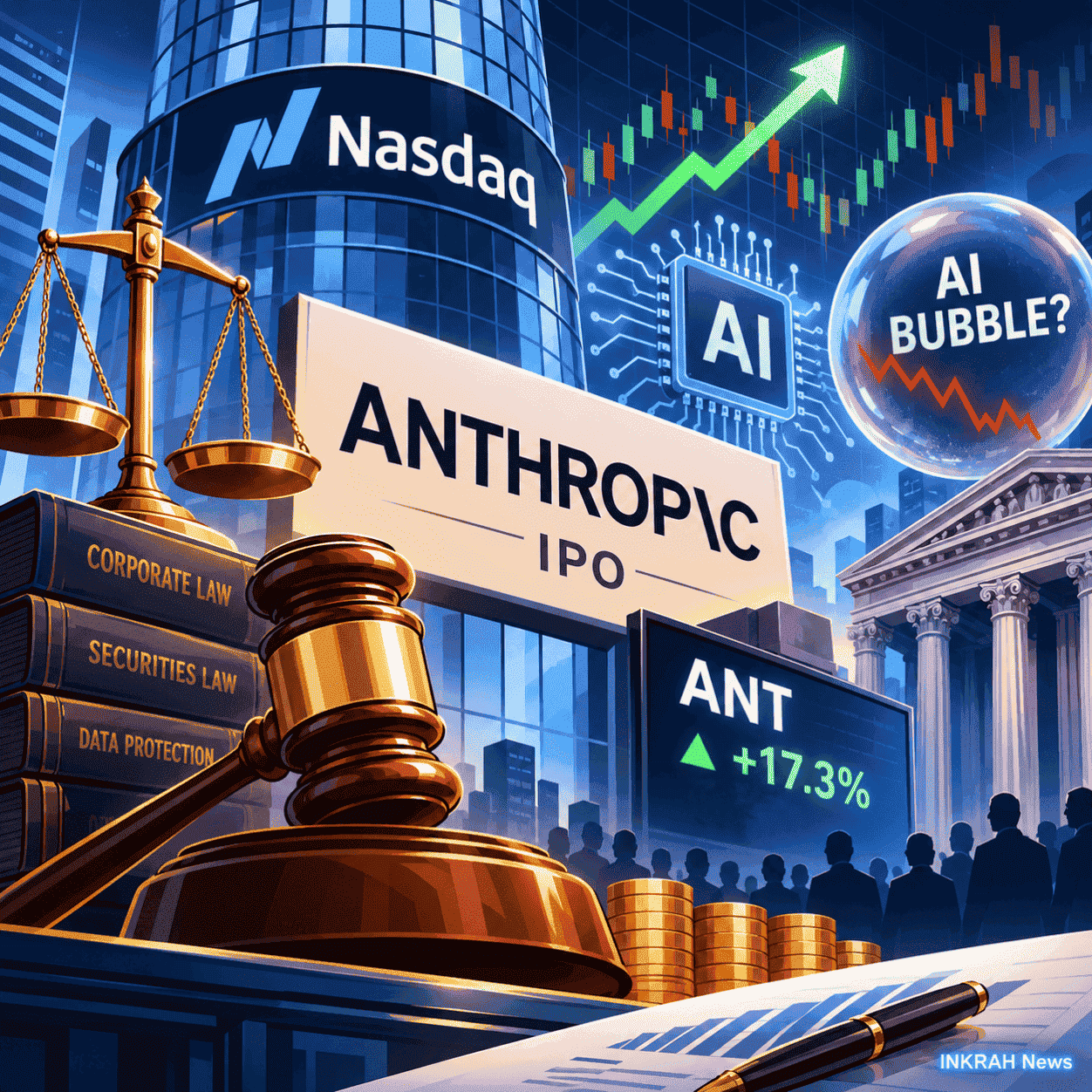
Anthropic's initial public offering (Initial Public Offering or IPO) on 19 November 2026 marked a significant event that reshaped the competitive landscape of the global artificial intelligence industry. The company behind Claude attracted considerable attention from the capital markets of the United States by raising approximately US$81 billion, equivalent to Rp1,480 trillion. Anthropic in the historical record as one of the technology companies to have conducted the largest initial public offerings ever undertaken. The achievement also surpassed the previous record held by SpaceX, Elon Musk's aerospace company, which raised approximately US$75 billion in July 2026. Anthropic's stock market debut took place on Nasdaq in New York, under the trading ticker ANT. Artificial intelligence companies had entered a new phase in which technology, capital and investor confidence converged in a single competitive arena. The capital market responded to Anthropic's commercial prospects by setting its initial share price at US$83 per share.
Anthropic's official announcement on 18 November 2026 stated that the company had priced its Class A shares at US$83 each. The total number of shares offered reached 980 million, comprising 956,351,354 shares issued by Anthropic and 23,648,646 shares held by certain selling shareholders. This composition demonstrated that the majority of the transaction originated from the company's own share issuance, whilst the remainder involved the disposal of holdings by investors who had previously committed capital. Based on the offering price, the total transaction value amounted to approximately US$81.34 billion. Anthropic specifically emphasised that proceeds from the sale of shares by existing shareholders would not be transferred into the company's treasury. Trading in ANT shares was scheduled to commence on 19 November 2026 on the Nasdaq Global Select Market, whilst settlement of the offering was scheduled for 20 November 2026, subject to the fulfilment of all closing conditions. The underwriters were also granted a 30-day option to purchase up to an additional 147 million Class A shares.
The surge in the offering's value becomes clearer when examined alongside the financing structure accompanying Anthropic's corporate action. Reuters reported that the company had also raised approximately US$26 billion through private share placements with selected investors. When both sources of funding are taken into account, Anthropic's total capital-raising transactions reached approximately US$107.3 billion. The company gained an opportunity to strengthen its financial resources to fund the development of artificial intelligence models, expand computing infrastructure and increase service capacity for corporate clients. Such substantial capital requirements reflect the nature of the artificial intelligence industry, which demands enormous investment in data centres, semiconductors, energy, skilled professionals and research. The competition surrounding generative technology has evolved into a race to control the infrastructure underpinning the global digital economy. The doctrine of economies of scale explains how increased production capacity can reduce average costs as operational scale expands. The principle of capital follows opportunity also finds relevance when investors direct funds towards companies perceived as having the potential to shape future markets. Anthropic has benefited from this confidence through a combination of public share offerings and private financing, strengthening its financial resilience in preparation for long-term competition.
The market's response to Anthropic's stock market debut demonstrated an exceptionally high level of investor enthusiasm. At the opening of trading on 19 November 2026, ANT shares immediately traded at US$111.50 each, approximately 34 per cent above the initial offering price of US$83. This increase pushed the company's valuation towards US$2 trillion during the early stages of trading. CNN reported that this achievement reflected the market's considerable expectations regarding Anthropic's ability to develop artificial intelligence technology with extensive commercial value. The share price subsequently underwent a correction as trading continued and some investors realised their gains. ANT shares closed their first trading session at US$97.17, still recording an increase of more than 17 per cent compared with the IPO price. The company's market capitalisation at the close of trading stood at approximately US$1.75 trillion. This phenomenon demonstrated the distinction between a company's value established through its offering price and the valuation formed through market supply and demand mechanisms on the stock exchange. The theory of market efficiency provides a foundation for understanding how share prices reflect market participants' information and expectations at a particular point in time, whilst price volatility demonstrates changes in investor assessments of a company's prospects and risks.
Anthropic's successful stock market listing also carries a corporate legal dimension worthy of attention. The company operates as a Public Benefit Corporation under the laws of the State of Delaware, United States. This corporate structure places shareholder interests, the interests of parties affected by corporate activities and the pursuit of public benefit among the considerations that must be taken into account in corporate governance. Anthropic states that its public benefit purpose concerns the responsible development and maintenance of advanced artificial intelligence for the long-term benefit of humanity. The company has also established a Long-Term Benefit Trust as part of its governance arrangements to maintain a balance between commercial objectives and its social mission. From the standpoint of capital market law, the share offering obtained effectiveness of its registration statement from the Securities and Exchange Commission on 18 November 2026. This procedure demonstrates the importance of disclosure, compliance with securities registration requirements and investor protection in public capital-raising transactions. The principle of disclosure serves as a fundamental instrument to ensure that prospective shareholders receive material information regarding ownership structures, financial conditions, business risks and the rights attached to the securities being offered. The legal maxim ubi societas ibi ius reminds us that every economic activity involving public interests requires a legal framework capable of providing certainty, accountability and protection for all relevant parties.
Anthropic's legal structure raises a philosophical question concerning the purpose of corporations in an era when technological developments increasingly shape human life. Milton Friedman, through his argument that corporate social responsibility should focus on increasing shareholder profits, provides one of the classical foundations of thought regarding the function of corporations. This approach contrasts with the stakeholder theory popularised by R. Edward Freeman, which holds that companies have responsibilities towards the various parties who influence or are affected by their business activities. Anthropic seeks to accommodate both interests through a corporate structure that legally recognises the pursuit of public benefit. This approach is relevant because artificial intelligence technology has the potential to influence education, healthcare, employment, information security and the distribution of wealth. Corporate decisions concerning algorithm design, data management and the limits of technological use can produce social consequences extending beyond shareholders' interests. The principle of primum non nocere, widely recognised in medical ethics, can serve as a moral analogy for technological development that must seek to prevent harm to human beings. Meanwhile, the legal maxim salus populi suprema lex esto places the safety and welfare of the public among the highest considerations in the governance of collective life. A company's value acquires a broader meaning when commercial success goes hand in hand with ethical responsibility towards humanity and its social environment.
Anthropic's fundraising achievement has also exposed a shift in economic power within the artificial intelligence industry, particularly in relation to technology companies associated with Elon Musk. Anthropic's record-breaking fundraising surpassed SpaceX's previous IPO achievement of approximately US$75 billion. This comparison illustrates the considerable confidence investors have placed in companies developing generative artificial intelligence models. CNBC Indonesia also reported that each Anthropic founder was said to have sold approximately 3.38 million shares, with the estimated combined value reaching US$1.96 billion. Such transactions provide liquidity opportunities for early shareholders whilst broadening the company's ownership base through the public capital market. This achievement represents a competitive challenge for Elon Musk's business ecosystem, particularly as SpaceX and other technology companies seek to maintain their positions in an industry requiring substantial financial resources. Joseph Schumpeter's theory of creative destruction explains how innovation can transform industrial structures through the emergence of new businesses and technologies that displace established dominance. Such changes create pressure on incumbent companies to renew their strategies, improve efficiency and maintain the relevance of their products. The economic maxim survival of the fittest illustrates the intensity of competitive selection in the technology industry, where the capacity to innovate, manage capital and anticipate market needs becomes essential to corporate sustainability.
Anthropic's substantial fundraising has taken place at a time when the artificial intelligence industry faces financing challenges and market uncertainty. Major technology companies such as Microsoft, Alphabet, Google's parent company, and Amazon continue to allocate enormous amounts of capital expenditure towards building computing infrastructure. CNBC Indonesia reported that Microsoft expected its annual capital expenditure to reach approximately US$170 billion, following an earlier projection of US$175 billion. Alphabet maintained its capital expenditure estimate at approximately US$205 billion, whilst Amazon projected expenditure of US$220 billion. These figures demonstrate the enormous infrastructure requirements underpinning the development and operation of artificial intelligence technology. Companies require large-scale data centres, high-speed computing networks, stable electricity supplies and advanced semiconductor devices with sophisticated processing capabilities. These conditions create economic risks arising from high fixed costs, uncertain investment returns and the possibility of excess capacity should demand fail to develop in line with projections. The concept of opportunity cost reminds us that every amount allocated to artificial intelligence infrastructure carries consequences for investment opportunities in other economic sectors. The principle of risk and return also emphasises that expectations of high profits must be considered alongside the possibility of proportionate losses, particularly when company valuations rise substantially beyond actual revenue levels and cash-generating capabilities.
The social impact of Anthropic's expansion deserves consideration as artificial intelligence becomes increasingly embedded in people's lives. Technology developed by companies of this kind has the potential to accelerate medical research, broaden access to education, improve workplace productivity and assist with complex administrative tasks. Dario Amodei, Anthropic's Chief Executive Officer, and Daniela Amodei, the company's president, also highlighted the technology's potential in healthcare and education when attending the company's Nasdaq listing ceremony. They also referred to the importance of making appropriate decisions concerning artificial intelligence safety. Their statements demonstrate that commercial success must be accompanied by responsibility for the consequences arising from the use of their products. Rapid technological development may create new inequalities between communities with access to digital infrastructure and those left behind due to limited resources. Changes in working patterns may also shift the skills required in the labour market, making adjustments to education and employment policies necessary. The principle of social justice is relevant to ensuring that the economic benefits of artificial intelligence can be distributed more equitably. Governments have an interest in ensuring that technological development proceeds alongside the protection of personal data, public safety, workers' rights and access to quality education.
Anthropic's IPO also raises fundamental questions concerning the relationship between capitalism, scientific progress and the responsibilities of civilisation. The company's trillion-dollar valuation demonstrates the extraordinary market appreciation for technology expected to transform human economic activity. However, market capitalisation cannot serve as the sole measure of success for a technology company. Business sustainability remains dependent on the ability to generate revenue, maintain customer confidence, control costs and develop products with genuine practical value. At the same time, technology's ability to generate decisions, process information and perform complex tasks raises questions about the limits of machine authority in human life. Philosopher Hans Jonas, through his principle of responsibility, known as The Imperative of Responsibility, emphasises humanity's moral obligation to consider the long-term consequences of the technological power it creates. This idea is particularly relevant to Anthropic because decisions concerning artificial intelligence development may have consequences extending across generations. The maxim scientia potentia est, meaning knowledge is power, illustrates the significant influence technological mastery can exert over the distribution of economic and social power. Such power requires legal oversight, institutional integrity and moral responsibility to ensure that innovation does not develop without adequate safeguards. Anthropic's stock market success serves as a reminder that the progress of civilisation should be measured through the benefits technology brings to human life, rather than solely through the amount of wealth recorded in financial statements.