
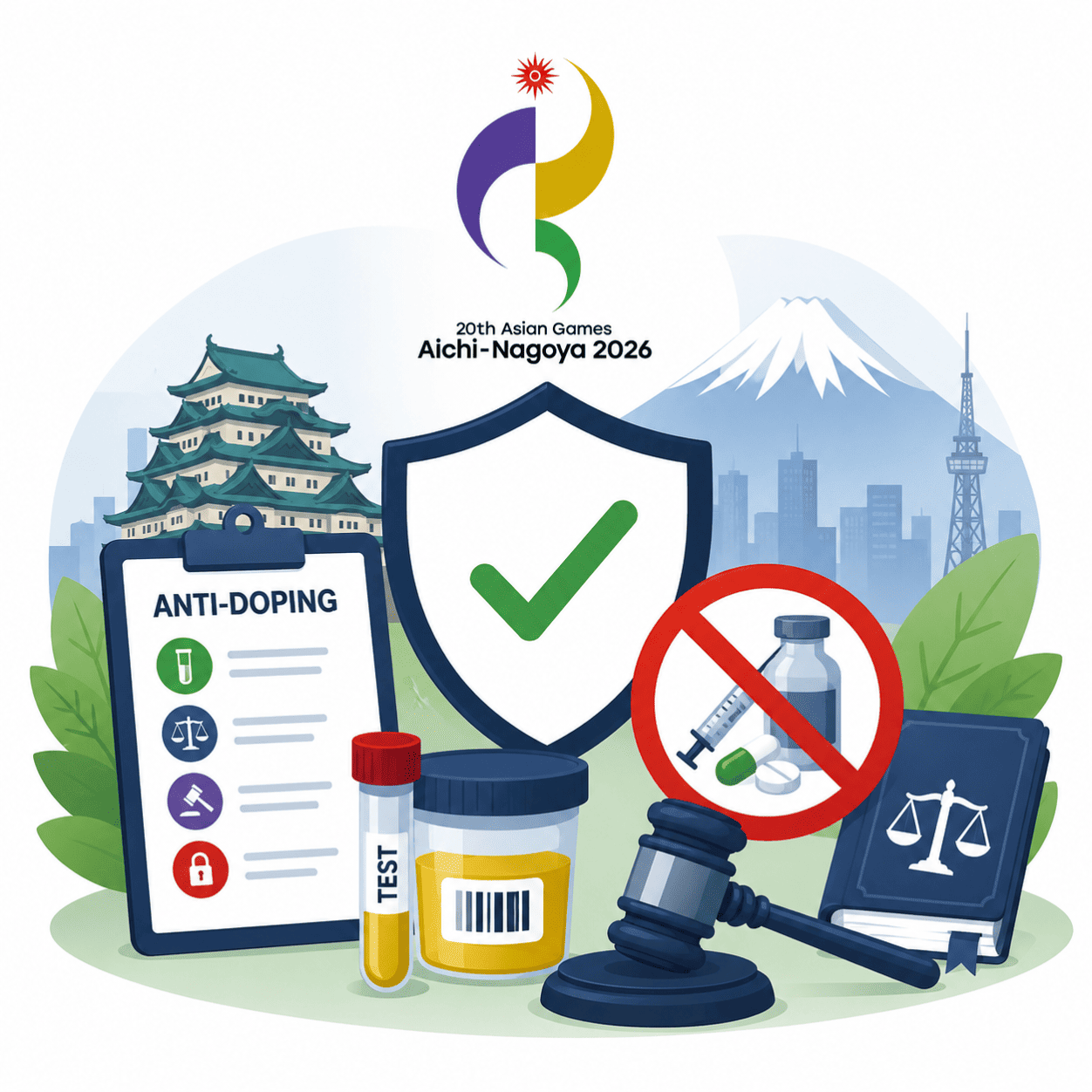
The Olympic Council of Asia, in close partnership with the International Testing Agency, spearheaded an aggressive operational framework across Japan to safeguard sporting integrity throughout the 20th Asian Games, Aichi-Nagoya 2026 held between 19 September 2026 and 4 October 2026. Sports administrators, tournament directors, and national delegates across the continent face an unprecedented wave of administrative enforcement designed to eradicate illicit performance enhancers from every competition hall in Aichi and Nagoya. Elite competitors who foolishly choose to cheat are finding out the hard way that modern testing regimes leave virtually no room to maneuver. Clean athletes are finally receiving proper protection from unfair competition under this strict institutional oversight. The foundational jurisprudence behind these measures relies on the well-known doctrine of strict liability, meaning an athlete remains fully accountable for any banned substance discovered within their system regardless of intention. Ancient legal wisdom reminds us of dura lex, sed lex, meaning the law is harsh, but it remains the law. Under World Anti-Doping Code standards, lack of intent offers zero defense against immediate disqualification. The socio-legal dynamics of competitive sports demand absolute compliance to preserve genuine athletic achievement. Sports officials insist that maintaining a level playing field forms the core backbone of fair play across all international arenas.
The legal apparatus governing Asian athletics operates under comprehensive mandates harmonised with global bodies like the World Anti-Doping Agency. Compliance managers and independent doping control officers actively inspect training facilities and athlete villages in Aichi Prefecture to ensure total adherence to updated protocols. Cheats attempting to game the system encounter rigorous sample collection procedures that operate around the clock throughout the fifteen-day competition window. Institutional authority rests firmly upon the legal principle pacta sunt servanda, obligating participating national Olympic committees to honour every signed anti-doping agreement without exception. From a sociological viewpoint, doping destroys the public trust necessary for international athletic events to flourish. Philosophical inquiry into sporting ethics reveals that artificial physical enhancement turns human achievement into a hollow pharmaceutical competition. Athletes taking dangerous shortcut methods ruin their long-term cardiovascular systems and suffer irreversible liver damage. The physical consequences of chemical enhancement regularly include severe kidney failures, stroke risks, and fatal heart attacks. The Olympic Council of Asia refuses to compromise on health protections, demanding every competitor respect fair play.
Administrative panels led by regional legal experts and independent arbitrators wield extensive powers to investigate suspected support personnel who aid illegal doping programs. Corrupt coaches and unethical doctors face life bans for feeding banned substances to vulnerable young athletes during preparations for the 20th Asian Games, Aichi-Nagoya 2026. Jurisprudential logic supports these extended sanctions under the doctrine of indirect liability, holding facilitators as guilty as the primary offenders. Legal scholars point to the principle ignorantia juris non excusat, proving that claiming ignorance of the banned list excuses nobody from severe penalties. Sociological studies demonstrate that systemic doping creates toxic pressure where honest competitors feel forced to risk their lives just to stay competitive. The philosophical spirit of sport requires authentic physical capability rather than laboratory-engineered performance. Toxic anabolic steroids permanently destroy endocrine function, leading to extreme psychological trauma and physical collapse. Organ failure remains a constant lethal hazard for those consuming clandestine performance boosters. The overarching mission stays rooted in fair play, ensuring that natural talent alone decides the rightful victor.
Testing officers carry out surprise out-of-competition inspections across all participating territories from Tokyo to Central Japan without prior warning. Competitors failing to provide accurate whereabouts information face swift suspensions under stringent regulatory provisions enforced during the Games. Modern sports law relies on the doctrine of procedural fairness, balancing strict oversight with formal appeals processes. Arbitral panels respect the fundamental Maxim audi alteram partem, granting accused athletes a fair hearing before issuing final rulings. The sociological consequence of rogue doping practices damages national prestige and undermines youth sports participation across member states. Philosophically, true victory demands authentic effort, rendering cheating a complete betrayal of the human spirit. Chemically altering blood viscosity through EPO injections causes sudden cardiac arrests during intense physical exertion. Banned stimulant abuse triggers catastrophic hyperthermia, fatal arrhythmias, and total bodily exhaustion. Promoting clean play remains the only ethical path to safeguard athlete health and sport integrity.
Regulatory agencies enforce a zero-tolerance stance against any form of sample tampering or procedural obstruction inside accredited testing laboratories in Japan. Athletes attempting to subvert biological passport tracking face maximum suspension terms under current rules established for the 20th Asian Games, Aichi-Nagoya 2026 cycle. The legal structure enforces the doctrine of strict compliance to guarantee equal conditions for every entrant. Adjudicating tribunals rely on ei incumbit probatio qui dicit, non qui negat, requiring anti-doping organisations to establish violations with solid scientific evidence. Social structures within elite sports culture shift rapidly as clean athletes demand tougher measures against persistent cheats. Philosophical frameworks confirm that a game without shared rules ceases to be a legitimate contest altogether. Consuming tainted dietary supplements often leads to accidental poisoning and irreversible neurological damage. Synthetic hormone abuse causes severe hormonal disruption, chronic depression, and severe organ toxicity. Every athlete must honor fair play to protect their physical well-being and preserve real sportsmanship.
Educational initiatives organised by continental health officers and local organisers now accompany punitive measures to ensure young competitors understand the true costs of cheating. Mandatory pre-Games educational programs conducted in host cities like Nagoya explain the specific health hazards associated with forbidden chemical compounds. Legal policy uses the doctrine of general deterrence, making high-profile sanctions a clear warning to prospective rule-breakers. Regulators operate under salus populi suprema lex esto, prioritizing the overall health and safety of the athletic community above all else. Sociological analysis proves that transparent anti-doping programs restore fan confidence and attract legitimate corporate sponsorship. The philosophy of sport holds that true human excellence shines only when competitors test their unenhanced boundaries. Human growth hormone abuse causes irreversible bone deformation, severe diabetes, and cardiovascular failure. Masking agents dangerously dehydrate the human body, leading to acute kidney injury and sudden circulatory collapse. Protecting athlete health remains paramount, reinforcing fair play as the non-negotiable standard.
Medical exemptions undergo thorough scrutiny by specialized independent panels to prevent fraudulent therapeutic claims before the action begins in Japan. Athletes requiring legitimate medication must present comprehensive clinical documentation before competing between 19 September 2026 and 4 October 2026. Sports law enforces the doctrine of proportionality, ensuring sanctions fit the severity of each specific infraction. Legal adjudicators follow ex aequo et bono, striving for equitable outcomes while maintaining rigid anti-doping standards. Sociological observations confirm that rigorous verification prevents bad actors from exploiting medical loopholes. Philosophically, fair competition requires complete transparency regarding any external substance introduced into the human body. Misusing prescription drugs for performance enhancement severely disrupts natural metabolic function, causing chronic organ destruction. Unsupervised pharmaceutical consumption carries massive risks of acute toxicity and sudden fatal reactions. Upholding fair play keeps the athletic arena safe and honorable for all participants.
International federations coordinate closely with regional bodies to share intelligence regarding illicit trafficking networks operating across continental borders. Confidential whistleblower channels operational throughout 2026 provide secure routes for individuals to report organized doping schemes safely. The legal framework incorporates the doctrine of institutional integrity, holding entire sports associations accountable for systemic failures. Courts apply the timeless maxim nemo plus iuris ad alium transferre potest quam ipse habet, proving that an athlete cannot claim a clean title won through fraudulent means. From a sociological standpoint, dismantling trafficking networks breaks the peer pressure that coerces clean athletes into cheating. Authentic victory cannot exist when constructed on deception. Illicit black-market compounds often contain lethal contaminants and unapproved chemical toxins. Injecting unregulated substances exposes athletes to deadly blood-borne infections and systemic sepsis. Maintaining clean play guarantees that health and moral integrity remain uncompromised.
Comprehensive laboratory testing continuously adapts to detect cutting-edge designer substances and gene manipulation techniques during the 20th Asian Games, Aichi-Nagoya 2026. Scientific advancements allow re-testing stored samples years after the Flame goes out in Nagoya. The legal system applies the doctrine of retrospective accountability, ensuring cheats face justice long after their initial podium finishes. Adjudicating bodies enforce veritas visu et mora adulterina advesperascit, meaning truth clarifies through sight and time while deception fades. Sociological studies show long-term re-testing acts as a massive psychological deterrent against sophisticated cheating syndicates. Philosophically, time strips away false glory, leaving only legitimate achievement intact. Experimental gene doping poses terrifying risks of uncontrolled cell mutation, cancerous tumor growth, and organ shutdown. The medical risks of unproven physical enhancement far outweigh any temporary glory on the track. Strict adherence to fair play protects athletes from becoming living experiments.
National anti-doping agencies across Asia must maintain absolute independence from political interference to guarantee impartial testing in every participating delegation. Government interference in regulatory decisions results in immediate international suspension for the offending country under statutory provisions enforced by the Olympic Council of Asia. Sports jurisprudence relies heavily on the doctrine of autonomous governance, insulating sporting bodies from political bias. Arbitral tribunals uphold fiat iustitia ruat caelum, demanding justice for clean athletes regardless of political fallout. Sociologically, independent oversight reassures the global public that competition results reflect true athletic merit. Philosophically, fair play serves as a universal language that unites diverse cultures under shared human values. Doping destroys the human body from within, causing irreversible cardiovascular decay and premature death. Choosing chemical shortcuts turns athletic pursuit into a dangerous path toward physical ruin. Absolute commitment to clean play remains the sole method to honor the nobility of sport.