
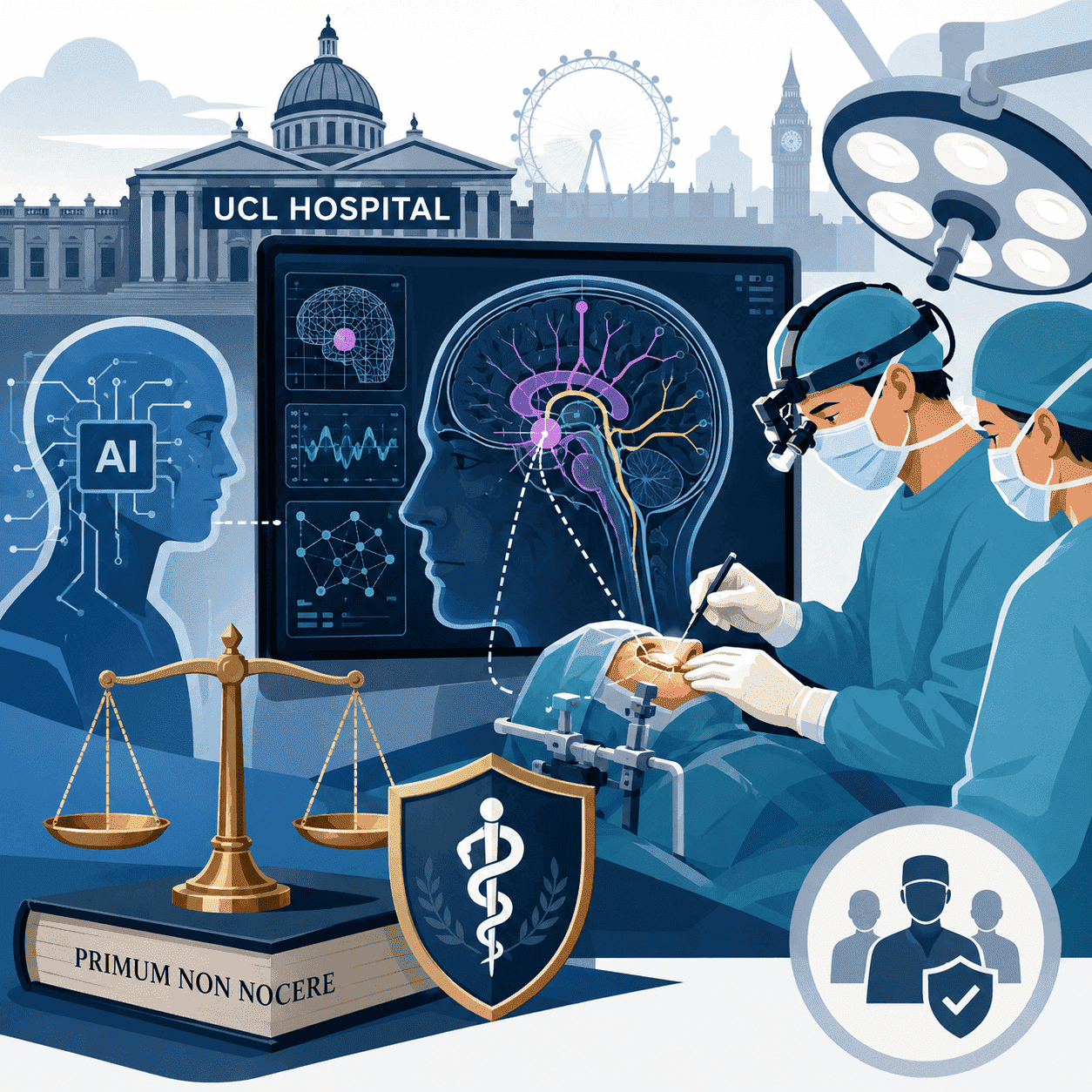
A blustery afternoon walk in London in 2024 took a terrifying turn when Rhys Hibbert, a 48-year-old father of 2, collapsed on the pavement following an unexpected seizure. A benign 11 mm mass had surreptitiously embedded itself within his pituitary gland, resting at the skull base like a lethal marble amidst vital neural pathways. Medical teams at University College London Hospital faced a daunting task due to the lesion's dangerous proximity to internal carotid arteries and optic nerves. Traditional surgical routes carried a high risk of permanent blindness or severe brainstem damage. Surgeons turned to state-of-the-art computational algorithms to navigate this delicate anatomical area. Artificial intelligence was used to provide live video analysis during the surgical procedure, mapping vascular pathways and highlighting hidden tissue boundaries to support the surgical team. The technology functioned as a complex modern calculator, providing dynamic guidance while surgeons maintained full manual control.
The human brain presents an intricate web where a fraction of a millimetre separates complete recovery from severe neurological harm. Artificial intelligence operates as an extraordinarily sophisticated modern calculator, a brilliant digital tool designed to streamline complex algorithmic calculations rather than replace human judgment. Legal scholars referencing Hippocrates and classical medical jurisprudence emphasise the Latin maxim primum non nocere, which dictates that medical intervention must never inflict harm. Artificial intelligence calculates spatial boundaries and estimates mass volumes at high speeds to support surgical decision-making during procedure planning. The legal responsibility for every incision remains entirely with the human surgeon. Algorithms lack moral agency, subjective awareness, and legal standing within public health frameworks. The technology acts purely as an advanced instrument, expanding surgical capability without taking away human authority.
The application of computational tools inside operating rooms raises important questions regarding informed consent and institutional accountability. Under the English legal precedent Montgomery v Lanarkshire Health Board, clinicians must disclose all material risks and innovative techniques to patients prior to surgery. Public acceptance of clinical technology relies on full transparency regarding the role of automated tools during procedure planning. Patients require clear assurances that human expertise remains the controlling force throughout surgery. Trust in medical institutions depends on maintaining clear boundaries between computational calculation and human clinical decision-making. The legal doctrine of respondeat superior confirms that ultimate liability rests with attending medical professionals and healthcare organisations. Modern algorithmic tools enhance technical precision, yet accountability remains grounded in human professional duty.
A delicate pituitary procedure demonstrates the great potential of advanced technology when applied within strict ethical boundaries. Computational analysis processed real-time visual feeds, identifying critical blood vessels during tissue removal. This automated mapping functioned like a dynamic digital chart, clarifying spatial structures hidden deep within the skull base. Surgeons maintained full control over every movement, relying on calculations to verify boundaries around vital optic pathways. Sociological studies show that public confidence in medical technology grows when patients view digital tools as supportive instruments rather than autonomous entities. Human expertise guided by precise data analysis achieved optimal tissue removal while protecting vital organ functions.
Surgical success restored Rhys Hibbert to full health, enabling a complete return to routine daily activities and family life. Ongoing post-operative evaluations over 18 months confirm full recovery without visual impairment or hormonal disruption. Bioethical principles derived from Immanuel Kant highlight that patients must be treated as ends in themselves, never as subjects for technological experimentation. Automated calculation provided spatial measurements, but human care ensured the patient's well-being throughout recovery. Digital tools served their true function as advanced instruments aiding medical practice. The successful outcome highlights how computational systems support, rather than replace, human clinical care.
The philosophical foundation of medical jurisprudence rests upon the Latin principle salus populi suprema lex esto, holding the welfare of the public as the supreme law. Integrating algorithmic calculation into surgical procedures requires strong oversight to protect patient rights and safety. Computational tools process complex spatial data to assist clinical teams in navigating delicate anatomy. The social contract between society and the medical profession depends on human accountability for every clinical outcome. Technology provides analytical support, while human judgment determines the appropriate course of action. This balance ensures that technological progress serves patient care without compromising ethical standards.
The application of digital calculation in neurosurgery demonstrates the proper role of technological tools in clinical practice. Advanced algorithms function as complex calculators, rapidly processing visual data to map critical anatomical structures. The Latin maxim quod medicina aliis est, aliis est exitium reminds us that medical tools must be applied with care, as precise intervention is essential to prevent harm. Sociological observations confirm that patient confidence flourishes when technology serves under strict human direction. Human surgeons interpret algorithmic data, using technical measurements to inform their physical movements. The partnership between computational power and human skill demonstrates how technology enhances surgical practice.
The ethical framework of healthcare dictates that digital tools must remain subordinate to human wisdom and professional duty. Algorithmic processing offers impressive analytical speed, yet lacks empathy, moral reasoning, and professional duty. Under the doctrine of lex artis, clinicians are held to accepted standards of professional practice, a standard no machine can fulfil. The deployment of advanced computational tools in complex procedures illustrates their utility as supportive instruments. Surgical teams use these technical calculations to improve precision while maintaining full responsibility for patient care. Technology serves as a powerful aid, amplifying human skill without altering the fundamental doctor-patient relationship.
The evolution of surgical technique through algorithmic assistance highlights the distinction between technical tools and human care. Digital systems process complex datasets to highlight critical structural details during procedures. Sociological frameworks emphasise that healthcare remains a deeply human experience built on trust, communication, and empathy. A computational tool cannot offer comfort or make complex ethical decisions during critical moments. Technology provides numerical analysis, while human clinicians supply the skill, judgment, and care necessary for patient recovery. The successful application of modern digital tools confirms their role as supportive instruments in medical practice.
The integration of advanced computational tools into modern surgery marks a meaningful step forward in clinical care. Automated systems calculate anatomical boundaries to assist surgical teams during delicate operations. The Latin principle actio personalis moritur cum persona emphasises the personal nature of legal rights and responsibilities, principles that apply strictly to human beings rather than automated systems. Technology provides valuable data to support clinical decision-making while human experts retain full control over procedures. Ensuring that digital tools remain subordinate to human authority safeguards patient rights and ethical standards. Modern algorithms serve as powerful instruments, expanding surgical capabilities while keeping human care at the centre of medicine.