
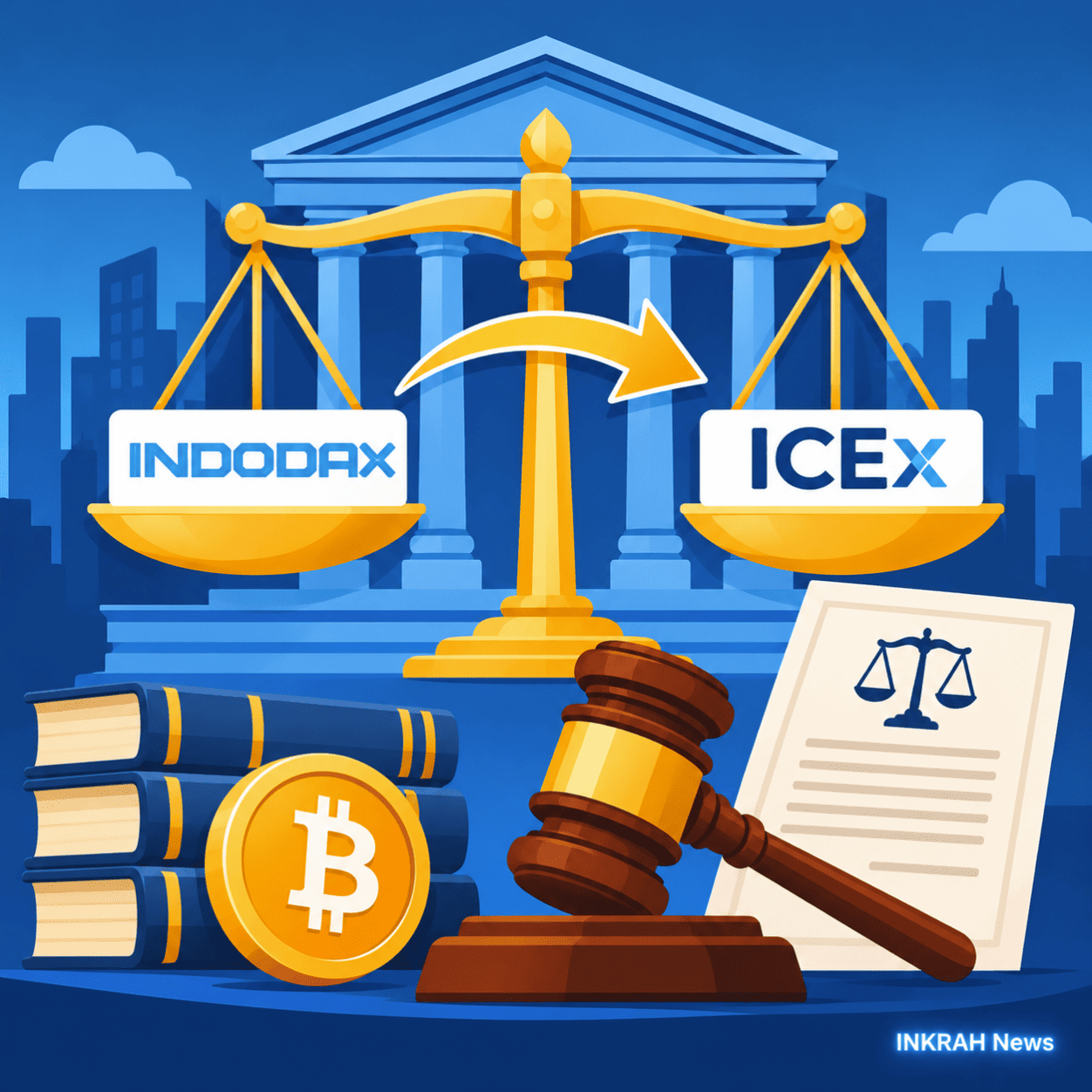
The transfer of membership by PT Indodax Nasional Indonesia from PT Central Finansial X (CFX) to Indonesia Crypto Exchange (ICEx), which took effect on 25 November 2026, marks a new chapter in the development of Indonesia’s digital financial asset industry. The decision was announced through a company statement on Thursday, 26 November 2026, following a migration process involving coordination with relevant parties. Indodax Co-Founder and Chief Executive Officer, William Sutanto, stated that the membership change was intended to strengthen cooperation in trading infrastructure, improve liquidity, broaden market options and encourage domestic transaction activity. ICEx itself is a digital financial asset exchange operated by PT Fortuna Integritas Mandiri and has obtained a licence from the Financial Services Authority (Otoritas Jasa Keuangan or OJK). This development has attracted attention because Indodax is one of the major players in Indonesia’s cryptocurrency trading industry, meaning that its transfer could have implications for competition between exchanges, institutional relationships and the future direction of the national digital financial industry.
This development should be examined through the institutional framework governing digital financial asset trading in Indonesia. Since 10 January 2025, regulatory and supervisory responsibilities for digital financial assets, including crypto-assets, have been transferred from the Commodity Futures Trading Regulatory Agency (Badan Pengawas Perdagangan Berjangka Komoditi or Bappebti) to OJK, pursuant to Law Number 4 of 2023 concerning the Development and Strengthening of the Financial Sector (the P2SK Law). Its operational framework is further regulated under Financial Services Authority Regulation Number 27 of 2024 concerning the Organisation of Digital Financial Asset Trading, Including Crypto-Assets, which was subsequently amended by POJK Number 23 of 2025. This transfer of authority demonstrates a change in the regulatory character of the cryptocurrency industry, moving from the commodity futures trading regime towards the financial services supervisory regime. This shift is significant because crypto-assets possess characteristics that intersect with technology, trading, wealth storage, information security and consumer financial risks. OJK bears the responsibility of ensuring that industrial innovation continues within a framework of accountable governance.
One fundamental distinction that the public should understand is the difference between a cryptocurrency exchange and a digital financial asset trader. An exchange, such as CFX or ICEx, provides trading infrastructure, establishes market rules and carries out supervisory functions over its members within its authorised remit. Meanwhile, a Digital Financial Asset Trader (Pedagang Aset Keuangan Digital or PAKD), such as Indodax, deals directly with consumers through services involving the purchase, sale, deposit and withdrawal of assets, as well as the provision of information concerning traded assets. This division of functions resembles the institutional arrangement in the capital market, where the Indonesia Stock Exchange provides trading infrastructure whilst securities companies conduct securities brokerage activities subject to applicable licences and regulations. This analogy helps the public understand that an application used to purchase Bitcoin or other crypto-assets does not automatically constitute the exchange responsible for operating the market infrastructure. From a legal standpoint, this distinction determines the scope of obligations, responsibilities, supervisory mechanisms and the parties that may be held accountable in the event of a breach.
Indodax’s transfer also carries broader institutional implications beyond a mere change in membership affiliation. ICEx operates through PT Fortuna Integritas Mandiri, whilst its supporting ecosystem involves Crypto Asset Clearing International (CACI) as the clearing institution and International Crypto Custodian (ICC) as the asset custodian. These distinct functions are important because trading, clearing and custody constitute interconnected activities, each carrying its own legal and operational risks. The exchange manages market governance, the clearing institution handles transaction clearing and settlement arrangements, whilst the custodian is concerned with the safeguarding and storage of digital financial assets. A separation of institutional functions can help establish risk-control mechanisms through a more clearly defined allocation of responsibilities. However, the presence of several institutions within one ecosystem still requires consistent coordination standards, information disclosure and clear accountability mechanisms to prevent uncertainty over liability when disputes or operational failures arise.
The legal implications are particularly evident in CFX’s official announcement dated 25 November 2026. The termination of Indodax’s membership did not constitute a unilateral action automatically indicating a breach by the company, but rather followed Indodax’s voluntary application to withdraw from its membership. The termination was formalised through CFX Decree Number CFX/SK/010/XI/2026 dated 24 November 2026 and became effective the following day. From that date, Indodax ceased to hold membership status with CFX, and its previously issued membership certificate was declared invalid. This fact is important to prevent inaccurate reporting that could create the impression that the transfer resulted from regulatory sanctions or compliance issues. Legally, voluntary withdrawal from exchange membership must be distinguished from the revocation of a business licence as a digital financial asset trader, since the two involve different legal objects, sources of authority and legal consequences.
Another development worthy of attention is the transfer of clearing services from PT Kliring Komoditi Indonesia (KKI) to PT Pranata Karya Solusi, known as Crypto Asset Clearing International (CACI). According to Indodax’s official notification, the updated exchange and clearing membership arrangements took effect on 25 November 2026 at 00.00 Western Indonesian Time (WIB). This integration required adjustments to several rupiah transaction facilities, including deposits through QRIS, electronic wallets and virtual accounts, as well as fund withdrawals. Indodax stated that cryptocurrency trading activities would continue as normal throughout the integration process, whilst certain payment services were temporarily suspended in accordance with the scheduled maintenance arrangements. The company also stated that recording and reconciliation procedures were being carried out to safeguard customers’ ownership rights over the funds and crypto-assets held in their respective accounts.
From a consumer protection standpoint, this infrastructure transfer raises issues that warrant serious consideration. Article 3 of POJK Number 27 of 2024 requires digital financial asset trading operators to conduct their activities in an orderly, fair, transparent and efficient manner, supported by sound corporate governance, risk management, market integrity, information system security, consumer protection and personal data protection. These provisions establish the security of consumers’ funds and assets as part of an operator’s legal obligations, rather than merely a commercial promise made by the company. Indodax’s statements concerning the protection of customers’ funds, assets and personal data should be supported by administrative and technical evidence that can be independently examined, including balance reconciliation, transaction records, digital wallet security and clear complaint resolution procedures. The principle of pacta sunt servanda reminds us that agreements lawfully entered into are binding upon the parties, meaning that changes in the institutional relationships of service providers do not automatically extinguish consumer rights arising from pre-existing legal relationships. Such protection is also connected to Law Number 8 of 1999 concerning Consumer Protection and Law Number 27 of 2022 concerning Personal Data Protection. Within this framework, information transparency is essential to maintaining public confidence in digital asset trading operators.
From an economic perspective, the principal reasons put forward by Indodax concern improving liquidity and expanding market options for domestic investors. Liquidity directly affects trading quality because it determines how easily market participants can buy or sell assets without causing excessive price movements. A market with adequate liquidity generally offers more competitive bid-ask spreads and provides room for transactions involving investors with different levels of capital. The presence of ICEx as an alternative exchange infrastructure may encourage competition between market operators to improve system quality, cost efficiency and service innovation. Such competition has the potential to generate economic benefits for traders and consumers when conducted through healthy market mechanisms. The doctrine of perfect competition in economic theory teaches that competition can improve the efficiency of resource allocation when market participants are afforded fair opportunities to conduct business and adequate information is available. Nevertheless, these economic benefits remain dependent on the regulator’s ability to safeguard market integrity, prevent conflicts of interest and ensure that competition does not develop into a race to lower security standards.
The sociological dimension of this development is closely connected to the level of public confidence in institutions operating cryptocurrency trading services. For some retail investors, trading applications represent their primary gateway to accessing digital financial instruments that are subject to substantial price volatility. They may understand movements in Bitcoin or Ethereum prices, yet remain unfamiliar with the respective functions of exchanges, traders, clearing institutions and custodians. This distinction is important because each institution has a different legal position and set of responsibilities within the transaction chain. Such a lack of understanding may increase public vulnerability to misleading information, excessive promotional claims and the assumption that a single company bears responsibility for every trading-related risk. Public education concerning the institutional structure of the cryptocurrency industry should therefore form part of the broader consumer protection agenda. A sound legal approach should take this social reality into account so that regulation does not remain merely a collection of administrative rules that are difficult for the public to understand.
Cyber resilience also occupies an important position in discussions surrounding Indodax’s transfer to ICEx. William Sutanto pointed out that several cyber incidents affecting global cryptocurrency platforms serve as a reminder of the need to develop resilient trading infrastructure. This statement demonstrates that competition between exchanges cannot be measured solely by transaction volumes, membership numbers or the variety of available assets. The ability to prevent unauthorised access, maintain the integrity of transaction records, safeguard consumer assets and restore systems following disruptions constitutes an important indicator of an operator’s quality. Article 3 of POJK Number 27 of 2024 expressly identifies the security and reliability of information systems, including cyber resilience, as principles that must be implemented by operators. This obligation is consistent with the maxim ubi jus ibi remedium, which conveys that the existence of a right must be accompanied by an available remedy when that right is violated. Consumers who lose access to their assets or suffer losses due to system failures require clear complaint mechanisms, evidential procedures and dispute resolution arrangements.
At the philosophical level, the development of the cryptocurrency industry brings together two equally important interests, namely the freedom to innovate and the obligation to protect the public interest. The principle of salus populi suprema lex esto conveys that the safety and welfare of the people should be regarded as the supreme law. This principle is particularly relevant to regulators when formulating policies governing digital asset trading, an industry that continues to evolve alongside technological developments. The state must provide sufficient room for innovation so that domestic industries can compete and attract economic activity within national borders. At the same time, business freedom must remain subject to standards of compliance, transparency, security and accountability towards consumers. Excessively relaxed supervision may create opportunities for abuse, whilst disproportionate regulation may obstruct industrial growth and encourage market participants to seek alternative jurisdictions. Balancing these two interests is an important measure of the quality of digital economic governance.
Indodax’s transfer from CFX to ICEx in November 2026 should be regarded as an institutional development carrying implications for business competition, legal certainty and consumer protection. The existence of more than one exchange provides alternative infrastructure for digital financial asset trading companies to select operational partners according to their business requirements and applicable regulatory provisions. For OJK, this development creates increasingly complex supervisory responsibilities, particularly in ensuring equal standards of licensing, governance, risk management and reporting across institutions. For trading companies, the choice of exchange should be based on considerations of efficiency, security, transaction settlement quality and compliance with applicable regulations. Meanwhile, for consumers, the success of this transfer should be reflected in improved services, transparent fees, efficient transactions and guarantees concerning asset security. The success of the digital financial industry should not be measured solely by increases in transaction values or user numbers, since the legitimacy of a market is also determined by its institutions’ ability to maintain public confidence. This is where legal certainty acquires substantive meaning, namely through clear rules, enforceable protection and accountability that can be pursued whenever losses occur.