
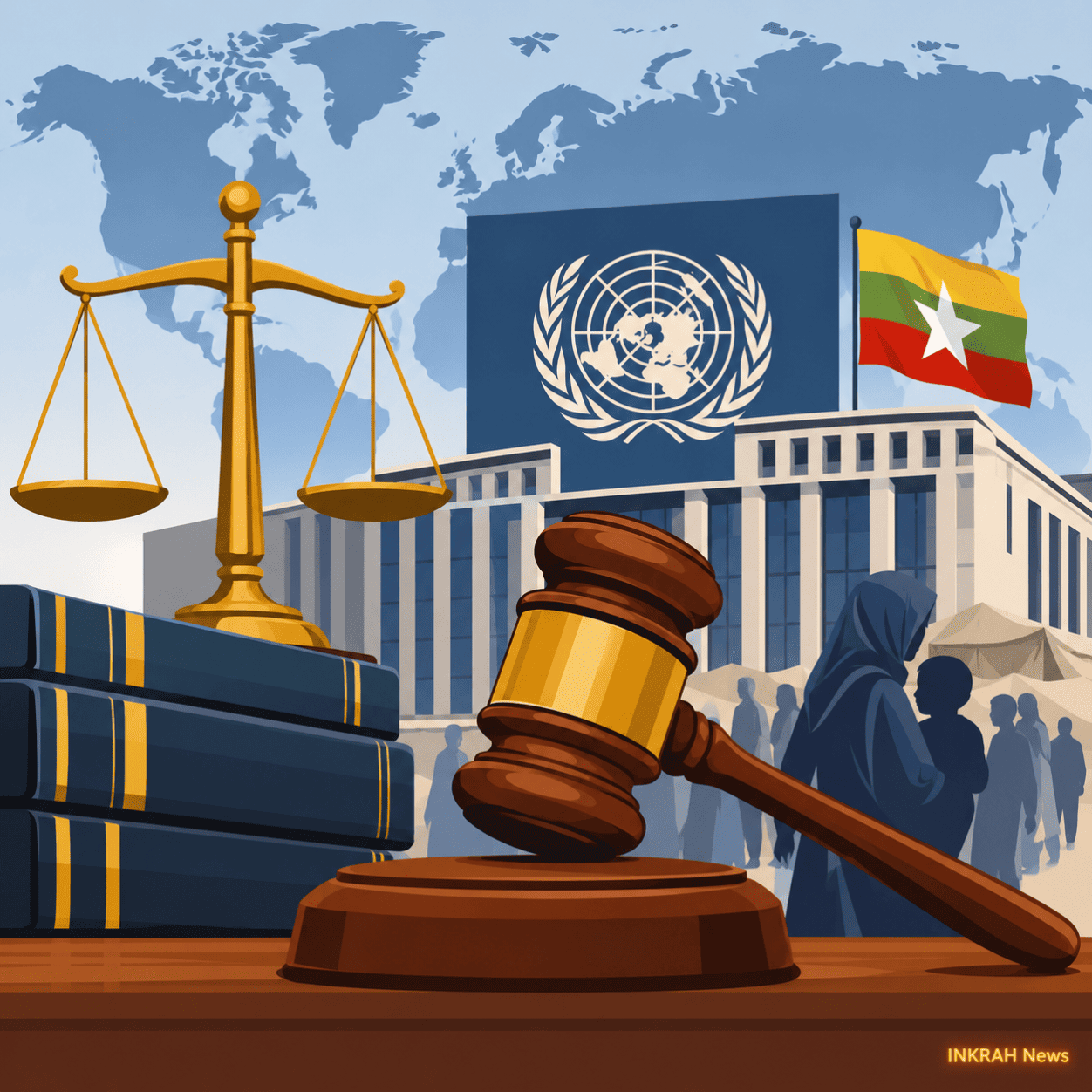
The Hague, 19 November 2026, the International Court of Justice (ICJ), the principal judicial organ of the United Nations, delivered a landmark judgement concerning systematic violence against the Rohingya ethnic community in Myanmar. The highest court of the United Nations ruled that the actions carried out by Myanmar's military against the Rohingya population in Rakhine State in 2017 constituted the crime of genocide. The judgement was based on a series of acts, including mass killings, widespread sexual violence, torture, and attacks against children and civilians attempting to flee. The panel of judges considered that the cumulative evidence demonstrated a specific intention to destroy a substantial part of the Rohingya as an ethnic and religious group. This case represents an important chapter in the history of international justice since the end of the Second World War. Reuters reported that the ruling marked the first time the ICJ had expressly established a state's responsibility for genocide.
The proceedings, which attracted considerable international attention, originated from an application brought by The Gambia against Myanmar in 2019. The West African country submitted its application to the ICJ alleging violations of the 1948 Convention on the Prevention and Punishment of the Crime of Genocide. The proceedings received support from the Organisation of Islamic Cooperation (OIC), which called for the alleged atrocities committed against the Rohingya to be examined through international legal mechanisms. The case remained under judicial consideration for seven years before the judges delivered their judgement in The Hague. One of the principal legal questions concerned the existence of dolus specialis, namely the specific intention to destroy, in whole or in part, a protected group. This element of intent is fundamental because genocide cannot be established solely by reference to the number of victims or the scale of destruction caused. The Court was required to identify a connection between the acts committed and the objective of destroying the targeted group.
Evidence concerning patterns of violence played a central role in the judges' considerations. Military operations conducted by Myanmar's security forces involved mass executions of men and boys, rape of Rohingya women, and the burning of hundreds of villages. According to reports from the United Nations fact-finding mission, which formed part of the evidential material considered by the Court, the death toll during these operations was estimated to have reached at least 10,000 people. At least 700,000 Rohingya were also forced to abandon their homes as a result of the attacks. The judges concluded that the combined evidence supported one reasonable inference, namely an intention to destroy a substantial part of the Rohingya population in northern Rakhine State. This reasoning demonstrates that the crime of genocide may be established through a combination of interconnected facts, including patterns of attacks, the scale of violence, the characteristics of victims, and the conduct of state authorities. Under international criminal law doctrine, proving specific intent remains one of the most complex challenges in genocide proceedings.
The principle of state responsibility represents one of the most significant legal aspects of this judgement. The ICJ held Myanmar responsible for the conduct of its military personnel who committed atrocities against the Rohingya community. This principle is closely associated with the doctrine of state responsibility, which establishes a state's liability for the conduct of its organs or officials where such conduct breaches international obligations. Under international law, acts committed by military personnel acting as state organs are, in principle, attributable to the state concerned. This principle is reflected, amongst other provisions, in Article 4 of the International Law Commission's 2001 Articles on Responsibility of States for Internationally Wrongful Acts. A state cannot avoid international responsibility merely by arguing that the unlawful conduct was carried out by a particular institution operating under its authority. The legal maxim ubi jus ibi remedium, meaning where there is a right, there must be a remedy, is particularly relevant when victims seek recognition of their suffering and redress for violations of their rights. The judgement reinforces the principle that state sovereignty does not provide absolute immunity for conduct that violates international legal norms.
The Rohingya crisis also demonstrates how identity-based discrimination can develop into organised violence when a state fails to protect members of its own population. For decades, the Rohingya community has faced restrictions on its rights, denial of its identity, and discriminatory treatment in predominantly Buddhist Myanmar. The situation deteriorated further when hate propaganda was used to foster hostility towards this minority group. The ICJ's judgement also addressed the dissemination of hate speech by Myanmar's military through Facebook, a social media platform widely used by the public at the time. This demonstrates how mass violence can acquire a degree of social acceptance through the creation of stigma, dehumanisation, and the dissemination of information targeting particular group identities. Philosophically, such conduct contradicts the principle of equal human dignity, which forms the foundation of modern human rights. The principle of human dignity recognises every individual as a legal subject possessing inherent worth, irrespective of ethnicity, religion, nationality, or social standing.
The displacement of the Rohingya population has also had far-reaching social and economic consequences across Southeast Asia. Approximately 1.2 million Rohingya refugees are now living in the Cox's Bazar refugee settlements in Bangladesh, whilst the displacement resulting from the 2017 military operations forced at least 700,000 people to leave Myanmar. The loss of homes, land, employment, and access to education has created long-term dependence on humanitarian assistance. Bangladesh has had to bear the burden of providing food, healthcare, accommodation, and basic facilities for an exceptionally large refugee population. These circumstances have placed considerable pressure on public expenditure, the environment, employment opportunities, and social stability within host communities. From an economic standpoint, forced displacement also represents the loss of human capital, productivity, and opportunities for the Rohingya to establish independent livelihoods. The resulting damage cannot be measured solely in material terms, as generations deprived of education and decent living opportunities may face structural poverty over the long term.
Regarding the restoration of victims' rights, the ICJ ordered Myanmar to provide compensation for the violations it had committed, with the amount and arrangements to be determined at a later stage. The Court also reaffirmed Myanmar's obligation to ensure the safe and dignified return of Rohingya refugees to their places of residence and to facilitate the reunification of families separated as a result of the unlawful acts. This order is significant because reparation for victims of international crimes must encompass both material and non-material dimensions. Such an approach is consistent with the principle of restitutio in integrum, which seeks, as far as possible, to restore the situation to the condition that existed before the violation occurred. Its implementation will require security guarantees, the restoration of civil documentation, recognition of identity, access to education, and protection against discrimination. Physical repatriation without guarantees of citizenship rights and legal protection risks exposing the Rohingya community to the same conditions of vulnerability once again. Respect for the dignity of victims must remain the principal measure of the success of implementing this judgement.
The legal force of an ICJ judgement differs from the mechanisms of international criminal justice. As the principal judicial organ of the United Nations responsible for resolving disputes between states, the ICJ has jurisdiction to determine whether a state has breached its international obligations under treaties or other applicable rules of international law. Its judgements are final and binding upon the parties to the proceedings, with no right of appeal. However, the ICJ does not possess its own enforcement authorities to compel a state to comply with a judgement establishing its responsibility. Article 94(2) of the United Nations Charter provides a mechanism through which an interested party may refer a failure to comply with an ICJ judgement to the United Nations Security Council. The Security Council may then consider measures necessary to give effect to the judgement. This arrangement illustrates a fundamental challenge between legal certainty at the normative level and the practical effectiveness of international law enforcement. The principle of pacta sunt servanda, which requires parties to perform their treaty obligations in good faith, remains an important foundation for state compliance with international obligations.
The distinction between the ICJ and the International Criminal Court (ICC) must also be understood to prevent any misunderstanding of the legal consequences of this judgement. The ICJ determines the responsibility of Myanmar as a state, whereas the ICC has jurisdiction to prosecute individuals for international crimes falling within its mandate. This means that the ICJ judgement does not automatically impose prison sentences on military officials or individuals suspected of involvement in atrocities against the Rohingya. Individual criminal responsibility still requires separate investigation, evidential assessment, and judicial proceedings in accordance with the applicable procedural rules. This distinction demonstrates that international law recognises responsibility at both state and individual levels. A state may be held internationally responsible for the conduct of its governmental organs, whilst individual perpetrators may separately face criminal liability under the applicable legal elements and jurisdictional requirements. These two mechanisms serve distinct functions in preventing impunity and securing justice for victims.
The consequences of this judgement are expected to extend beyond Myanmar's geographical boundaries, as it may serve as a reference point for the examination of other genocide cases before international courts. One proceeding that may attract attention in light of the Court's legal reasoning is South Africa's application against Israel concerning alleged genocide in the Gaza Strip, submitted in 2023. The two cases involve different facts, parties, and evidential questions, meaning that the Myanmar judgement cannot automatically determine the outcome of other proceedings. Nevertheless, the ICJ's reasoning concerning the proof of specific intent, patterns of violence, and state responsibility may provide important guidance for the development of international legal jurisprudence. The history of international justice has previously recorded findings of genocide in Rwanda in 1994, the Srebrenica massacre in Bosnia in 1995, and the atrocities committed by Cambodia's Khmer Rouge regime in the late 1970s. The judgement concerning Myanmar adds another significant development to international efforts to establish accountability for the most serious crimes against humanity.
For the Rohingya community, the judgement delivered in The Hague represents legal recognition of the suffering they have endured for many years. In the Cox's Bazar refugee settlements in Bangladesh, more than a thousand refugees welcomed the announcement through television broadcasts with considerable hope. Wai Wai Nu, Executive Director of the Women's Peace Network and a former political prisoner, described the decision as recognition of the suffering and identity of the Rohingya people. Another Rohingya community representative, Sayed Ullah, expressed hope that the judgement would strengthen their efforts to return to their homeland. The British Government also took diplomatic action by expelling Myanmar's defence attaché and indicating that further measures would be considered. Several British parliamentarians also called for discussions at the United Nations Security Council to secure concrete measures supporting the implementation of the judgement. These responses demonstrate that international justice requires political support, diplomacy, and collective commitment from the international community.
The ICJ judgement against Myanmar conveys a fundamental message that state power must always remain subject to the rule of law and respect for human rights. Recognition of genocide represents an important legal achievement, yet the true value of the judgement will depend largely on the fulfilment of reparation obligations and the establishment of safeguards against the recurrence of similar crimes. Victims require more than formal recognition, as they are entitled to security, identity, housing, and opportunities to live with dignity. The international community also bears a moral and legal responsibility to encourage Myanmar to comply with the Court's judgement. The maxim justice delayed is justice denied serves as a reminder that excessively prolonged justice can perpetuate victims' suffering and undermine confidence in legal institutions. The history of the Rohingya people demonstrates how tolerated discrimination and violence against minority communities can develop into humanitarian tragedies extending far beyond national borders. The measure of international law's success lies not merely in a court's willingness to declare a state responsible, but in the international community's ability to ensure that victims' rights are genuinely restored and that perpetrators are denied the opportunity to commit similar atrocities again.