Saudi Arabia's air defences shot a Houthi drone out of the sky south of Mecca on Tuesday evening, 16 September 2026, according to Major General Turki al-Maliki, spokesman for the Saudi-led coalition fighting in Yemen. Al-Maliki called the targeting of Islam's holiest shrine a disgraceful act, a phrase that landed with real weight given Mecca's status as the focal point of the annual Hajj pilgrimage drawing millions of the faithful each year. The 57-nation Organisation of Islamic Cooperation piled in within hours, branding any strike on Mecca or on Medina province, home to Islam's second holiest shrine, an intolerable transgression that no political grievance could excuse. The Houthis, the Iran-backed group that now controls most of western Yemen, hit back hard, insisting through military spokesman Yahya Sarea that no threat whatsoever had been aimed at the holy sites and that their operations strike only oil facilities and military bases well away from sacred ground. Sarea framed the barrage as payback for more than four hundred and fifty Saudi air strikes battering Houthi territory over the previous week, adding for good measure that his fighters had downed a Saudi jet over Marib province. Riyadh's coalition offered no immediate rebuttal to the denial, though al-Maliki promised deterrent measures against what he called the terrorist Houthi militia and its hostile conduct, a threat that reads less like posturing and more like a government readying its next move. Saudi authorities sounded a string of brief incoming-projectile alerts across western regions that same day, Mecca and the port city of Jeddah among them, sending a jolt through a kingdom unused to sirens near its most sacred address. The American embassy in Riyadh piled on further unease, issuing a reconsider-travel advisory over Houthi strikes hitting cities, airports, military bases, diplomatic posts and energy infrastructure alike. Every strand of who did what, where the drone fell, and when the alarms sounded points toward a single uncomfortable truth: a war fought mainly with words and denials until now has started producing hardware that lands within sight of the world's most sacred skyline. Getting to the bottom of why this particular night mattered so much requires stepping back into the wider Yemeni conflict feeding it.
Yemen's civil war stretches back to 2014, when Houthi fighters stormed out of their northern heartland and drove the recognised government out of the capital, Sanaa, a coup that tipped the country into chaos within months. Saudi Arabia assembled a coalition of Arab states the following year determined to restore that ousted government, dragging the kingdom into a Yemeni quagmire it has never fully escaped since. Over a decade of fighting has reportedly claimed more than one hundred and fifty thousand lives and produced what the United Nations still calls one of the planet's worst humanitarian catastrophes, leaving upward of twenty-two million people dependent on some form of aid. A fragile informal ceasefire held rough shape for four years before beginning to fray in July 2026, when the Houthis declared what they termed a maritime embargo against Saudi Arabia and resumed missile and drone strikes on airports, oil sites and Red Sea tankers. The Houthis justified that renewed offensive as retaliation for a Saudi blockade choking their own ports and airports, together with an air strike on Sanaa's airport that Sanaa blamed squarely on Riyadh. Momentum has swung hard in the Houthis' favour on the ground this month, with fighters seizing the strategic Red Sea port of Mokha and Perim Island, a chokepoint commanding the Bab al-Mandab Strait through which vast volumes of Asia-Europe trade normally pass toward the Suez Canal. Saudi Arabia's East-West pipeline, its vital artery for shuttling Gulf crude across to the Red Sea export terminal at Yanbu, had to shut down entirely after a strike Riyadh pinned on Iran-backed militias operating out of Iraq, with some experts warning repairs could stretch beyond a month even as America's energy secretary predicted flows resuming within days. Saudi Crown Prince Mohammed bin Salman has reportedly leaned personally on President Trump to authorise direct American military action against the Houthis, sources telling CBS News that Trump has so far resisted committing troops while offering intelligence and targeting help instead. Weighing every thread together, a localised insurgency has metastasised into a genuine regional flashpoint entangling superpower diplomacy, global energy flows and, now, the safety perimeter around Islam's most sacred city.
Approached through a strictly juridical lens, this affair sits uncomfortably close to several bright lines drawn by international humanitarian law decades before a single Houthi drone existed. The Fourth Geneva Convention singles out religious buildings and sites for heightened protection during armed conflict, a rule grounded in the recognition that destroying such places wounds an entire community's identity rather than merely its infrastructure. The Latin adagium nullum crimen sine lege reminds every tribunal that punishment demands a pre-existing rule, and this particular rule has sat on the books since 1949, long predating any Yemeni civil war. International humanitarian law's twin principles of distinction and proportionality separate legitimate military targets from protected civilian and religious sites, a test any projectile straying near the Kaaba would fail regardless of who launched it. Scholars working within the jus cogens tradition, the peremptory norms no state may lawfully override even by treaty, would slot the prohibition on attacking sacred sites alongside the bans on genocide and torture, categories from which no derogation is ever permitted. The maxim aut dedere aut judicare, extradite or prosecute, binds any state that might one day shelter an individual found responsible for ordering such a strike, an obligation that exists mostly on paper given how rarely it gets enforced in practice. Attribution remains genuinely contested in this case, since al-Maliki's accusation and Sarea's denial cannot both be accurate, and any credible prosecution would demand forensic evidence sturdy enough to withstand scrutiny rather than wartime posturing from either capital. The underlying legal architecture stands firm regardless of that unresolved attribution question, since the ban on striking religious sanctuaries binds every party to every conflict without exception. A further Roman-law maxim, ubi jus ibi remedium, insists that wherever a right exists a remedy must exist too, and the chronic absence of any workable remedy for threats against sacred geography is exactly the gap this piece means to expose. Treaty text drafted with the finest legal craftsmanship changes nothing on its own without an enforcement body prepared to act the moment danger appears on the radar.
Viewed through a human rights frame, the stakes climb higher still rather than settle down. Article 18 of the Universal Declaration of Human Rights guarantees freedom of thought, conscience and religion to every person alive, a guarantee mirrored in the International Covenant on Civil and Political Rights that binds much of the international community in principle if not always in domestic practice. Mecca functions as the qibla, the fixed direction toward which well over a billion Muslims turn in prayer multiple times daily, meaning any projectile entering its airspace threatens the single most concentrated expression of religious devotion found anywhere on Earth. Sending a drone or missile anywhere near that shrine, whatever its intended target, risks trampling the collective right of an entire global faith community to worship without fear, a right that international law treats as inviolable rather than negotiable. Human rights specialists increasingly categorise credible threats against sites of comparable sanctity, Mecca among them, as gross violations precisely because the psychological harm radiates vastly beyond any physical blast radius a weapon might actually produce. A drone intercepted well short of its supposed destination still manages to rattle millions of believers who will never come within a thousand miles of the interception site, a form of collective distress that casualty statistics alone can never capture. The doctrine of erga omnes obligations, duties every state owes to the whole international community rather than to a single victim state, applies with unusual force here, since an assault on worship at its most sacred node wounds humanity's shared conscience rather than any one nation's pride alone. Sociologically, faith communities process threats to sacred geography as existential rather than tactical, meaning the trust deficit created by even a failed strike lingers across generations and feeds grievance narratives that outlast any particular ceasefire agreement. The Organisation of Islamic Cooperation's swift condemnation reflects precisely that dynamic, a fifty-seven-member bloc closing ranks the instant its members sensed a threat to shared devotional ground rather than to any single nation's territory. Treating this episode as an ordinary battlefield mishap badly misjudges both the legal category it falls into and the emotional depth of the wound it risks inflicting on fourteen centuries of unbroken pilgrimage tradition. Freedom to worship unmolested sits at the very foundation of what makes a person free, a truth this incident forces the world to confront afresh.
Sovereignty forms the second load-bearing pillar propping up this entire argument, and it earns identical rigour. Article 2(4) of the United Nations Charter bars the threat or use of force against any state's territorial integrity or political independence, a rule international lawyers routinely describe as the cornerstone holding up the entire post-1945 order. The maxim par in parem non habet imperium, an equal holds no power over an equal, distils centuries of Westphalian thought into a single crisp phrase, insisting no sovereign may dominate another regardless of size, wealth or ideology. Saudi Arabia's territory and airspace belong to Saudi Arabia alone, and any armed incursion reaching that space from beyond its borders chips away at a principle every government on the planet relies upon for its own protection. Non-state actors such as the Houthis complicate the tidy Westphalian picture considerably, since sovereignty doctrine was built for relations between states and struggles to accommodate an insurgent movement wielding missiles allegedly supplied by a foreign patron. That complication never dissolves the underlying principle, it simply proves why the international system urgently needs mechanisms capable of holding both states and their proxies to identical account. Iran's alleged role in arming and training the Houthis, a claim repeated across successive intelligence assessments and Security Council reports, raises the spectre of a state using deniable intermediaries to violate a neighbour's sovereignty by remote control. Should that pattern be proven, it represents exactly the sort of hybrid aggression the UN Charter's framers never anticipated and that today's enforcement bodies remain woefully unequipped to punish. A state's borders and airspace express its people's right to self-determination in physical form, and puncturing them with missiles launched from beyond the frontier amounts to an assault on that right every bit as grave as a full ground invasion. No grievance, however longstanding or however many air strikes preceded it, earns any faction a licence to fire ordnance across an international boundary and call the matter purely domestic. Sovereignty and freedom of worship turn out to be two faces of a single coin in this story, since a state's capacity to protect its citizens' devotional life depends entirely on its capacity to keep hostile projectiles out of its own skies.
Cast an economic eye across the same events and the numbers only sharpen the urgency further. The Houthis' capture of Mokha and Perim Island hands them a grip on the Bab al-Mandab Strait, the southern gateway through which enormous volumes of Asia-Europe trade normally flow toward the Suez Canal, and that grip alone rattles shipping insurers worldwide. Saudi Arabia's East-West pipeline, its lifeline for moving Gulf crude across to the Yanbu export terminal, sits offline after a strike blamed on Iran-linked militias, with repair estimates ranging from a matter of days to well over a month depending on whose assessment you trust. Riyadh has leaned on Red Sea export routes with growing intensity since the American and Israeli confrontation with Iran effectively shut the Strait of Hormuz, meaning any disruption along the Red Sea corridor now threatens a far larger share of the kingdom's oil revenue than it once did. War-risk insurance premiums for vessels transiting Red Sea waters have historically spiked within days of any escalation touching Saudi territory, a cost that inevitably trickles down to households filling up their cars from Newcastle to Naples. The Hajj and Umrah pilgrimage economy generates tens of billions of dollars annually for the kingdom across hospitality, aviation, retail and construction, an entire ecosystem resting on pilgrims trusting that Mecca remains safe to visit regardless of what else is happening in the region. Even a thwarted drone strike risks denting that trust, and trust, once cracked, generally costs vastly more to rebuild than it ever cost to preserve in the first place. Missile defence economics compound the strain further, since Patriot-style interceptors carry eye-watering per-shot costs that bleed the wealthier combatant's treasury even when every intercept succeeds cleanly. The UN Security Council's emergency session on Tuesday saw both the Yemeni government and Saudi Arabia press for tougher action specifically to protect freedom of navigation through Bab al-Mandab, underlining how thoroughly a religious and military dispute has fused with hard commercial interest. Global energy markets, already jumpy from the wider Iran-linked confrontation, treat any hint of instability near Mecca or the Red Sea as a cue to bid prices upward, a shock that lands eventually on petrol pumps and heating bills right across Britain and Europe. A single averted strike can therefore carry a price tag running into the billions once shipping disruption, insurance costs and pilgrimage anxiety are tallied together, a sobering demonstration of how tightly sacred geography and hard commerce have become entwined.
Philosophically, the episode forces a reckoning with doctrines stretching back centuries, starting with Augustine and Aquinas's theory of the just war, which drew a sharp line between jus ad bellum, the justice of resorting to war at all, and jus in bello, the justice of conduct once fighting has begun. A movement convinced of the righteousness of its cause forfeits moral standing the instant its weapons drift toward civilian sanctuaries, because just war theory has never accepted the notion that a worthy end sanctifies any available means. Immanuel Kant's essay on perpetual peace imagined a federation of free states bound by shared law rather than fear, a vision that reads today less like starry-eyed idealism and more like an unfinished design brief the modern world still owes itself. Kant's insistence that no state should interfere by force in another state's constitution or government maps almost exactly onto the sovereignty norm this piece has already defended, suggesting an eighteenth-century philosopher grasped something the twenty-first century still struggles to build into working institutions. Thomas Hobbes supplies the darker counterweight, warning that without a common power capable of keeping every party in check, relations among competing sovereigns risk sliding into a condition uncomfortably close to permanent war, an image that fits the current Middle Eastern landscape with unsettling precision. Social contract thinking, running from Hobbes through Locke to Rousseau, rests on the notion that individuals surrender a slice of natural liberty in exchange for collective protection, a logic with nothing stopping its extension upward into a genuine compact among sovereign nations. John Rawls, writing generations later in his reflections on the law of peoples, argued that decent societies owe one another mutual respect and non-aggression as the bare minimum condition for any just international order worth the name. Each of these thinkers, separated by continents and centuries, converges on a single hard-won insight: peace has never been the natural resting state among nations, it has always required deliberate architecture built and maintained on purpose. The drone streaking toward Mecca's outskirts this week stands as fresh evidence that architecture remains unbuilt, a world still drafting blueprints for perpetual peace without ever pouring the foundations. Treating institution-building as urgent statecraft rather than idealistic seminar-room chatter is precisely the shift these philosophical traditions have been demanding all along.
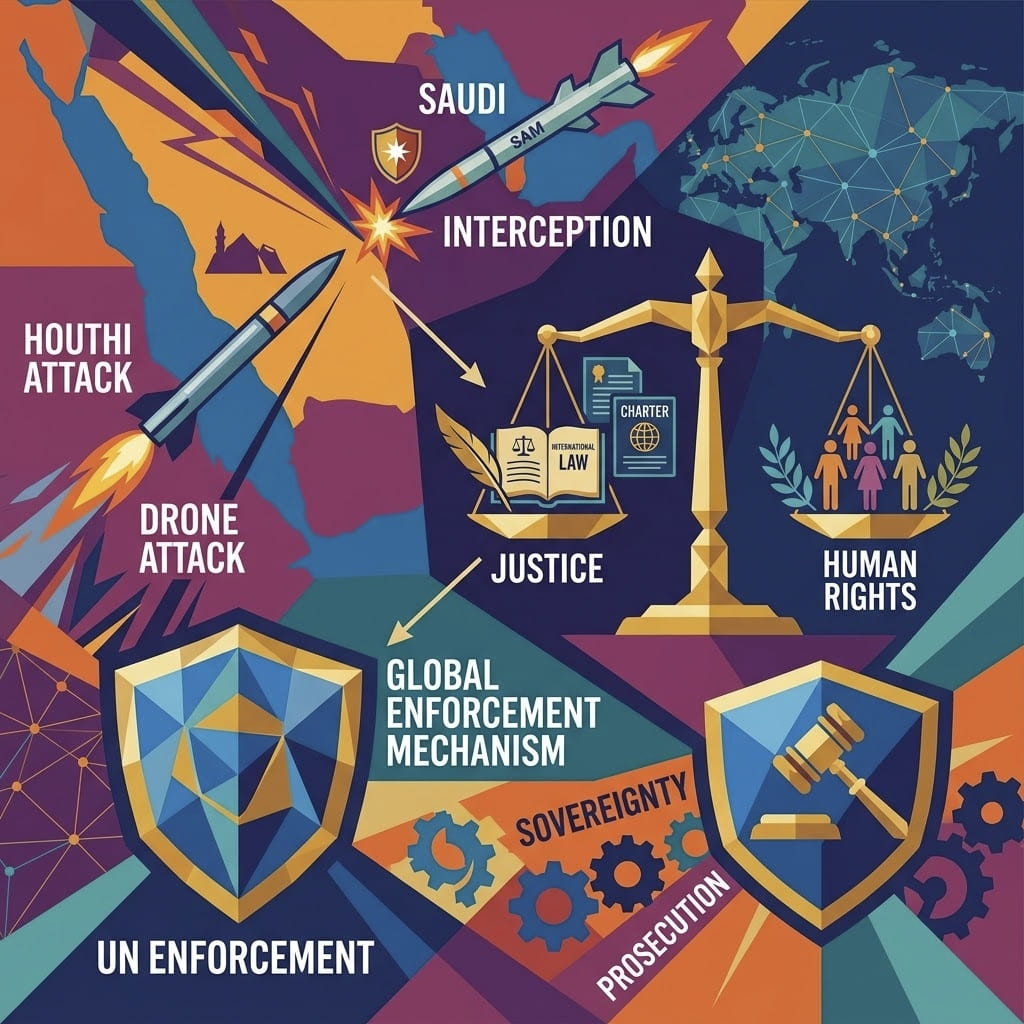
This is the point where the argument sharpens to its keenest edge, one worth pressing without apology. An attack against Mecca, attempted or completed, amounts to a grave violation of human rights precisely because it strikes at freedom of worship in its most concentrated and irreplaceable form, and no political grievance, however long-nursed, can launder that act into legitimacy. Any state's territory and airspace remain inviolable under the sovereignty principle underwriting the entire post-war order, meaning no faction, government or foreign patron earns the right to punch missiles across a border and dress it up as an internal Yemeni affair. Both principles reinforce one another rather than compete, since a world tolerating cross-border strikes on sovereign soil is, by identical logic, a world that cannot guarantee safety for the worship conducted within that very soil. What today's international order conspicuously lacks is a standing mechanism capable of intercepting these threats before they materialise and of hauling perpetrators before a court armed with genuine enforcement muscle rather than symbolic condemnation alone. The case for assembling a dedicated global guardian alliance, drawn jointly from every sovereign state committed to the rule of law, has rarely looked more pressing than it does this week. Such a force would operate as a genuinely multilateral shield rather than any single bloc's private army, tasked specifically with detecting, intercepting and deterring cross-border ordnance aimed at civilians, holy sites and critical infrastructure alike. Britain's own long record of peacekeeping contribution, from Cyprus through the Balkans, proves that pooled sovereignty in the service of collective security is neither unprecedented nor unworkable, it simply needs scaling up several orders of magnitude and given proper teeth. Alongside that guardian force, the argument demands an international court vested with unambiguous legitimacy to issue binding warrants and direct law enforcement bodies to apprehend and try those responsible for strikes on protected sites, closing the aut dedere aut judicare gap that currently lets so many culprits sleep soundly at home. The existing International Criminal Court, valuable as its record has been, suffers from patchy jurisdiction and an enforcement arm entirely dependent on member-state goodwill, a design flaw that has let plenty of wanted men sleep undisturbed beyond its reach for years. What this moment calls for is standing capability, standing law and standing will, wielded jointly by every state prepared to declare that sovereignty and sacred worship both deserve genuine protection rather than another round of statements issued and forgotten.
Sceptics will reasonably ask whether such a guardian force risks becoming yet another vehicle for great-power meddling dressed up in noble language, and that concern earns a straight answer rather than a brush-off. Genuine safeguards would bind the force to a strict mandate limited to intercepting cross-border strikes and referring evidence to an independent tribunal, stripping it entirely of any licence to interfere in a state's internal governance or pick sides within a civil war. Membership and command rotation would need spreading widely enough that no single power, Washington, Beijing, Moscow or Riyadh included, could ever capture the institution for its own strategic advantage. Funding drawn proportionally from every member state, rather than concentrated in whichever capital shouts loudest, would further insulate the force from morphing into a wealthy nation's private militia wearing a borrowed blue badge. Transparency mechanisms, independent audits and judicial panels rotated across diverse legal traditions would guard against the victor's-justice criticism that has dogged international tribunals since Nuremberg first sat in judgment. None of these safeguards counts as remotely exotic, every element already exists in some form scattered across various UN peacekeeping and judicial bodies, the task is assembling them coherently rather than inventing anything from scratch. Scepticism about implementation should sharpen the institution's design, it should never serve as an excuse to abandon the project and leave holy cities exposed to the next drone some faction decides to send their way. History delivers a blunt lesson worth remembering, since the League of Nations collapsed precisely because its members lacked the will to enforce their own founding charter, a cautionary tale the United Nations has only partly absorbed. Getting the guardrails right matters enormously, building nothing at all matters more, because the status quo already proves week after week how little protection existing structures actually provide anyone. A guardian force constructed with genuine humility about its own capacity for abuse stands a far better chance of lasting than one resting on the naive assumption that good intentions alone will keep it honest forever.
Bringing every thread together, Tuesday's drone over Mecca's approaches lands as a single data point within a pattern building for years and showing no sign of easing off on its own accord. The legal architecture already condemns strikes on holy sites, the human rights framework already treats freedom of worship as inviolable, and the sovereignty doctrine already forbids cross-border aggression in the plainest possible language available to treaty drafters. What remains conspicuously missing is the connective tissue, the standing capability and binding enforcement that would turn well-worded principle into something with actual bite once a threat appears on the horizon. Sociologically, every unanswered strike on sacred geography deepens sectarian mistrust between Sunni and Shia communities and hands extremists on every side fresh grievance material to recruit with for another decade. Economically, every disrupted oil shipment and every hiked insurance premium quietly taxes ordinary households on continents that hold no stake whatsoever in the underlying dispute. Philosophically, every unbuilt institution represents another year lost from Kant's unfinished blueprint for a federation of law-bound states living in something better than permanent dread. The precise culprit behind Tuesday's drone may remain contested pending forensic clarity, and fairness demands the Houthi denial sit on the record beside the Saudi accusation until firmer evidence settles the question one way or another. What should never remain contested, whatever the eventual attribution turns out to be, is the underlying principle that holy cities deserve protection, that borders deserve respect, and that a world content to shrug at both is quietly rehearsing its next avoidable tragedy. More than ninety thousand Yemenis have already been displaced by the fighting feeding this crisis, the World Health Organization has logged at least five hundred deaths since the start of August alone, and every one of those numbers represents the human cost of a system still waiting to be built. Britain, the wider international community, and every state that has ever leaned on the UN Charter for its own protection carry a shared stake in constructing the guardian architecture this moment demands, because the next drone will not announce beforehand which nation's sacred ground or sovereign soil it happens to be aimed at.