
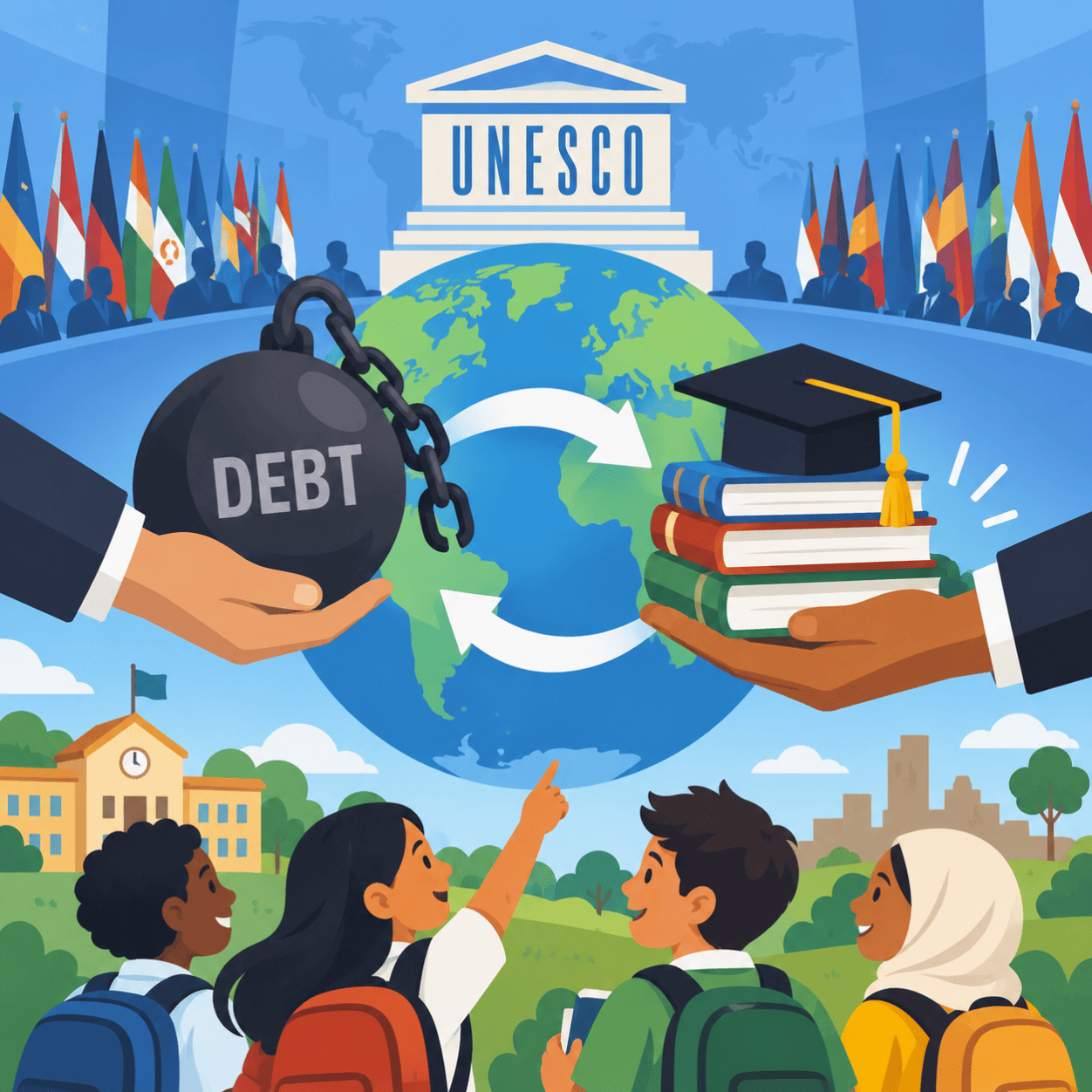
The grand halls of the Transforming Education Summit witnessed a sobering revelation on the tenth of July, 2026. World leaders convened to confront a colossal systemic failure draining the lifeblood of developing nations. UNESCO brought together an assembly of over thirty education ministers, civil society luminaries, and global icons. South African President Cyril Ramaphosa and United Nations Deputy Secretary-General Amina J. Mohammed spearheaded these crucial deliberations. Grammy-nominated artist Audrey Nuna lent her voice to this urgent chorus advocating for global intellectual emancipation. The prevailing narrative painted a grim picture of one hundred and thirteen sovereign states pouring national wealth into external debt repayment. These massive financial outflows completely dwarf their domestic expenditures on public learning institutions. Such a fiscal trajectory effectively cripples the foundational bedrock of any modern, functioning society. International development banks and youth leaders listened intently as the sheer scale of this crisis unfolded. The global community now faces a profound reckoning regarding the true priorities of modern statecraft.
The fundamental right to education stands as a non-negotiable pillar of international human rights law. The Universal Declaration of Human Rights explicitly guarantees free and compulsory elementary schooling for every child. Modern governance structures bear an absolute legal obligation to fulfil this mandate without prejudice. The doctrine of erga omnes dictates that this duty is owed by sovereign states to the international community as a whole. State actors cannot legitimately invoke financial hardship to completely abrogate core constitutional responsibilities toward their citizens. The legal maxim salus populi suprema lex esto commands that the welfare of the populace must reign supreme over all state affairs. Prioritising foreign creditors over domestic school children fundamentally violates the sacred social contract binding a government to its people. Legal scholars have long argued that an uneducated populace equates to a disenfranchised citizenry unable to exercise other civic rights. Access to quality learning facilities forms the absolute prerequisite for the meaningful enjoyment of all subsequent human liberties. We must scrutinise these debt-servicing regimes through a strict constitutional lens to demand immediate, actionable remedies.
The statistical projections released by UNESCO paint a terrifying picture of impending intellectual famine across the globe. Global assistance directed toward educational infrastructure faces a catastrophic plunge of up to thirty per cent between 2023 and 2027. Low-income and lower-middle-income territories confront a terrifying annual financing crater amounting to ninety-seven billion United States dollars. This gaping fiscal wound continues to widen with each passing fiscal quarter. Development assistance allocated to schooling has plummeted to a dismal seven point five per cent of total aid in 2024. This figure marks the absolute lowest recorded level of educational support observed in the past two decades. The global military-industrial complex consumes in exactly thirty-seven hours the precise financial equivalent of an entire year of international education aid. Such grotesque misallocation of planetary resources exposes a deeply flawed geopolitical value system. Certain vulnerable nations, including Afghanistan, Liberia, Mali, and Niger, have already suffered aid contractions exceeding forty per cent. These sharp declines threaten to completely obliterate decades of painstaking institutional progress achieved in these fragile regions.
The systemic starvation of public schooling mechanisms triggers a cascading societal collapse across multiple generations. Educational institutions serve as the primary engines of social mobility in any stratified society. Depriving these vital organs of necessary funding actively accelerates the calcification of intergenerational poverty. Marginalised communities find themselves trapped in an inescapable cycle of intellectual deprivation and economic disenfranchisement. The widening chasm between affluent nations and debt-ridden states creates a bifurcated global caste system. Children born in heavily indebted territories are structurally predetermined to inherit a legacy of curtailed opportunities. Societal cohesion inevitably fractures when a state abandons its duty to nurture the minds of its youth. The proliferation of underfunded schools directly correlates with rising rates of juvenile delinquency and civil unrest. A citizenry deprived of foundational knowledge becomes highly susceptible to populism, misinformation, and political manipulation. We are witnessing the deliberate dismantling of societal progress through the weaponisation of sovereign financial obligations.
A staggering population of six point one billion people currently resides within the borders of those one hundred and thirteen deeply indebted nations. Governments in low-income jurisdictions are redirecting funds toward external creditors at a rate nearly four times higher than their domestic education budgets. Eighteen of the most severely encumbered states are pouring capital into debt servicing at levels exceeding five times their scholastic investments. Sovereign debt obligations have metastasised into a predatory force devouring the future prospects of developing nations. The rigid enforcement of loan contracts under the strict principle of pacta sunt servanda completely ignores the material reality of these struggling nations. International law gracefully accommodates the doctrine of clausula rebus sic stantibus, allowing treaties to become inapplicable due to a fundamental change of circumstances. The impending collapse of an entire nation's educational infrastructure surely qualifies as a fundamental shift necessitating immediate contract renegotiation. Creditor nations bear a profound moral culpability for enforcing repayment terms that directly result in mass illiteracy. Forcing a sovereign state to choose between financial default and mass uneducation constitutes an unconscionable geopolitical ultimatum. International banking consortiums must recognise the inherent illegitimacy of debts serviced at the direct expense of fundamental human rights.
The philosophical underpinnings of a just society demand a fair distribution of intellectual resources among all citizens. A truly equitable global order would ensure that every child possesses the raw materials necessary for self-actualisation. Denying funding for basic literacy violates the fundamental Kantian imperative to treat humanity as an end rather than a means to economic leverage. We hold a strict deontological duty to equip unborn generations with the cognitive tools required to navigate an increasingly complex world. The current geopolitical framework operates on a grotesque distortion of distributive justice, funnelling wealth upwards while crushing the most vulnerable demographics. Education is no common commodity to be traded on the open market subject to the whims of international financiers. It represents the purest manifestation of human capability, enabling individuals to transcend their immediate material conditions. A society that commodifies learning inevitably corrodes its own moral foundation, sacrificing its collective soul for short-term fiscal solvency. True enlightenment requires a radical reimagining of our obligations toward the intellectual nourishment of the global collective. The prevailing obsession with austerity measures actively dismantles the philosophical architecture required to sustain long-term human flourishing.
The Transforming Education Summit provided a beacon of practical hope amidst this suffocating atmosphere of fiscal despair. UNESCO formally launched a comprehensive technical guide detailing the precise mechanics of debt-for-education swaps. These innovative financial instruments allow sovereign states to convert external liabilities into targeted domestic scholastic investments. The newly published Debt and Education package outlines precise methodologies for implementing these transformative economic mechanisms. Such arrangements offer a pragmatic escape route from the suffocating cycle of endless loan repayments. Debtor nations can effectively channel their limited capital directly into classroom construction, teacher training, and curriculum development. Creditor institutions receive tangible assurances that forgiven debts translate directly into measurable developmental outcomes. The legal framework surrounding these swaps requires meticulous drafting to ensure absolute transparency and strict accountability. This mechanism perfectly embodies the legal principle of ex aequo et bono, allowing parties to resolve financial disputes according to equity and good conscience. Scaling up these bilateral agreements represents the absolute most viable strategy for rescuing endangered educational systems across the developing world.
Historical precedents demonstrably prove the extraordinary efficacy of these debt conversion strategies when executed with genuine political commitment. A landmark bilateral agreement established with France in 2023 successfully liberated substantial domestic resources for Cote d'Ivoire. This specific fiscal arrangement directly facilitated the construction of over thirty modern learning facilities in historically underserved Ivorian communities. Approximately thirty thousand young students gained unprecedented access to quality instruction as a direct result of this diplomatic breakthrough. A separate twenty-nine million euro swap negotiated with Germany in 2024 empowered Egypt to revolutionise its nationwide school feeding programmes. Egyptian authorities utilised these freed funds to dramatically expand nutritional support and basic service access for millions of vulnerable pupils. An older, highly successful programme executed between Spain and Peru converted twenty million dollars of national debt into fifty medium-term scholastic projects. This ambitious Spanish-Peruvian initiative successfully impacted the lives of roughly one hundred and seventy-four thousand students and teachers across eight vulnerable regions between 2006 and 2017. These concrete examples completely demolish the cynical argument that financial innovation cannot solve entrenched social crises. Widespread replication of these proven models remains entirely dependent on the political courage of the world's leading economic powers.
The contemporary discourse at this global gathering extended far past immediate financial triage to encompass long-term strategic visioning. Delegates engaged in intense deliberations regarding the fundamental reshaping of pedagogical methodologies through artificial intelligence. UNESCO reaffirmed its absolute commitment to ensuring that machine learning technologies actively enhance cognitive outcomes in developing regions. The integration of advanced algorithms into national curricula must proceed with extreme caution to preserve essential human agency. A strict regulatory framework is absolutely necessary to prevent these new technologies from exacerbating existing structural inequalities. Participants critically examined the devastating impact of escalating climate catastrophes on vulnerable schooling infrastructure across the globe. Building robust resilience into the architectural and organisational design of future schools emerged as a paramount priority for all member states. The summit served as a crucial accelerator mechanism for achieving the Sustainable Development Goal 4 targets ahead of the impending deadline. The next five years of concerted global action will definitively determine the absolute success or failure of this universal promise. The year 2030 represents a critical milestone to assess progress rather than a final destination in the perpetual quest for human enlightenment.
The sheer magnitude of this educational financing crisis demands a unified, uncompromising response from the entire international community. Sovereign debt must be radically restructured to prioritise the intellectual development of the next generation above the profit margins of institutional lenders. We must view the law as an active instrument of progressive social engineering capable of dismantling predatory economic architectures. The legal maxim lex prospicit, non respicit reminds us that the law must look forward to the future, avoiding antiquated financial dogmas. Protecting the sanctity of the classroom constitutes the highest form of sovereign defence available to any modern state. The recommendations published by UNESCO provide a highly detailed, legally sound roadmap for escaping this devastating economic quagmire. World leaders possess the exact technical tools required to immediately halt the deliberate financial suffocation of the developing world. A failure to act upon these clear directives amounts to a tacit endorsement of mass intellectual starvation. The global citizenry must hold their respective governments strictly accountable for delivering on the fundamental promise of universal learning. Funding public intellect remains the absolute most powerful, legally imperative, and philosophically sound investment any civilization can possibly undertake.