
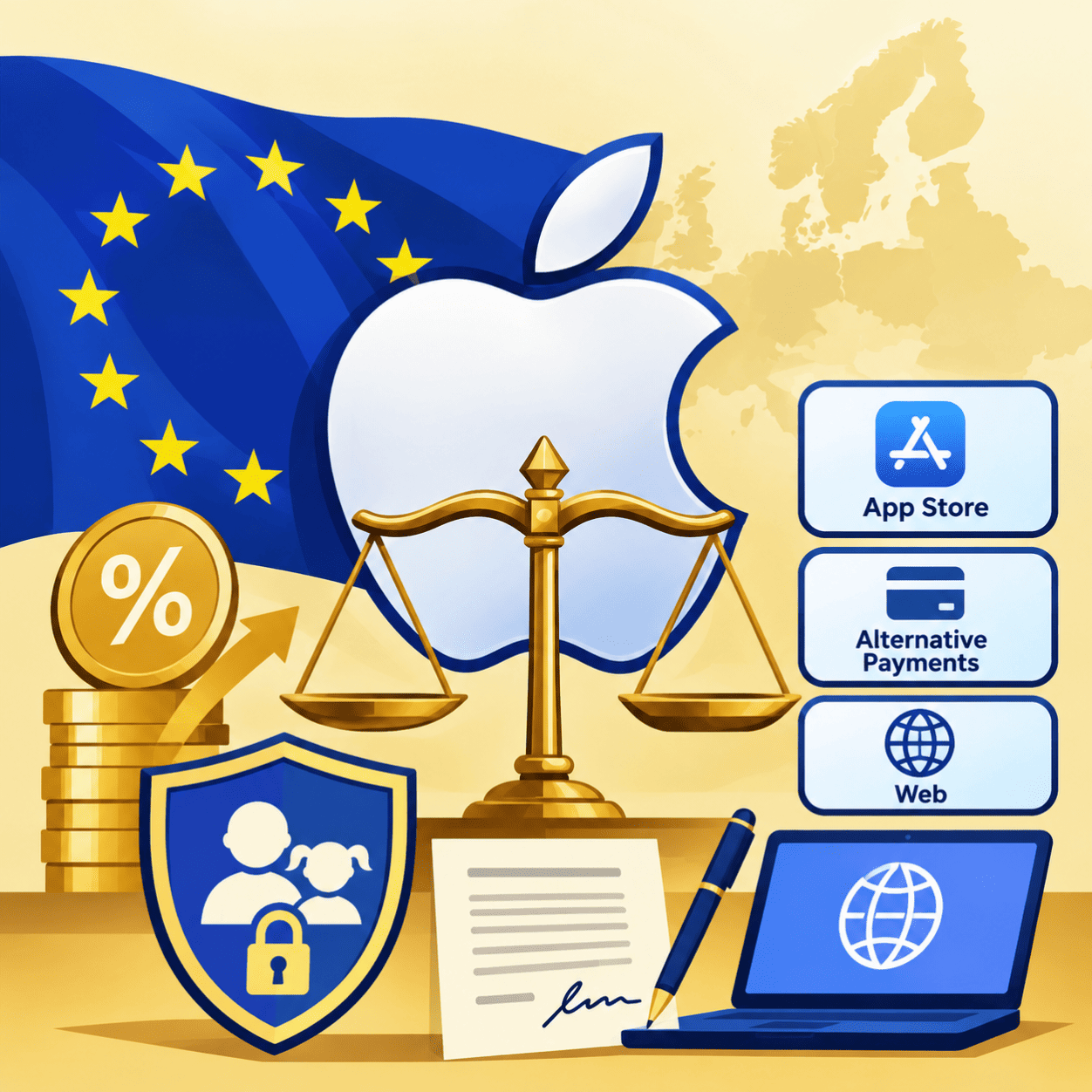
Apple’s announcement on 18 August 2026 marks a substantial recalibration of the commercial architecture governing apps in the European Union. The company stated that it had worked closely with the European Commission before introducing the revised business terms. The changes address disagreements surrounding commercial conditions and alternative distribution. Apple is also attempting to simplify the contractual structure facing developers operating within the Union. Every developer distributing apps in the EU will move towards a single set of business terms. Developers may sign the revised terms immediately. The new regime is scheduled to take effect on 1 October. The measure reaches beyond a mere alteration of commission percentages. It reflects a continuing regulatory struggle over the legal boundaries of digital gatekeeping. The central question concerns who should control the economic pathways through which software reaches consumers. That question carries considerable constitutional weight within a market governed by European competition principles. The maxim ubi jus ibi remedium acquires renewed relevance here because a legal entitlement to market access requires an effective institutional mechanism capable of protecting it.
Apple’s revised structure replaces the Core Technology Fee with a Core Technology Commission. The new commission imposes a five per cent charge on digital transactions conducted through apps distributed outside the App Store. The previous fee operated through a per-install mechanism for developers reaching extraordinary scale. The replacement therefore introduces a transaction-based architecture. Apple will also remove the initial acquisition fee. The store services fee will disappear under the revised terms. Developers will face a more consolidated economic framework. Such consolidation has a significant legal dimension because contractual complexity can itself become a barrier to commercial participation. A sophisticated digital market requires rules that can be understood by enterprises with different levels of financial and technical capacity. Legal certainty becomes especially important when private contractual rules operate alongside public regulatory obligations. The classical doctrine pacta sunt servanda remains relevant because contractual arrangements retain normative force once accepted. Yet contractual freedom in a highly concentrated digital ecosystem cannot be examined without considering the structural power held by the platform. The social consequence reaches small developers whose survival may depend upon predictable and proportionate access to digital consumers.
The revised commission structure introduces several distinct rates according to the method used to distribute and monetise an app. Apps using Apple In-App Purchase through the App Store will attract a 26 per cent commission. Most developers covered by specified programmes will pay 15 per cent. The reduced rate applies to qualifying participants in the App Store Small Business Programme, Mini Apps Partner Programme and Video Partner Programme. Auto-renewing subscriptions after their first year will also receive the 15 per cent rate. Apps using alternative payment processing through the App Store will face a 20 per cent commission. Eligible developers within the specified programmes will pay 10 per cent under that arrangement. Apps directing consumers outside the app to complete purchases will attract a 15 per cent commission. Eligible developers will face a reduced 10 per cent rate for that route. Apps distributed through alternative marketplaces or the web will attract the five per cent Core Technology Commission. These figures demonstrate a legal regime in which technological architecture and economic regulation are becoming increasingly intertwined. The platform is no longer merely a technical intermediary. It functions as a private rule-maker whose commercial terms influence the practical distribution of economic opportunity.
The revised payment framework gives developers greater freedom to combine Apple In-App Purchase with alternative payment methods within the EU. Apple states that this option was previously unavailable under its European arrangements. Developers may now provide alternative payment processing alongside Apple’s own purchasing mechanism. The arrangement remains subject to presentation requirements intended to produce a consistent and transparent user experience. Developers must choose their payment configuration from several available possibilities. They may use Apple In-App Purchase. They may employ alternative payment processing within the application. They may direct users towards the web. They may also combine these mechanisms. Once selected, the chosen options must remain in place for 12 months. The rule introduces a measure of contractual stability into an environment characterised by rapid technological change. Stability has value for consumers because payment architecture can influence expectations concerning security and transaction integrity. It also has value for developers because commercial planning depends upon predictable regulatory conditions. The principle nemo judex in causa sua invites a deeper institutional question when a dominant platform establishes rules governing its own commercial interests. European regulation therefore places the platform’s private authority under continuing public scrutiny.
Child protection occupies a separate and particularly sensitive dimension of the revised framework. Apple states that the App Store is intended to provide a safe environment for users, with particular attention to children. The company has worked with the European Commission on safeguards for alternative payments. Apps placed within the Kids category will not contain links directing children to websites for transactions. The restriction seeks to reduce exposure to fraud and scams. Users below 18 who encounter alternative payment processing or external transaction links must encounter a parental gate. The mechanism requires younger users to involve a parent or guardian before completing a purchase. Users below 13 will face a stronger restriction. Apps from the App Store cannot direct those users to websites for transactions. Member States with parental-consent requirements extending beyond the age of 13 will apply corresponding protections. These measures illustrate the principle that digital autonomy cannot be detached from age-based vulnerability. Children possess legal interests that demand heightened protection within commercial environments. The maxim salus populi suprema lex expresses an enduring legal proposition that public welfare may justify regulatory restraints upon private commercial freedom. Child safety therefore becomes an important test of whether technological openness can coexist with responsible platform governance.
The revised rules also expand eligibility for companies seeking to operate alternative app marketplaces or distribute applications through the web. Apple identifies several qualifying categories. A company may satisfy a moderate financial-stability threshold assessed through Dun & Bradstreet. A publicly traded company may qualify. A company owned by a publicly traded entity may also qualify. Established venture funding may provide another route to eligibility. A company that has completed a financial audit by a licensed accountant may qualify. Government entities may participate under the expanded framework. Educational institutions may qualify. Non-profit organisations may also qualify. These criteria reveal an attempt to connect market access with minimum institutional credibility. The approach reflects a sociological concern surrounding trust in digital commerce. Consumers rarely possess the technical capacity to inspect the integrity of every software distributor themselves. Institutional credentials can therefore operate as proxies for reliability. The legal challenge lies in ensuring that such credentials do not become unnecessary barriers to entry. A regulatory framework must preserve competition while protecting users from fraudulent or irresponsible operators. Ubi societas, ibi jus remains pertinent because emerging forms of digital association inevitably generate new demands for legal ordering.
Web distribution presents a distinct regulatory problem because it lacks an intermediary performing the supervisory role associated with the App Store. Apple emphasises that web distribution does not have a marketplace operator standing behind it. It also lacks the continuing oversight that Apple provides through its own marketplace. A malicious actor could therefore distribute harmful software through the web for an extended period. Users could suffer damage before the responsible actor is identified. Apple intends to preserve Notarization for applications distributed through alternative channels. Notarization functions as a baseline review mechanism. The review focuses upon basic functionality and protection against serious threats. The requirement demonstrates that alternative distribution does not mean unrestricted distribution. Market openness is being paired with a minimum security threshold. This creates an important distinction between access and immunity from oversight. European digital regulation increasingly treats cybersecurity as an element of market integrity. The maxim sic utere tuo ut alienum non laedas offers a useful jurisprudential principle because the exercise of private technological freedom should not inflict unjustified harm upon others. Digital sovereignty therefore requires a balance between commercial autonomy, consumer protection and technological security.
The dispute between Apple and the European Commission also illustrates the changing relationship between private corporate governance and public economic regulation. Apple possesses extensive control over the infrastructure through which applications reach millions of users. The Commission possesses regulatory authority derived from European law. Their interaction demonstrates how modern competition governance can reshape the internal rules of a global technology company. The revised terms emerge from institutional engagement rather than unilateral corporate design. That process reflects the broader transformation of competition law in platform economies. Market power can arise from control over infrastructure, data, distribution and consumer access. Such power can influence contractual conditions even when transactions remain formally voluntary. A developer may technically possess freedom to reject contractual terms. Commercial reality may make that rejection economically difficult. This tension gives substance to the doctrine of economic dependency. The social significance is substantial because small enterprises may depend upon dominant digital platforms for visibility, revenue and consumer access. Legal institutions therefore face the difficult task of preserving innovation while preventing private infrastructure from becoming an instrument of excessive economic control. The maxim fiat justitia ruat caelum captures the uncompromising ideal that justice must retain authority even when powerful economic interests are involved.
The revised arrangements also reveal a deeper philosophical debate concerning the meaning of freedom within digital markets. Freedom for developers can mean the ability to select payment mechanisms. Freedom for consumers can mean access to transparent purchasing choices. Freedom for platforms can mean the ability to design secure commercial ecosystems. Each conception carries legitimate interests. Each conception also creates consequences for other participants. John Stuart Mill’s harm principle provides a useful philosophical reference because regulatory intervention becomes more compelling when conduct produces substantial harm to others. Immanuel Kant’s conception of autonomy adds another dimension because consumers should possess meaningful capacity to make informed choices. A payment option presented through a digital interface can influence behaviour through design as much as through price. Transparency therefore becomes a condition of meaningful autonomy. The European approach appears to treat consumer choice as a substantive value rather than a purely formal entitlement. That principle carries particular importance where technical complexity makes genuine comparison difficult for ordinary users. A digital market becomes more legitimate when its participants can understand the consequences of the choices presented to them. The philosophical issue therefore extends beyond commission rates and reaches the architecture of human decision-making.
For developers, the October implementation date creates a period of commercial and legal adjustment. Developers distributing apps within the EU can sign the new terms from the date of Apple’s announcement. The new arrangements will become effective on 1 October. Businesses must therefore determine which payment and distribution mechanisms best correspond with their commercial models. The 12-month requirement attached to selected payment configurations adds a further planning consideration. Developers must evaluate transaction costs alongside consumer experience. They must also consider the regulatory obligations associated with alternative distribution. Companies seeking to establish alternative marketplaces must satisfy one of the specified eligibility routes. Organisations choosing web distribution must account for the continuing Notarization requirement. These conditions create a more structured environment for market entry. The practical effect may be greater predictability for some developers. The legal effect may be a clearer allocation of rights, duties and economic obligations. Predictability is a fundamental component of the rule of law because economic actors require intelligible norms before committing resources. Lex certa therefore provides an appropriate principle for a digital economy in which commercial decisions increasingly depend upon rapidly evolving regulatory frameworks.
Apple’s new European terms ultimately represent a significant moment in the continuing legal construction of the digital marketplace. The five per cent Core Technology Commission establishes a new economic mechanism for apps distributed outside the App Store. The revised commission rates create different financial consequences according to distribution and payment methods. Alternative payments can now coexist with Apple In-App Purchase under specified conditions. Child safety safeguards impose additional restrictions upon transactions involving younger users. Eligibility for alternative marketplaces and web distribution has been broadened through defined institutional and financial criteria. Notarization remains a security requirement for alternatively distributed applications. The European Commission’s involvement demonstrates the growing influence of public regulators over the internal commercial architecture of dominant technology platforms. Developers receive new options accompanied by new compliance responsibilities. Consumers receive broader payment possibilities accompanied by safeguards designed to preserve security and transparency. The deeper legal significance lies in the attempt to reconcile innovation, competition, contractual autonomy, consumer welfare and technological security within one regulatory structure. The old maxim aequitas sequitur legem remains instructive because fairness must operate through a coherent legal order rather than through commercial discretion alone. Apple’s European regime therefore becomes another chapter in the continuing effort to determine how law should govern private power when digital infrastructure becomes indispensable to modern economic life.